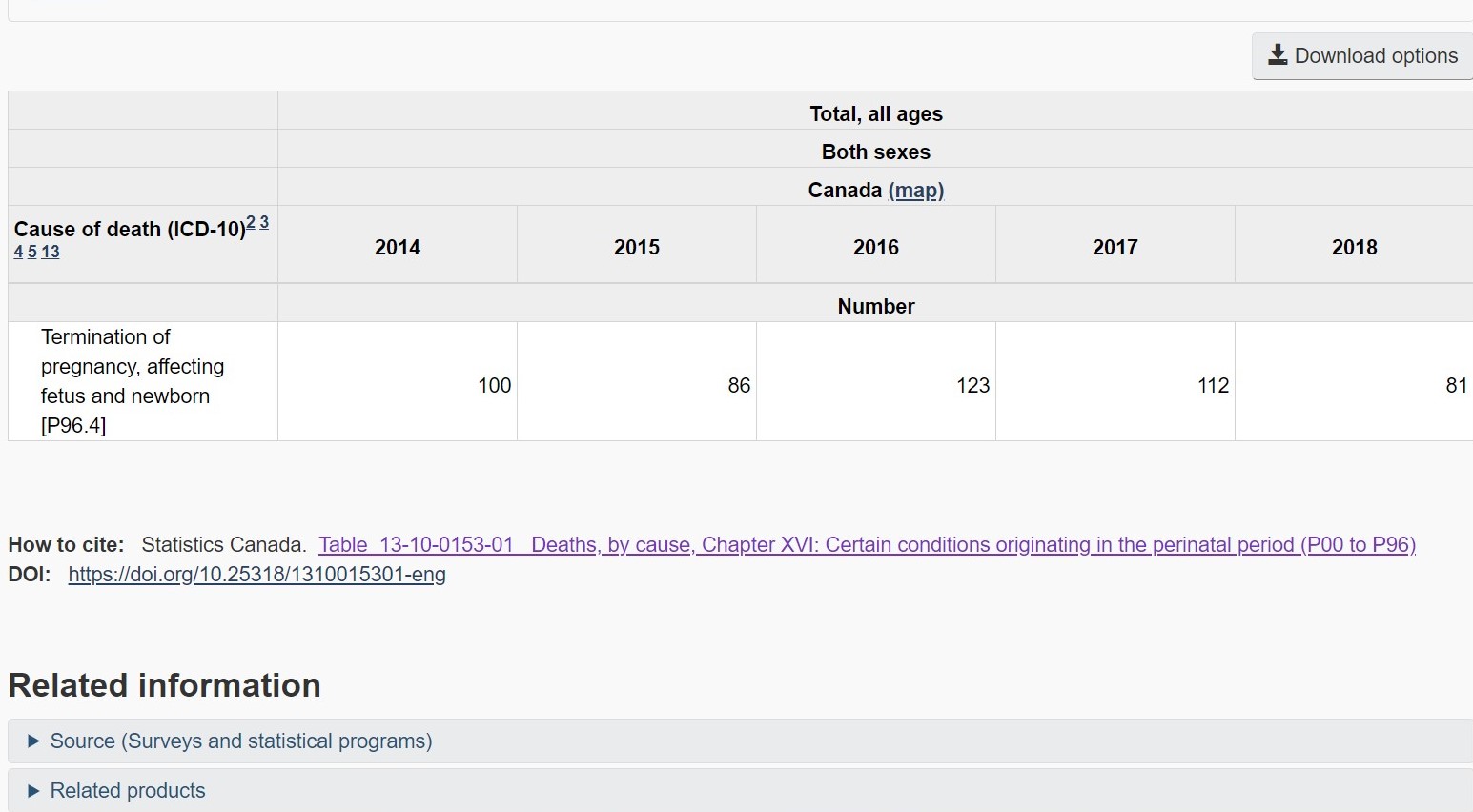
Statistics Canada continues to report live birth abortions. There were 410 of them from 2018 to 2022. Code is P96.4 Termination of pregnancy affecting fetus and newborn.
Wednesday, November 29, 2023
Thursday, April 1, 2021
Statistics Canada VS CIHI late-term abortions
UPDATE: May 14, 2021
Melissa asked
"How come the CIHI doesn't report statistics for Quebec? If Ontario has 74 abortions resulting in live births, Quebec is bound to have a few as well."
CIHI's response:
"The official source of abortion data from Québec is provided to CIHI in the form of an annual file containing aggregated data. This file does not contain the information you are requesting. Available abortion-related data for Québec is published in our annual induced abortion tables here: https://www.cihi.ca/sites/default/files/document/induced-abortions-reported-in-canada-in-2019-en.xlsx" (we already know this)
I also asked them another questions:
"On your quick stats for the country, gestational age abortions are also excluded for Quebec. Why? And why do you not report gestational ages of abortions done at clinics?"
Here is CIHI's response:
"Clinic data is provided to CIHI on a voluntary basis, and does not include volume breakdowns by gestational age."
-----------------------------------------------------------------------------------------------------------
More gruesome numbers of late-term deaths (>=20 weeks gestation) of pre-born children.
CIHI's numbers for 2019-2020 stillbirth abortions, and livebirth abortions in Canada.
CIHI reports 999 deaths by abortion of children in the womb that resulted in stillbirths in 2019-2020.
CIHI reports 112 deaths by abortion of children in the womb that resulted in livebirths in 2019-2020.
Statistics Canada reports "Termination of pregnancy affecting fetus and newborn [Code P9.64]" 69 deaths. Notice that Statistics Canada uses the term "newborn". That is because of course, once a baby is born alive, it is considered a person.
Once again CIHI's numbers are different than Statistics Canada's.
Previous posts on death by abortion:
https://run-with-life.blogspot.com/2020/06/502-livebirth-abortions-in-canada-from.html
https://run-with-life.blogspot.com/2020/03/late-term-live-birth-abortions-in.html
Tuesday, June 30, 2020
502 Livebirth abortions in Canada from 2014 to 2018
I've reported on these Stats Canada's livebirth abortions, and CIHI's livebirth abortions, many times before.
Stats Canada's and CIHI's livebirth abortion numbers are never the same. I've never been able to get an answer as to why their numbers are always different.
We still don't know why these late term abortions are born alive. We still don't know what happens to these little souls when it happens. We do know that they died because they are reported as a death by Stats Canada. Are these tiny humans held and comforted as they wait to die? Are they thrown into the garbage? How much do they suffer? Did anyone ask them what they wanted?
These livebirth abortions are shameful. They are a tragedy. And they continue to happen year after year.
Monday, March 9, 2020
Canada abortion rates by province
So instead I just used CIHI's numbers.
Saturday, October 28, 2017
Ireland worries about Canada's born alive abortions
Well Ireland has picked up on this worrisome fact and has some worries of their own:
"Concerns were raised to the Canadian prime minister, Justin Trudeau, over claims made in the Oireachtas..."
"Abortion is not criminalised in Canada and is governed under the same laws as other health procedures. Anti-abortion campaigners in Ireland have claimed that the liberal law has led to terminations where the foetus was still alive after the procedure."
Rónán Mullen, the independent senator, claimed on the record of the joint Oireachtas committee considering repeal and replacement of the Eighth Amendment that in Canada “botched abortions have taken place in recent years and where children were alive after the procedure”.
Mattie McGrath, the independent TD, has made similar claims and Cora Sherlock, a spokeswoman for the Pro Life Campaign, has said that there were more than 400 babies in the last ten years “born alive in botched abortions and left to die alone” in Canada. "SOGC was not able to respond to the allegations:
“The SOGC is not aware of cases where there is evidence of any dereliction of duty, and therefore we are not able to respond to the allegations that you refer to in your email,” he said."And Stats Canada could not "support or refute" Ireland's concerns about these born alive abortions:
“There is nothing in the data that would support or refute the characterisation of these events as ‘botched abortions’ or the assertion that these infants were ‘left to die alone in hospital corners’,” Statistics Canada said in a letter.(Note that for the 10 years 2000 to 2009 there was an average of 49 born alive abortions per year. The latest numbers are an average of 73 per year or a 50 % increase in born alive abortions. See below.)
__________________________________________________________________________
Previous entries on live births:
https://run-with-life.blogspot.ca/2014/03/2010-and-2011-late-term-abortion.html
https://run-with-life.blogspot.ca/2015/04/941-stillbirth-and-livebirth-abortions.html
Here is an update on Canada's born alive abortions. These abortions are coded P96.4, "Termination of pregnancy, affecting fetus and newborn".
1) After you go to the link above, click on "Add/Remove data".
2) Go to "Step 4 - Select: Cause of death" and click on "All" twice (the first click all causes of death to be ticked, and the second click removes all causes). Then scroll down towards the bottom and click only on "Termination of pregnancy, affecting fetus and newborn [P96.4]"
3) Then go to "Step 5 - Select the time frame" and choose from 2009 to 2013.
Between 2009 and 2013 there were 366 born alive abortions in Canada or an average of 73 born alive abortions per year:
(UPDATE: I realized that I included 2009 in both calculations. If we ignore 2009 in this most recent calculation, it would be a total of 299 for four years for an average of 74.75 born alive abortions per year)
Saturday, January 30, 2016
FOI Charter Challenge helps pro-abortions too
“That’s [Therapeutic Abortion Survey] been collected since 1970. And then they cancel it. They cancelled the publication, the tables, and the survey,” he said. “We should look into it more. Again, we’ve had a lot of news reports about how abortions are hard to obtain in different provinces. Once you get rid of this tracking, it makes it very, very difficult to do things like enforce the Canada Health Act.Nobody else in this country can write or comment about abortion statistics either, because you can't write or comment on something (especially on something as political as abortion) if you don't have the facts to back you up.
The abortion statistics we do have from CIHI, are woefully inaccurate. And we know too well that Ontario has chosen to exclude and hide all Ontario abortion statistics from any and all Freedom of Information requests. BC isn't doing any better.
So our Charter Challenge will benefit even the NDP. You're welcome Kennedy Stewart.
Tuesday, June 24, 2014
Repeating untruths doesn't make them true
I've already debunked her make-believe world here when I wrote on January 12, 2012 about 2009 Canadian abortion statistics, and here when I wrote on November 19, 2012 about 2010 Canadian abortion statistics.
So here we go again--now I'll do it for 2012 abortion statistics.
1) Arthur says:
"Since 1988, when the Supreme Court of Canada threw out our abortion law as unconstitutional, the sky has not fallen, but our abortion rates have – we’ve witnessed a continuing decline since 2000 and now have a relatively low abortion rate compared to many other developed countries – about 14 abortions per 1000 women of childbearing age per year." (emphasis added)Arthur points to CIHI as proof that Canada's abortions statistics have been declining since 2000. But how does she know this? She doesn't. Because as CIHI themselves tell us their numbers are underestimated:
"...while this is probably an underestimate of induced abortions done in the country, it is currently the best way to produce pan-Canadian comparable data."That's because CIHI's numbers don't record abortions done in private physician's offices; don't record medical abortions; and don't record all clinic abortions, because many clinics choose not to report that information, and nobody makes them do it.
Arthur then says there are 14 abortions per 1000, but neglects to tell you, that that number is from Statistics Canada data from 2005--nine years ago. We have no idea right now how many abortions are committed per 1000 abortions, because our data is inaccurate. And even if it was accurate, you can't use nine year old data to talk about today's trends.
(In fact, discerning minds must question why CIHI reports at all--if their numbers are so woefully inaccurate? But that's a question for another day.)
2) Arthur says
"90 per cent of abortions occur during the first trimester, and less than half a percent after 20 weeks." (emphasis added)For 2012, CIHI reported a total of 83,708 clinic and hospital abortions (and as stated above this is under reported). Of these abortions, a full 62,178* have "unknown" gestational age.
That means all 62,178*, or most of them, or some of them, or none of them, could be late term abortions. We. Do. Not. Know. That's what "unknown" means. And we don’t know these gestational ages because most abortion providers don't report them.
So concluding late-term abortions are "less than half a percent" is impossible.
3) Arthur says:
"The latter [after 20 weeks] are all for compelling reasons, such as fetal abnormalities incompatible with life or a serious threat to the woman’s health or life."How does Arthur know these late-term abortions are for compelling reasons? Because nobody else in Canada knows this. Arthur can't know--since reasons are not reported.
We know for sure that in 2012 there were 563 late term hospital abortions (as reported by CIHI). And remember, we don't know how many late term abortions were done in clinics because clinics don't report late-term abortions. And since we don't know the gestational ages of 62,178* abortions, Arthur's conclusions are based on bad, wrong, missing, and or inaccurate information.
Even if Arthur can prove there are "only" 563 late abortions per year, are we supposed to take comfort in the fact that in relative terms there are so many fewer late term abortions than early abortions? That just means we have many, many, many, many, many, many early abortions.
4) Then Joyce gets creative, by actually redefining the medical term "fetal viability":
"Much of the debate in the UK media has focused on the science of fetal viability and at what gestation they can survive on their own. This issue is totally irrelevant to women who need abortion care, as the survival ability of premature babies applies only to fetuses being carried to term. If a woman needs an abortion, then by definition, her fetus is not viable." (emphasis added)In other words, if you don't like the definition of something, hey just change its meaning. That was easy.
5) Finally we get to the bottom of Arthur's real worry. That darned fetus. Always gets in the way of a good abortion fairy tale.
To solve this thorny issue of decapitating, dismembering and disemboweling another human being, we simply advise the reader to NOT focus on the fetus.
"When we focus on the fetus, we forget about the woman and her reasons for an abortion. Women don’t ask for an abortion because it’s their ‘right to choose,’ or because they don’t understand what’s inside of them. They request abortion because they can’t provide responsibly for a child (or another child) at this point in their lives. A woman’s abortion decision is about ensuring her future and that of her family, not about the current legal or moral status of her fetus. It’s about being the best mother possible when she’s ready – or maybe not becoming a mother at all if she knows she’s not suited to it. That is the very definition of conscientious decision-making. We can trust women to know what’s best for themselves and their families, without imposing punitive criminal laws against their private decisions."So many problems dissipate when we make up numbers, change definitions, and ignore the fetus. It's easy, really. Just ask Joyce.
(* 62,178 unknown gestational age abortions is calculated using simple arithmetic: 83,708 total known abortions - 21,530 known gestational age abortions (see page 6 of CIHI's 2012 statistics) = unknown gestational age abortions)
Wednesday, March 19, 2014
2010 and 2011 late term abortion statistics - born alive
For these two years, there were 131 abortions, of 20 weeks gestation and greater, that resulted in live births. This means that the aborted child died after it was born. These abortions are coded as P96.4 or "Termination of pregnancy, affecting fetus and newborn".
This number does not include late term abortions that are born dead (stillbirths).
See my last post on this to calculate the figures.
Here is a screen shot of the numbers and the footnotes:
Monday, February 18, 2013
We don't know what we're talking about
National Post
Feb 18, 2013 8:19 AM ET
By Pat Maloney
There is a lot of confusion in Canada regarding statistics about abortions. This makes it very difficult to have a proper discussion when the facts are not readily available. And it shouldn't matter if you are pro-life or pro-choice; we need accurate information regarding abortion in Canada.
There are a couple of reasons for this confusion. The first stems from the fact that not all abortions are reported. As well, the reasons abortions are performed are not captured or reported. Another problem is that the gestational age of most abortions is unknown.
This means we have no idea how many abortions are performed, how many of them are late-term, and what the reasons are. Consequently, there is no way we can say Canada has very few late-term abortions, or that their reasons are for fetal anomalies, or danger to the mother, because of this lack of good information.
We do know that Statistics Canada reported 491 children died due to "termination of pregnancy" after being born alive from 2000 to 2009. We know this happened, but we don't even know the reasons it happened, except for the few women who wrote letters to the National Post, and other anecdotal information.
What else we know, is that in 2010 (the last year for which we have abortion statistics), the Canadian Centre for Health Information (CIHI) reported 64,641 abortions. This number is very under-reported for these reasons:
1) Quebec did not report any statistics in 2010 (We do know though, that there were 27,139 in 2009 in Quebec, so the 2010 numbers would likely be a similar or higher number).
2) It is not mandatory for clinics to report abortion data and clinic data is under-reported.
3) Abortions performed in private physician's offices are not published or reported at all. (There were 18,330 in Ontario alone in 2010 based on access to information from the Ontario Ministry of Health and Long term care. We can assume that each province would have a similar proportional number of abortions performed in doctor's offices raising the numbers even higher.)
Of these 64,641 known abortions reported by CIHI, the gestational age was only reported for 22,668 abortions (8,300 performed on fetuses <=8 weeks, 11,191 on fetuses 9-12 weeks, 1,794 on fetuses 13-16 weeks, 846 on fetuses 17-20 weeks, 537 on fetuses 21+ weeks). These known gestational age abortions are reported for hospital abortions only--we have no gestational ages for those done in clinics or physician's offices.
Therefore, there were at least 41,973 abortions performed in 2010 with an unknown gestational age. This means all of those 41,973 abortions, or most of them, or some of them, or none of them, could be late term abortions--we just don't know. And we don’t know these gestational ages because most abortion providers don't report them.
If all of the unknown gestational age abortions were in fact late term, then the percentage could be as high as 65%.
Joyce Arthur, Canada's leading abortion advocate, frequently makes statements that all late-term abortions are done "for compelling reasons, such as fetal abnormalities incompatible with life or a serious threat to the woman’s health or life".
There is no way that Ms. Arthur, or anyone else in Canada for that matter, can make such a claim. Since there is no requirement to report or publish the reasons for late-term abortions, or for any abortions, no one including Ms. Arthur can assert this.
We don't know how many abortions are being done in Canada every year. We don't know how many abortions are late-term. And we don't know the reasons women are having abortions.
A couple of solutions to this problem are as follows. Make the reporting or all abortions statistics mandatory. This would include all clinics, private physician's offices and Quebec. Make it mandatory to report the gestational age of the unborn child and the reasons for the abortions. Then make the facts public, including the cost to the taxpayer.
Abortion is the only medical procedure where ready and accurate statistics are not available in Canada. So why not abortion? Then we can really start the discussion.
Friday, December 7, 2012
Update: Live birth abortions on the rise in Canada; also some abortions reported as stillbirths
Stillbirth statistics from Statistics Canada (SC) are shown in Table 1 below. The stats refer to babies of at least 500 grams or at least 20 weeks gestation. (1)
Stillbirth statistics published on-line CANSIM table 102-4514 do not separate natural stillbirths from abortion stillbirths, so I asked SC to separate them out for me. I asked for years 2000 to 2010 (11 years). I compiled their four pages of statistics into the one table you see below, Table 1.
As Table 1 shows, there were 4,624 stillbirths of 20 weeks or more due to abortion (code P96.4, termination of pregnancy) from 2000 to 2010. Of these, there were 279 abortions 28 weeks or more (code P96.4, termination of pregnancy).
Note that all stillbirths > 28 weeks gestation, are included in the > 20 weeks gestation totals.
I have already reported on SC live birth abortions here.
CIHI
Stillbirth and livebirth abortion statistics from CIHI are shown in Table 2 below. This data was for fiscal year 2010/2011 (For one year only. Also note that their on-line annual published tables are produced by calendar year and not fiscal year.)
This is what CIHI told me in an email on November 1, 2012, when I asked why the data they gave me for stillbirths had no gestational age, whereas their regular published data here, had gestational ages for abortions:
"The gestational age is found on the mother’s termination of pregnancy abstract, which is why we were able to provide gestational age in our published tables. However, the gestational age is not on the stillborn abstract, and there is no way to link the mother and stillborn abstracts, so we are not able to provide the gestational age for stillborns."
There were 727 stillbirth abortions reported by CIHI for that one year 2010/2011. SC reported that there was an average of 420 per year (4624/11 years for 2000-2010). That is a big difference. So I asked SC to explain the discrepancy between their data and CIHI's data. Their complete explanation is below.
Note that CIHI's stillbirth data does not include any stillbirths for Quebec, while SC data does include Quebec stillbirths.
Regarding live birth abortions: I believe it is possible that the live birth abortions reported by SC/CIHI may be over and above CIHI's annual published abortions because of what SC told me here:
"On the very rare occasion when an induced abortion might result in a live birth (and possibly subsequent death) these cases may or may not be included in the Therapeutic Abortion Database. The Canadian Institute for Health Information, however, instructs hospital coders to identify a birth rather than an abortion in this situation, thus such cases would not be counted in the Therapeutic Abortion Database. It is unknown whether private clinics would still report an abortion if the outcome of the abortion procedure was a live birth."
(This paragraph forms part of the reply I received from SC, the full text appears below.)
From Table 2, you will notice that the number of live birth abortions from CIHI was 157 for 2010/2011. But that number includes: 38 abortions less than 20 weeks, 9 abortions 25-28 weeks and < 5 for 29+ weeks (2). So in order to compare to the SC numbers, we need to look at just the known live birth abortions > 20 weeks. That number is 119 live birth abortions in one year. SC is reporting 491 over 11 years (52 in 2000, 29 in 2001, 21 in 2002, 43 in 2003, 44 in 2004, 52 in 2005, 49 in 2006, 71 in 2007, 63 in 2008, and 67 in 2009).
As you can see, the 119 live birth abortions reported by CIHI for the year 2010/2011 is much higher than any of these previous reported years from SC.
Regarding stillbirth abortions:
Notice this from SC and the part underlined in particular:
"As mentioned above, a termination of pregnancy resulting in the death of a fetus that meets the gestational age and/or weight defined as a stillbirth will be registered. However, retrieving all such events based on the underlying cause of stillbirth variable is not possible. The cause of stillbirth will not be classified as due to the termination of pregnancy (ICD-10 code P96.4) unless there is sufficient information to make this conclusion. The calibre of the certification of the medical cause of stillbirth certificate is such that often what is likely a stillbirth due to a termination of pregnancy, is classified to some other underlying cause."
(This paragraph forms part of the reply I received from SC, the full text appears below.)
I interpret this to mean that some unknown number of stillbirths reported as "other underlying cause" could, and probably are, late term abortions (or code P96.4, termination of pregnancy). Recall that there are many abortions reported by CIHI that are of unknown gestational ages, see here and here.
The question we can't answer is, how many of these stillbirths with “other underlying cause” are in fact late term abortions?
Another question we can’t answer: are the 727 abortion stillbirths reported by CIHI over and above the annual abortion stats that CIHI reports, or are they included in those counts? Even CIHI does not know the answer. This is what CIHI told me in an October 22, 2012 email:
"since CIHI’s abortion tables count terminations of pregnancy, technically this means that terminations of pregnancy that result in a stillbirth may also end up being included in the counts. However, this cannot be confirmed as there is no way to link the stillbirth abstracts with the mothers’ terminations of pregnancy abstracts that were included in CIHI’s abortion tables.”
----------------------------------------------------------------------------------
Below is the full text of the response I received from SC in an email dated November 20, 2012 regarding the discrepancy between the data between CIHI and SC.
You may interpret it differently than I did.
"It is normal that the vital stats would be lower for various reasons. 1) The TA numbers up to 2003 include Quebec data. 2) Although an induced abortion was performed, the “underlying cause of death” may not have been certified/coded as a termination of pregnancy. 3) Reporting stillbirths resulting from a termination of pregnancy has not been done consistently over the period of observation.
I have been asked to address the questions you raised in regard to the scope and coverage of the Therapeutic Abortion Database.
The Therapeutic Abortion Database contains information on induced abortions performed in hospitals and clinics in Canada. The database also includes counts from some American states of abortions performed on Canadian residents. The database includes all reported induced abortions, regardless of the gestational age. In other words, the database does include induced abortions performed at 20 weeks gestation or more.
The level of information on gestation period varies within the database, however. Some induced abortions are reported simply as total counts, while other data sources provide detailed records including date of last menses or reported gestational age. In the 2000 data year, there were 105,669 reported induced abortions. Of this number there were 58,167 cases with no gestational information.
It is possible that an induced abortion event can be included in the Therapeutic Abortion Database as well as in the Vital Statistics Stillbirths database (or even very rarely the Vital Statistics Birth and Death databases.) The following paragraphs describe the definition and registration of stillbirths, especially those resulting from termination of pregnancy.
Statistics Canada's statistics on stillbirths are obtained from an administrative survey that collects demographic information annually from all provincial and territorial vital statistics registries on all stillbirths (late fetal deaths) in Canada. Some data are also collected on stillbirths to Canadian resident women in selected American states.
Stillbirth is currently defined as the complete expulsion or extraction from its mother of a product of conception, which did not at any time after birth breathe or show other sign of life. Any product of conception that does not show signs of life and meets the reporting requirements, must be registered as a stillbirth under provincial and territorial vital statistics acts. In 2001, most provinces and all three territories required a stillbirth with a gestational age of at least 20 weeks or a birth weight of at least 500 grams to be registered. In Quebec and Saskatchewan (and New Brunswick prior to November 1996), only stillbirths weighing at least 500 grams were required to be registered, regardless of the gestational age. Until 1997, a gestational age of at least 20 weeks was required for stillbirths to be registered in Prince Edward Island, regardless of the birth weight.
In all provinces and territories except for New Brunswick, a fetal death that results from an intentional termination of the pregnancy would be registered as a stillbirth if the fetus met the definition in terms of its gestational age and/or birth weight. New Brunswick does not register fetal deaths that result from intentional termination of the pregnancy as stillbirths even if the fetus would otherwise meet the definition for a stillbirth. Statistics Canada compiles stillbirth statistics on all registered stillbirths for which data are received from the provincial and territorial vital statistics registries, regardless of whether the stillbirth resulted from a spontaneous or intentional pregnancy termination.
The registration of a stillbirth uses a different registration form than that which is used to register a death, although both forms have some common elements such as the cause, whether an autopsy was held, and the designation of the certifier. Statistics on births, stillbirths, and deaths are reported separately. There are editing procedures at both the provincial / territorial and at Statistics Canada to ensure that there are no duplicate records: a fetus born dead is registered as a stillbirth; one that is born alive and later dies, appears in both the birth and death statistics. In either of these situations the fetus may have been extracted from the woman by an induced abortion. Statistics for abortion, however, are based on hospital or clinic reports, the requirements for these are separate and different from those required under the vital statistics acts. On the very rare occasion when an induced abortion might result in a live birth (and possibly subsequent death) these cases may or may not be included in the Therapeutic Abortion Database. The Canadian Institute for Health Information, however, instructs hospital coders to identify a birth rather than an abortion in this situation, thus such cases would not be counted in the Therapeutic Abortion Database. It is unknown whether private clinics would still report an abortion if the outcome of the abortion procedure was a live birth.
As mentioned above, a termination of pregnancy resulting in the death of a fetus that meets the gestational age and/or weight defined as a stillbirth will be registered. However, retrieving all such events based on the underlying cause of stillbirth variable is not possible. The cause of stillbirth will not be classified as due to the termination of pregnancy (ICD-10 code P96.4) unless there is sufficient information to make this conclusion. The calibre of the certification of the medical cause of stillbirth certificate is such that often what is likely a stillbirth due to a termination of pregnancy, is classified to some other underlying cause.
In summary, a termination of a pregnancy of at least 20 weeks gestation can feasibly be included in both the Therapeutic Abortion Database and the Vital Statistics Stillbirth database. On the very rare occasion that the outcome of an induced abortion is a live birth (and possible subsequent death), the abortion event is highly unlikely to be included in the Therapeutic Abortion Database, but will appear in the Vital Statistics Birth and Death databases.
Footnotes:
(1) Stats Can defines “stillbirth” as follows: “Fetal death (stillbirth) is death prior to the complete expulsion or extraction from its mother of a product of conception, irrespective of the duration of pregnancy; the death is indicated by the fact that after such separation the fetus does not breathe or show any other evidence of life, such as beating of the heart, pulsation of the umbilical cord, or definite movement of voluntary muscles. Only fetal deaths where the product of conception has a birth weight of 500 grams or more or the duration of pregnancy is 20 weeks or longer are registered in Canada.” (from footnote 2 of CANSIM table 102-4514)
(2) Cell sizes less than 5 are suppressed due to privacy and confidientality
Table 1: Source: Statistics Canada, Canadian Vital Statistics, Stillbirth database
Table 2: Source: Canadian Institute for Health Information (CIHI), Discharge Abstract Database (DAD)/ Hospital Morbidity Database (HMDB)
Friday, October 19, 2012
Late term abortions statistics - born alive
This number does not include late term abortions that are born dead (stillbirths).
This data comes from Statistics Canada here.
To see the data for yourself:
1) After you go to the link above, click on "Add/Remove data".
2) Go to "Step 4 - Select: Cause of death" and click on "All" twice (the first click all causes of death to be ticked, and the second click removes all causes). Then scroll down towards the bottom and click only on "Termination of pregnancy, affecting fetus and newborn [P96.4]"
3) Then go to "Step 5 - Select the time frame" and choose from 2000 to 2009.
You can read the descriptions of this abortion code here at CIHI, on page 215.
Here is a screen shot of the data. If you add up the columns you get 491.
Monday, December 5, 2011
Ontario abortion doctors very busy in 2010
There were 77 selective fetal reduction procedures done in Ontario in 2010.
Note: On May 4, 2012, I corrected an error I made in this blog entry in the percentage calculation above. I reported OHIP's numbers as being 31% higher that CIHI's numbers. It should have read that OHIP's numbers were 45.4% higher than CIHI's numbers.
UPDATE January 15, 2017: OHIP's numbers are actually 53.3% higher than CIHI's numbers for 2010 stats as I calculated here.
Sunday, March 13, 2011
Government must listen to calls for improved abortion statistics
It seems everyone is calling for better information on abortion statistics. Yet we continue to have numbers that are contradictory, unreported, or unknown.
Anastasia Bowles of LifeCanada recently reported a discrepancy between CIHI's figures, and a recent study done by an Ontario group, Project for an Ontario Women’s Health Evidence-Based Report (POWER).
Bowles states:
"By comparison, the new POWER study uses OHIP billing records and several different databases, making it more reliable than other recent data. This may account for a large discrepancy between the study’s and CIHI’s figures. The study does not give absolute numbers for abortions but it does provide the abortion to live birth ratio. Since Statistics Canada reports the number of Ontario live births as 138,000, this would suggest the number of Ontario abortions in 2007 may actually be around 51,000, much higher than CIHI’s figure of about 32,000."
If we extrapolate the discrepancy for these numbers from Ontario, and assume that this discrepancy is the same for all provinces, we may not be looking at 94,010 abortions per year in Canada (as per CIHI), but rather a staggering 150,000 abortions in Canada each year.
Of course all of this is simply best-guess numbers because our Government refuses to make the collection of abortion statistics mandatory. And it isn't just pro-life groups that want accurate statistics.
In an Access to Information request I made to Statistics Canada (to learn how Statistics Canada decided to change participation in the Therapeutic Abortion Survey from mandatory to voluntary), I learned many others also want accurate statistics including pro-choice groups.
In a document entitled A note on Slipping Timelines and Declining Data Quality of Therapeutic Abortion Statistics Program Canada, written in 1998 by Surinder Wadhera, the Program Manager of the Therapeutic Abortion statistics, Wadhera stated:
"Phase I - Sept. 1964 - July 1986...Abortion reports for the 16 year period (1970-1986) were timely, comprehensive and met the increasing data needs of the users. The satisfaction element of users is reflected in positive feed back: (a) in the form of a letter from Justice Minister to the Chief Statistician at that time; (b) appreciation from Canadian Medical Association, Media, Pro-life and Pro-choice abortions groups and international agencies like World Health Organisation, Population Council.
Phase 11- August 1986- July 1998 Statistics Canada cancelled the therapeutic abortion program in August 1986 and the reason assigned was budgetary constraints. The activity of data collection and analysis was suspended for the next 15 months till November 1987. At that time the Minister in charge of Statistics Canada announced the re-instatement of the program, which was as a result of pressure from users across Canada, comprising of members of provincial legislatures, Members of Parliament and other interested parties like Pro-life and Pro-choice groups."
(I need to digress here for a moment. It is tragic that the preceding information is only available to me because Statistics Canada is ATIPPable. Now that CIHI produces and collects the abortion statistics, other abortion related information like the information above, will no longer be available to Canadians. It will remain permanently hidden from our purview.)
Here is an example of abortion analysis Statistics Canada used to produce in this document called Pregnancy Outcomes. The author states is his introduction:
"Data on pregnancy rates and outcomes are important for planning, implementing, and evaluating maternal and child health and family planning programs. Such information also has implications for the provision of facilities and treatment now and in the future."
This is just as true today as it was in 1996 when this was written. But we don't get this kind of analysis anymore from Statistics Canada since the responsibility for abortion collection and publication was transferred to CIHI.
In a counterpoint article to Ms. Bowles article, Ruth Croxford, Sheila Dunn, and Lorraine E. Ferris of the POWER project, also advocated for improved data collection. (Ms. Dunn conducts clinical trials of hormonal contraceptives and means of medical abortion.):
"We were pleased to see Ms. Bowles make the point for improved data collection. Health services researchers have long advocated for better data about all health care services. The provision of effective and efficient evidence-based health care can only thrive in an environment rich in data."
Abortion reporting is not mandatory for clinics, so numbers will only get worse, especially as more and more abortions are performed at clinics. The few statistics we do have are poor. Pro-life, pro-choice, and many other groups want better statistics.
So what's to be done?
The Conservatives need to honour their promise that:
"Government will become more transparent and more open. It will provide Canadians with access to more information from Crown corporations, Agents of Parliament, and government-funded foundations".
This can be accomplished by the government mandating reporting of abortions performed by all abortion clinics, along with a law to disclose the statistics to the public.
Friday, January 28, 2011
Abortion Statistics: Despotic Secrecy or a Right to Know?
Pierre Trudeau once said:
"Democratic progress requires the ready availability of true and complete information. In this way people can objectively evaluate their government's policy. To act otherwise is to give way to despotic secrecy ."
In 2006 the Conservatives promised--via their Federal Accountability Act--that:
"Government will become more transparent and more open.”
This Act was supposed to increase government accountability, but as it relates to abortion statistics, government accountability has actually decreased to the point where abortion statistics are grossly under-reported and completely unreliable.
Before 1988 it was mandatory for hospitals and abortion clinics to report abortions performed to Statistics Canada. With the Morgentaler ruling in 1988 when abortion was decriminalized, Statistics Canada deemed abortion reporting to be “voluntary”.
Allowing abortion reporting to become voluntary, resulted in a decreased level of clinics reporting. Statistics Canada who collects and publishes all sorts of statistics has always prided themselves on the quality of their statistics. But since abortion statistics were now unreliable, SC didn’t want their name associated with numbers that weren’t accurate. So in 1995 the responsibility for abortion data collection was transferred to the Canadian Institute for Health Information (CIHI). CIHI is funded by federal, provincial and territorial governments but is not a government department.
In 2010 CIHI took over complete responsibility for the collection and publication of the abortion statistics. Because CIHI is not one of the government organizations covered under the Access to Information Act, not only have the abortion statistics become unreliable, but possibly more worrisome, Canadians can’t ask pertinent abortion related questions to CIHI under Access To Information rules.
This is goes against what the Conservatives' Federal Accountability Action Plan was supposed to accomplish:
“Allow Canadians and organizations to participate more fully in public policy development and better assess the Government of Canada’s performance in order to hold it to account...Government will become more transparent and more open.”
Part of this Plan includes the Office of the Information Commissioner
“Who is committed to ensuring that individuals' rights to information under the Access to Information Act (ATIA) are respected and that government operates within a culture of transparency and fairness.”
But so what? Since CIHI is not ATIPable, an increase in getting access to information is meaningless.
Yet the Information Commissioner's website says we have a “Right to Know”:
"In a landmark Supreme Court of Canada decision in Dagg vs. Canada, Justice Gérard La Forest wrote:
'The overarching purpose of access to information legislation, then, is to facilitate democracy. It does so in two related ways. It helps to ensure first, that citizens have the information required to participate meaningfully in the democratic process, and secondly, that politicians and bureaucrats remain accountable to the citizenry."
So what do we know?
- We know that Access to Information is about transparency, openness, accountability and our right to participate in democracy.
- We know we had the vehicle to collect and produce the information with Statistics Canada.
- We know abortion statistics are now voluntary.
- We know that CIHI who now collects the abortion statistics, is not ATIPable.
- We know that the Conservatives promised better access to information.
So how can Canadians “objectively evaluate their government's policy” on our any-time, any-reason, no-reason, taxpayer-funded abortion policy--when we don’t know how many tax payer funded abortions are done every year, how much we are paying for them, where they are being performed, what the gestational age of the babies being destroyed is, what the complications are, the type of abortion procedure, the age of the girl/woman, how many are repeat abortions, and the reasons for the abortions? And we aren’t allowed to ask abortion related questions to the very organization who is collecting the few statistics we do have?
We can’t.
Abortion reporting must again be made mandatory for all hospitals and all clinics. The responsibility for abortion collection must be returned to Statistics Canada.
Otherwise, it’s despotic secrecy.
Friday, November 26, 2010
CIHI is not ATIPable
As an interesting side note to the fact that Statistics Canada does not publish abortions statistics anymore since they transferred the responsibility to The Canadian Institute for Health Information (CIHI), is that CIHI is not subject to the same Access to Information and Privacy (ATIP) rules as Statistics Canada is, since CIHI is not a government organization.
This is what CIHI told me:
"CIHI is a not-for-profit organization and is not subject to any federal or provincial access to information or privacy legislation."
Yet The Office of the Information commissioner of Canada website states:
"the right of individuals to access information held by public bodies and marks the benefits of transparent, accessible government."
"Access to information is a right of everyone
Access is the rule—secrecy is the exception
The right applies to all public bodies
Making requests should be simple, speedy, and free
Officials have a duty to assist requesters
Refusals must be justified
The public interest takes precedence over secrecy
Everyone has the right to appeal an adverse decision
Public bodies should pro-actively publish core information
The right should be guaranteed by an independent body"
So remind me again how the transfer of abortion statistics to CIHI bodes well for "transparent, accessible government"? I'm just saying.
--------------------------------------------------
A 'sensible' debate on abortion
National Post · Thursday, Nov. 25, 2010
Re: Can We Sensibly Debate Abortion?, letter to the editor, Nov. 24.
Letter-writer David Bowland says that "what passes today as argument on a critical and fundamental issue like abortion [is] emotionally charged language devoid of fact but designed to tug at one's heartstrings rather than appeal to one's rational mind."
OK, let's talk facts. Canada has no abortion law and abortion is legal up until a woman gives birth. We have about 100,000 abortions a year. According to Statistics Canada in 2006 we had 464 (reported) late-term abortions. Also in 2006, Statistics Canada reported 55,006 abortions "of unknown gestational age."
We aren't allowed to have a debate about abortion in Canada -- especially not in Parliament. The letter writer doesn't like the term "culture of death." Since abortions are the willful destruction of unborn children, which are members of the human species, we can't call this a "culture of life." He also doesn't like the phrase "widespread extermination of ... our humanity." We are exterminating pre-born humans, and 100,000 is quite a few.
Those are the facts. Disliking them doesn't change them.
Patricia Maloney, Ottawa.
--------------------------------------------------------
2006 Abortion statistics
Under 9 weeks 13,368
9 to 12 weeks 17,848
13 to 16 weeks 3,241
17 to 20 weeks 1,383
21 to 40 weeks 464
Unknown or not reported (2) 55,006 60%
Total abortions 91,310
(2) Note the large percentage of abortions with an unknown or not reported gestation age of fetus.
Source: Statistics Canada from an ATIP request, November 2010