Showing posts with label maternal and child health initiative. Show all posts

Saturday, October 17, 2015

Catholics wake up to Justin Trudeau's pro-abortion agenda (the series)

I know of Catholics who will vote for Justin Trudeau. I know of Catholics who are unaware of his pro-abortion ideology. Unbelievable but true.

Now we hear that Justin Trudeau wants Canadians to fund abortions overseas as part of the Maternal, newborn and child health initiative.

This is just one more attack on the sanctity of human life, brought to you by the most pro-abortion leader Canadians have ever known.

We already know that Justin Trudeau won't let pro-life people be part of the Liberal party. Not unless they agree to park their pro-life consciences at the door. He even uses his Catholic faith as some kind of perverse justification for his pro-abortion stand:
“As someone who was raised Roman Catholic, and who attended a Jesuit school, I understand that it is difficult for people of deep faith to set their beliefs aside in order to serve Canadians who may not share those beliefs.” (From Justin Trudeau's book Common Ground)
Jonathon Van Maren says this about Trudeau:
"Justin’s comments on the Catholic Church throughout his memoir betray the fact that he is about as Catholic as the rest of Quebec—which is to say, not at all. He appreciates the spirituality, the historicity, the tradition—but not the irritating moral obligations, such as the obligation to protect all human life or the recognition of natural law. He is counting on the fact that most voters—and many Catholics—will not examine his claims too closely, and thus he will don the cultural garb of Catholicism without any of the restraints."
Justin Trudeau also thinks the Charter of Rights and Freedoms includes a right to abortion. It doesn't.

Justin Trudeau also thinks the Canada Health Act includes abortion. It doesn't. See here.

Wake up people. A vote for Justin Trudeau is a vote for a pro-abortion agenda.

(To know more about Justin Trudeau and his pro-abortion agenda, the following links will take you all to my blog posts on the Liberal leader. Note that each page has multiple blog postings:)
http://run-with-life.blogspot.ca/search/label/Justin%20Trudeau
http://run-with-life.blogspot.ca/search/label/Justin%20Trudeau?updated-max=2015-07-23T16:52:00-04:00&max-results=20&start=20&by-date=false
http://run-with-life.blogspot.ca/search/label/Justin%20Trudeau?updated-max=2014-09-19T07:38:00-04:00&max-results=20&start=40&by-date=false

Friday, May 30, 2014

Thomas Mulcair and Nycole Turmel's "reproductive medicine" kills babies

[Translation]
    In developing countries, 800 women die every day from causes related to pregnancy, childbirth and unsafe abortions. Funding for reproductive medicine is key to putting an end to this tragedy. Nevertheless, the Conservatives refuse to give funding to groups that provide safe and legal medical procedures, even when those procedures are required because of war rape.
    Why are the Conservatives refusing to fund these basic health care services for women, when they know that 800 women are dying every day?
[English]
    Mr. Speaker, it is important, and the Prime Minister deserves a significant amount of praise for the leadership he has demonstrated. We have got many other countries off the bench and into the game, providing a substantial amount of funding to support these mothers and support their young babies. Canadians can be very proud of our leadership initiatives.
 
    Mr. Speaker, the Conservatives' ideological stubbornness is appalling. They refuse to contribute to the United Nations Population Fund because the fund supports family planning and reproductive health, which are topics that make their anti-choice friends unhappy. However, 800 women die every day in developing countries as a result of pregnancies, deliveries or botched abortions.
    Why do the Conservatives refuse to fund these groups that provide safe and legal treatment, particularly in the case of rape?
[English]

    Mr. Speaker, Canadians believe in achieving results, not just in rhetoric, like what the New Democrats are talking about.
    Let me say what I just said. At this time, the Prime Minister is in Toronto with other world leaders talking about women's, newborns' and children's health.That initiative has saved the lives of over 1.3 million children and newborns as well as more than 60,000 young mothers. If that is not a result, then I do not know what is.

Tuesday, October 15, 2013

What's going on in Bangladesh?

Detective: Mr. Smith, did you murder your wife?
Mr. Smith: No detective, I did not.
Detective: Can I have that in writing please?
Mr. Smith: I, John Smith, did not murder my wife. Signed John Smith.
Detective: Okay Mr. Smith, you're free to go. Have a nice weekend!


This is similar to how it appears CIDA satisfies its due diligence responsibility, regarding our $6 million funding to IPPF, as it relates to Menstrual Regulation (MR) services in Bangladesh.

(MR is an abortion only if the woman is pregnant; so not all MR's amount to abortions. Because they don't check whether the woman is pregnant first, laws that ban abortions can be circumvented, since they don't actually know that she is pregnant. But if she is pregnant, then MS is an abortion.)

Here is correspondence between CIDA and IPPF on this subject. I received the information through an Access to Information request. There are two separate instances of such correspondence.

The first exchange occurred on October 3, 2011.

(Note: I use the word "IPPF" to identify the IPPF employee in the email exchange. "CIDA" is used to identify the CIDA employee.)
............
Dear IPPF,
Just as ___  predicted on Friday, CIDA is now being called on to discuss IPPF's activities in Bangladesh, specifically with regard to "menstrual extraction" or "menstrual regulation". Can you please provide information on whether or not IPPF supports this practice/offers this service in Bangladesh, and if you do, how? How can concerned donors be assured that funding to Bangladesh will not support this practice if it can in fact be called abortion or "an abortion-related-service"? What is IPPF's position? (If possible, can you also provide the text of the response you issued to the media in response to the same inquiry?)
FYI, our response will likely re-emphasize what IPPF and CIDA have maintained---that Canadian funding will not support abortion-related services---, but the decision is far from mine to make.  
Thanks very much, 
CIDA 
............
Hi CIDA, 
I hope you are well. 
I am happy to send you the IPPF Bangladesh Brief in response to the questions you have posed. I would like to particularly highlight that menstrual regulation is not a part of IPPF's proposal to CIDA. 
As discussed, our revised proposal focuses on the delivery of increased access to family planning services. 
I do apologise for the delay in sending this brief to you. As you know, our budget meetings have been ongoing this week, meaning we were a bit thin on the ground. Thank you for your patience and understanding! 
Please do let us know if you require any further information. We are always happy to help! 
With best wishes, 
IPPF
............ 
Hi IPPF, 
Thanks very much for the information! We appreciate your help, as always. I hope the budget meetings were fruitful. 
............
Then on March 15 2013 we see another similar exchanger between IPPF and CIDA.
...........
Hi IPPF, 
Further to our conversation today, I wanted to clarify something from your recent Semi-Annual Report. 
In a document you provided us a little while back entitled IPPF, Bangladesh and Menstrual Regulation, you indicate that "No Canadian money will be used for abortion services or menstrual regulation services." However, in your recent Semi-Annual report to CIDA (April-September 2012), menstrual regulation is listed as an activity undertaken by FPAB. 
Could you please confirm that, as per the document quoted above, CIDA funds are not used to cover these menstrual regulation services undertaken by FPAB? 
Many thanks ___. Wishing you a wonderful weekend! 
CIDA
............ 
Dear CIDA, 
I, ____ confirm that no funding from CIDA will be used for abortion services or menstrual regulation services including activities undertaken by FBAB in Bangladesh. 
As per the IPPF, Bangladesh and Menstrual Regulation brief, we confirm that FPAB does offer menstrual regulation services. This is in line with government regulations and other service providers in Bangladesh. 
However, no CIDA funds are used to support these activities. 
IPPF
Well there you have it folks. Right from the horse's mouth.
 
 
(The document in question that was in IPPF's semi-annual report.)

Friday, October 4, 2013

CIDA and IPPF and abortion - Fact Sheets

In February this year I requested the following information from CIDA:

"Briefing notes, memoranda, and question period notes sent to or from the Vice-President level and above regarding funding to abortion, maternal and child health or reproductive health programming. From January 2012 to April 30, 2012."

This ATIP had already been completed for someone else and was available for the asking. So I asked for it.

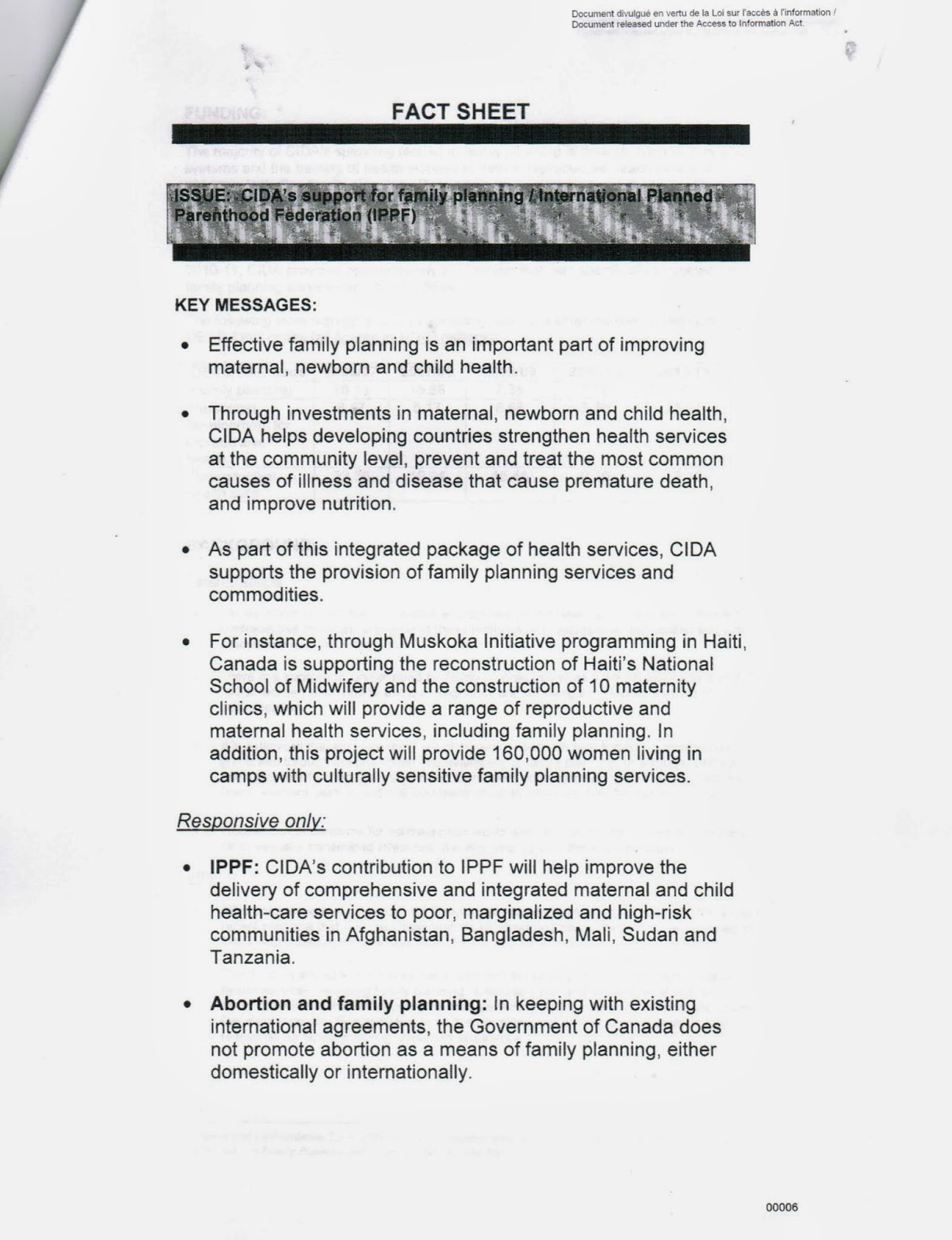
Below are some of the more interesting pages, that appear to be briefing notes to the Minister, regarding IPPF's funding of $6 Million, that mention abortion and how we don't fund it.

One excerpt states:

"Is there a distinction between abortion and contraception?

Modem contraceptive methods include hormonal methods (i.e. the pill, injectables and implants), IUDs, condoms and modern vaginal methods (e.g., the diaphragm and spermicides). Abortion is not a means of contraception. This is enshrined in Paragraph 8.25 of the ICPD Cairo Programme of Action, which reads: "In no case should abortion be promoted as a method of family planning. All Governments and relevant intergovernmental and non-governmental organizations are urged to strengthen their commitment to women's health, to deal with the health impact of unsafe abortion as a major public health concern and to reduce the recourse to abortion through expanded and improved family-planning services. Prevention of unwanted pregnancies must always be given the highest priority and every attempt should be made to eliminate the need for abortion." Guided by paragraph 8.25 of the Cairo Programme of Action, organizations such as UNFPA do not support or promote abortion as a method of family planning."

Another excerpt states:

"Responsive only:

IPPF: CIDA's contribution to IPPF will help improve the delivery of comprehensive and integrated maternal and child health-care services to poor, marginalized and high-risk communities in Afghanistan, Bangladesh, Mali, Sudan and Tanzania.

Abortion and family planning: In keeping with existing international agreements, the Government of Canada does not promote abortion as a means of family planning, either domestically or internationally."

and this about the funding to IPPF:

"Abortion services will not be funded under this program. On-request abortion is illegal in the five target countries. IPPF has also indicated that menstrual regulation will not be funded under this program.

To support this program, CIDA and IPPF signed a contribution agreement in the amount of $6 million on January 27, 2012."


Monday, January 23, 2012

ATIP: CIDA and IPPF (Part 4)

Attached are the appendixes which provides the details of the proposed deliverables by IPPF for the Muskoka initiative on maternal and child health initiative.

Click on each picture, print, then place them side by side to get the full table.


ATIP: CIDA and IPPF (Part 3)

Below I have scanned the Programme Goals and Objectives of the proposal to CIDA from IPPF for funding from the Government’s Muskoka initiative on maternal and child health initiative approved by Minister Oda (pages 7, 8, 9, part of page 10, and part of page 12).

I also referred to some of what is below, in my previous entry.

Sorry for the length of this entry.

--------------------------------------------------------------------------------

Programme Goal
All people, particularly the poor, marginalized, the socially excluded, and underserved are able to exercise their right, to make free and informed choices about their SRH, and have access to SRH information, sexuality education and high quality services, including family planning, all of which are stigma-free, sensitive to gender dynamics and sexual diversity, and offer a positive approach to sexuality. (10)

Objectives
1. To ensure access to IPPF quality-assured, client-oriented, rights-based and integrated package of SRH services including family planning, ante-natal care, STI prevention and care including HIV;
2. To ensure affordable community based outreach services and easy access to services, with a focus on the poor, marginalized and socially-excluded, stigmatized and underserved women and young people;
3. To ensure contraceptive and RH commodity security and to promote under-utilized and new contraceptive technologies;
4. To strengthen health systems through strong partnerships

Expected Results (11)
In partnership with CIDA, IPPF will deliver a comprehensive response to the Muskoka Initiative at two levels - globally and at country level. Globally, IPPF will drive the delivery of expected results and contribute to:
o Preventing the deaths of 1.3 million children under five years of age;
o Preventing the deaths of 64,000 mothers;
o Giving access to modern methods of family planning for 12 million couples


Through funding from the Government of Canada, IPPF's network of service delivery MAs based in 5 ountries (12) will deliver:
• 307,273 unintended pregnancies averted; (13)
• 1,229,092 CYPs provided by method including 98,971 IUD, 191,450 sterilization, 623,706 oral contraceptive pills, 140,511 condoms, 134,104 Injectables, 28,964 Implants, 10,438 Other Barrier Methods, 89 Other Hormonal Methods;
• 3,676,063 SRH services (excluding family planning) and provided by type of service: 186,623 gynaecological, 1,551,019 maternal and child health, 476,518 STI and RTI, 697,166 HIV and AIDS, 436,459 other SRH medical, 571 urological, 35,161 infertility;
• 5,738,052 SRH services including 3,245,485 family planning services provided to young people under age 25;
• 7,090,090 family planning (FP) services provided by method provided by type of service: 37,943 IUD, 19,192 sterilization, 5,196,801 oral contraceptive pills, 1,190,709 condoms, 511,674 Injectables, 67,440 Implants, 18,256 Other Barrier Methods and 568 Other Hormonal Methods;
• 1,321,938 HIV-related services provided along the prevention to care continuum
• 70 estimated percentage of Member Association's clients who are poor, marginalized and/or socially excluded.


A Logical Framework is presented at Annex 1 to demonstrate the programme's goal, objectives, idicators, targets, and contribution to the MDGs. Annex 2 includes a breakdown of these figures by member Association.


Strategy and Approach
IPPF proposes to scale-up services focused on delivering a core set of health outputs in 5 countries. We will drive the delivery of expected results in line with the Muskoka Initiative through IPPF's strategic Goal on Access. Our approach builds on IPPF's global experience of comprehensive family planning programming and the provision of integrated services, lessons learned and best practice hared among our network of MAs.


Objective 1: To ensure access to IPPF quality-assured, client-oriented, rights-based and itegrated package of SRH services including family planning, ante-natal care, STI prevention and care including HIV

Over 31 million clients, men or women, married or unmarried, young or old visit our 64,500 service delivery points every year. Every client visiting an IPPF service delivery point can expect to receive a holistic and integrated package of services. Clients arriving at our clinics for contraceptive services will typically be informed about other common SRH issues. They will also be offered the choice to be asked a set of rapid and standardized screening questions to elicit STI symptoms, safer sex practice, including condom use and voluntary counselling and testing (VCT), risks of gender-based violence, and as appropriate reproductive cancer screening history, such as cervical cancer. Additionally, every client coming to the service delivery points for non-contraceptive services will be asked about their contraceptive practices, family size and child-spacing desires. These services are essential integrated package of SRH services that IPPF MAs endeavour to make available at the primary level of care.


Our service delivery points are designed to be non-intimidating, as well as user and youth-friendly. They offer a safe space free from stigma and judgment. Our SRH information and services emphasize a positive approach to sexuality. In settings with a shortage of doctors, and whenever safe and effective, we train and provide supportive supervision to community-based health workers and mid-level providers to deliver specific procedures. This ensures that clients in resource-poor settings are still able to access high quality services from trained service providers.


• Quality-assured, client-centred care
Quality-assured and client-centred care means that clients' needs guide the planning and implementation of our services. IPPF services meet clinical standards, which require the commitment and expertise of clinic managers and service providers. We believe that clinic and programme tanagers, service providers and clients, all play a role in achieving quality-assured, client-centred care.

IPPF will strengthen the quality of care at service delivery points, taking into account our commitment to a holistic, no-missed opportunity and stigma-free approach through providing:


o Updated self-assessment checklist tool to reflect most recent technical developments.
o Guidelines and job-aids based on current global standards (WHO Medical Eligibility Criteria, Selected Practice Recommendations, or Decision Making Tool for Family Planning, including the tool for people living with HIV)
o A revised Quality of Care tools through revised edition of `IPPF Medical Service Delivery Guidelines, (14) which complements 'IPPF's Global Handbook on Family Planning. (15)


Objective 2: To ensure affordable community based outreach services and easy access to ervices, with a focus on the„poor marginalized and socially-excluded, stigmatized and underved women and young people

IPPF MAs are committed to ensuring easy access to services by using an integrated model of service delivery points, which are conveniently available to everyone, especially to the poor, marginalized, socially-excluded, stigmatized and underserved. All services are of quality, free of unnecessary administrative and medical barriers. People can choose from a wide range of SRH services and a large mix of contraceptive methods.


• Innovative outreach channels
Our MAs offer services through multiple channels, including static and mobile clinics, community-based distributors, retail outlets and other public and private-sector providers. IPPF's community-based health workers offer information and education as well as contraceptives such as condoms and oral contraceptives. They refer people to clinics for other contraceptives and SRH services. IPPF offer clients a larger mix of contraceptives, and in particular long-acting and reversible contraceptives (LARC), such as IUDs and implants, through mobile clinics.


We build the capacity of primary health care public and private-sector providers on new contraceptive technologies, supply them with contraceptive commodities where needed, and offer them regular technical support and supportive supervision. As grassroots organizations part of the national health system, IPPF MAs are committed to strengthening the health care system where they operate.


• Information and education
IPPF's high quality and accessible services are pointless if people do not know about them or want them. Demand generation will be conducted through a combination of channels, such as mass media, interpersonal and community channels, in order to maximize the effect of behaviour change communication (BCC). Instead of one-time BCC campaigns, we will ensure sustained healthy behaviour through continuous communication materials and campaigns.


Objective 3: To ensure contraceptive and reproductive health commodity security and to promote under-utilized and new contraceptive technologies

IPPF aims to deliver a continuous supply of a variety of contraceptives, so that clients can choose their preferred method without interruption whenever they want. Other SRH commodities needed to implement the integrated SRH package, such as antimicrobials for STI treatment, will also be secured. IPPF and our MAs will promote and offer under-utilized and new technologies:


o Oral contraceptives, emergency contraceptive pills and condoms are known to be challenging to use perfectly and consistently. These short acting methods will be readily available and accessible to people using such methods, including young people. J
o LARC (16) and surgical methods such as IUDs, vasectomy and bilateral tubal ligation, based on the needs of communities and the training needs of service providers.
o We will continue to participate in research and development initiatives with partners such as the World Health Organization (WHO), by piloting new service delivery models and contraceptive technologies, such as the Uniject injectable contraceptive that will be available by 2012. (17)


Objective 4: To strengthen health systems through strong partnerships.

IPPF MAs will continue to build on partnerships with key agencies, including Ministries of Health
(MOH), and UNFPA Country Offices to strengthen health systems. Most is participate in me annual planning meetings of their respective UNFPA Country Office and MOH, and play an important role as their implementing partner. (18) Many MAs play a critical role as national service providers on behalf of the government, with whom they have contractual arrangements.


Throughout the proposed initiative, IPPF MAs will continue to partner with key agencies, including
MOH and UNFPA Country Offices. In addition we will strengthen our collaboration with other national partners, such as:

o The national branch of the International Federation of Obstetrics and Gynaecology (FIGO), with whom IPPF also has a global Memorandum of Understanding. Many of our MAs' volunteers belong to the national FIGO branch, and will provide technical assistance through competency-based training on new contraceptives or quality of care supervision to our service providers;
o Public and private-sector providers will play an important role as implementing partners of the social franchising of our integrated SRH delivery models. We will give emphasis on training them on under-utilized and new contraceptive technologies;
o Training institutions, including nursing, midwifery, medical schools and MOH, to ensure that their pre-service training curricula are up-to-date with regard to contraceptive and SRH technologies, and quality of care standards.


10 IPPF Strategic Framework Goal 4: Access to SRH services.
11 The program expected results are based on expected results in 5 countries as presented in the Logical Framework Analysis at Annex 1
12 Member Associations selected work in OECD DAC recipient countries
13 Number of Pregnancies Averted is currently calculated using the impact calculator. The Impact Calculator is currently being used by the Futures Group to harmonize Couple Years of Protection conversion. Multiples of the three are generally used worldwide by USAID, WHO, and MSI. IPPF uses the lowest values so as to not inflate performance. If IPPF used the highest, its CYP would be 45 per cent higher.
14 'IPPF Medical Service Delivery' can be accessed at
http://www.ippf.org/en/Resources/Guides-toolkits/IPPF+Medical+and+Service+Delivery+Guidelines.htm
15 Global Handbook on Family Planning' can be accessed at
http://www.ippf.org/NR/rdonlyres/E8AA38AE-AE7A-4D35-BD57-A55D2B4BE7A5/0/Family_Planning_Global_Handbook.pdf
16 LARC and surgical methods are known to be more cost-effective in terms of couple years of protection (CYP) than short-term methods, such as condoms, Injectables and oral contraceptive pills. LARC methods may be suitable for many clients but require frequent repeat visits.
17 Uniject has an integrated hypodermic needle and a small squeezable bubble-like container, Uniject has the potential to improve the safety and acceptability of injectable contraceptives given by service providers, and in particular by community-based distributors. Uniject will be easier for clients to self-administer their injectable contraceptive in the privacy of their home, which is in line with the demedicalization philosophy of IPPF.
18 UNFPA-IPPF collaboration is backed up by a global Memorandum of Understanding and action plan that was updated in July 2010 by both agencies.


(and this from page 12):


Eligible Countries
IPPF will deliver a comprehensive response to the Muskoka Initiative at the country level in Afghanistan, Bangladesh, Mali, Sudan and Tanzania. IPPF's Secretariat, through joint collaboration with Central and Regional Offices, will drive expected results globally in line with the Muskoka Initiative through IPPF's Strategic Goal on Access. The Secretariat will also manage the programme through offering technical expertise on comprehensive family planning and other SRH services, and the development, harmonization and implementation of the programme's main components. Central Office and Regional Offices will also support selected MAs in terms of technical assistance and capacity building. The Secretariat will support implementation in areas such as financial and human resources management, resource mobilization and monitoring and evaluation. 75 per cent of the programme budget will be allocated to MAs to deliver health outcomes in the 6 countries. The 6 MAs all fall into the list of 49 low-income countries identified in the Taskforce on Innovative International Financing for Health Systems (22) the Muskoka Initiative (23) and CIDA priority countries.

IPPF will ensure that no MA will use Canadian funds for abortion activity. In the past certain Governments have placed various legislative or policy restrictions on the use of funds, including for induced abortion services. IPPF has procedures in place that can immediately be reinstated to ensure that no funds from the Government of Canada are used for abortion services. This includes he holding of funds in a separate bank account.


22 The Taskforce on Innovative International Financing for Health Systems identifies 49 low-income countries where investments in national health systems would save four million children and babies annually, and up to 322,000 maternal deaths, and 193,000 adult HIV deaths.
23 The Muskoka Initiative is focused on achieving significant progress on health systems strengthening in countries with high burdens of maternal and under-five child mortality and an unmet need for family planning.

ATIP: CIDA and IPPF (Part 2)

Further to my last entry on my Access to Information and Freedom (ATIP) request to CIDA...

I actually made two ATIP requests.

My first request asked for the signed funding agreement between CIDA and IPPF for the $6 Million funding IPPF would receive, as part of the Government’s Muskoka initiative on maternal and child health initiative approved by Minister Oda. I was informed that the agreement hadn’t been signed yet.

So I revised my first ATIP request, and asked to see the actual IPPF proposal itself, since we had heard that IPPF would receive $6 million.

I received back the 54 page proposal. It came with the following qualification in CIDA’s covering letter:
"For your information, IPPF's recent proposal does not reflect the terms of the approved program and CIDA has not yet signed a funding agreement with IPPF."

We do know that IPPF asked for $6 million, and news reports said they will get $6 million. Therefore, I imagine the funding agreement will be pretty close to the proposal but that remains to be confirmed.

Sprinkled throughout the proposal, is the mention of all kinds of contraceptives, emergency contraceptives and IUDs, including charts of how many of these will be provided.

Many consider emergency contraceptives and IUDs to be abortifacients.

On Page 12, I learned that:
"IPPF will ensure that no MA [member association] will use Canadian funds for abortion activity. In the past certain Governments have placed various legislative or policy restrictions on the use of funds, including for induced abortion services. IPPF has procedures in place that can immediately be reinstated to ensure that no funds from the Government of Canada are used for abortion services. This includes the holding of funds in a separate bank account."

What I'd like to know is, what mechanisms will be in place on the ground, to ensure that abortion services are not provided or referred?

On Page 7 under Program objectives and Components, Programme Goal:
"All people, particularly the poor, marginalized, the socially excluded, and undeserved are able to exercise their right, to make free and informed choices about their SRH [Sexual Reproductive Health], and have access to SRH information, sexuality education and high quality services, including family planning, all of which stigma-free, sensitive to gender dynamics and sezual diversity, and offer a positive approach to sexuality."

This above type of wording permeates the entire proposal.

On Page 8 under Program objectives and Components, Quality-assured, Client Centred care:
"IPPF will strengthen the quality of care at service delivery points, taking into account our commitment to a holistic, no-missed opportunity and stigma-free approach through providing:

Updated self-assessment checklist tool to reflect most recent technical developments.

Guidelines and job-aids based on current global standards (WHO Medical Eligibility Criteria, Selected Practice Recommendations, or Decision Making Tool for Family Planning, including the tool for people living with HIV)

A revised Quality of Care tools through revised edition of `IPPF Medical Service Delivery Guidelines, (14) which complements 'IPPF's Global Handbook on Family Planning. (15)"

Another question I have: If abortion services are not being provided, then why would they provide these manuals which discuss all aspects of abortion, at the "service delivery points"?

Here are a few interesting items from these guidebooks (Note that the guidebooks themselves are not part of the proposal, they are only referred to in the proposal. With a total of 840 pages in these two guidebooks, I'm sure there are a lot of other pieces of fascinating abortion information tidbits):

Chapter 10 is on "Emergency Contraception". Note this: "Mode of action (some clients may need reassurance that emergency contraception is not an abortion)."

Chapter 11 is on "Diagnosis of Pregnancy": "In the event of pregnancy, determination of the gestational age is important to give the woman an estimated date of delivery. This determination is also useful in the diagnosis of certain pregnancy complications (e.g. ectopic pregnancy or threatened abortion). When a client is considering an abortion, information about gestational age helps the woman to make a decision, and where legal, is essential for selection of the appropriate technique."

Chapter 12: "Safe Abortion": "In circumstances where abortion is not against the law, health service providers should be trained and equipped to offer a safe and accessible service. Provision of, or referral for, abortion services is an essential part of women’s sexual and reproductive healthcare: fulfilment of a woman’s right to choice should be a high priority for such programmes. As with all sexual and reproductive health services, the client’s right to confidentiality and privacy must be sustained."

Chapter 13 is on "Options for unintended pregnancy":
"HIV does not necessarily have a negative impact on the pregnancy but might have an adverse effect on the health of the mother especially if her CD4 count is low and ARVs are not available. HIV also leads to increased rates of complications after delivery and is associated with an increase in maternal mortality. If the client is currently pregnant but does not wish to continue her pregnancy, she should be referred to safe abortion services, where legally permitted. Postpartum contraception should be offered as an option for those who do not wish to become pregnant again".

These paragraphs from the guide books, guide the IPPF people (or MAs) on how to refer for abortion, where legal. But when abortion is not legal, what kind of advice do the IPPF people give to their clients?

My next entry will disclose more information from the IPPF proposal.

Saturday, January 21, 2012

ATIP: CIDA and IPPF (more to come...)

There is a best way to get money from CIDA--and there is a worst way.

The best way involves telling CIDA you’ll give out lots and lots and lots of condoms to third world countries. International Planned Parenthood Federation (IPPF) did this, along with promising all kinds of other contraception methods/abortifacients including emergency contraception and IUDs.

According to a recent Access to Information Request I did with CIDA, I learned that in IPPF’s proposal for $6 million of funding, IPPF promised to deliver :

1,229,092 Couple years of protection (CYP)
7,090,090 family planning services (FP)
3,738,052 sexual reproductive health (SRH) services (excluding family planning) and
5,738,052 SRH services provided to young people under the age of 25 (including family planning)

The worst way to get funding is to be MaterCare. Their applications for funding, have now been denied for eleven years in a row.

In their 2004 refusal from CIDA, MaterCare were told that one of the reasons their funding request was refused was because—are you ready for this?
Because their project [West African regional Birth Trauma Centre in Ghana] was:
“aimed at curing the problem rather than preventing it from taking place”.

MaterCare was trying to cure a problem of maternal child mortality. Oh my goodness, what were they thinking?

In Matercare’s 2008 refusal, CIDA said:
there was concern that MaterCare’s approach to the subject matter is not consistent with CIDA’s policies on maternal health.CIDA's approach to improving maternal health and reducing maternal mortality includes access to reproductive health care and family planning, themes that were not addressed in MaterCare’s proposal...”
Why? Because MaterCare won’t give out lots and lots and lots of condoms. Simple really.
And how does birth control save women’s lives? They don’t, not according to MaterCare:
Abortion and birth control are irrelevant to reducing maternal mortality as most deaths occur during the last 3 months of pregnancy, during labour and delivery and one week afterwards. It is egregious to suggest to mothers that in order to save their own lives they must kill their babies, rather than to provide them with safe comprehensive maternity care. Early abortion is being promoted, by oral medication, and surgical means using manual vacuum aspirators (MVAs). The problem with these procedures is that having been given the pills or having undergone and MVA, the mother is sent home where bleeding or infection may result but she has no access to medical follow-up. Many African mothers are anemic due to malnutrition and malaria and with post abortion haemorrhage or infection death may well occur. In addition, these MVA kits are supposed to be for one time use only but as we know with injection needles and AIDS there is no assurance that they will not be used again, and as they cannot be sterilized, further use may result in spreading infection and leading to more maternal deaths.

To deny the provision of essential obstetrics is a form of violence against women. Violence may be by commission i.e. a person is physically assaulted in some way, or by omission i.e. by culpable negligence not to have done what is necessary – in this case, providing essential care during pregnancy and childbirth.”

See here for MaterCare’s full statement released in October last year on how they continue to be banned from receiving funding from CIDA.

Which brings me back to IPPF and my recent ATIP, on which I will write more later.

Friday, January 20, 2012

MaterCare - Background on CIDA refusing funding (more to come...)

(This was released by MaterCare last year)

MATERCARE INTERNATIONAL
SUMMARY OF DISTRIBUTION OF
MUSKOKA FUNDING OF THE GOVERNMENT OF CANADA
FOR MATERNAL HEALTH CARE
&
 - 11TH TIME MCI HAS BEEN DENIED
10 October 2011
        The funding announced on September 22nd, by Prime Minister Harper, of  $82 million for 28 NGO’s as part of the G8 Maternal, Newborn and Child Health Initiative went as expected to the "big" agencies for "maternal health and family planning" which included IPPF - $6 million and UNFPA - $40 million, both non Canadian organizations.  As far as we can see there is little, if any, funding for essential obstetrics, which the Muskoka initiative was supposed to deliver, and only one for the drought area of east Africa e.g. Kenya.  However there are 23 other agencies not listed.

        In May of last year MaterCare International (MCI) was invited to the P.M’s office to meet with a senior policy advisor, about the work of MCI in west and east Africa since 1981. The meeting focused on MCI’s maternal health essential obstetrical projects, which met with the objectives of the Muskoka initiative.  Also discussed were the reasons MCI’s has been denied funding for all its last applications since 2002 i.e. 11 times.   

        Reproductive health (abortion and birth control) has been the ideology of Canadian International Development Agency (CIDA) for years, which it is determined to impose throughout the developing world, especially sub-Saharan Africa, now despite the intent of the Muskoka G8 initiative. The way it is distributing these funds favours large abortion/birth control/population agencies, which have little interest in providing essential obstetrics as that is not their prime interest.

        Abortion and birth control are irrelevant to reducing maternal mortality as most deaths occur during the last 3 months of pregnancy, during labour and delivery and one week afterwards. It is egregious to suggest to mothers that in order to save their own lives they must kill their babies, rather than to provide them with safe comprehensive maternity care. Early abortion is being promoted, by oral medication, and surgical means using manual vacuum aspirators (MVAs).  The problem with these procedures is that having been given the pills or having undergone and MVA, the mother is sent home where bleeding or infection may result but she has no access to medical follow-up. Many African mothers are anemic due to malnutrition and malaria and with post abortion haemorrhage or infection death may well occur.  In addition, these MVA kits are supposed to be for one time use only but as we know with injection needles and AIDS there is no assurance that they will not be used again, and as they cannot be sterilized, further use may result in spreading infection and leading to more maternal deaths.

         To deny the provision of essential obstetrics is a form of violence against women. Violence may be by commission i.e. a person is physically assaulted in some way, or by omission i.e. by culpable negligence not to have done what is necessary – in this case, providing essential care during pregnancy and childbirth.  

           MCI applied to CIDA for Muskoka funding for a comprehensive rural obstetrical project for the severely affected drought district of Kenya, which has been badly neglected by government and NGOs.  MCI’s proposal has been turned down twice.  The first time was due to a CIDA technical issue in uploading our proposal to their site.  We were told that we had not pressed a “submit” button however there was no indication that this was required especially as CIDA confirmed it had received the 29 page proposal/budget and 27 other documents.  Thus as the application was complete, a project number was assigned.  We challenged this reason on the grounds that process was flawed, which CIDA later agreed.  If we had not done so, we would have been unfairly denied.  MCI was then told that the application had been found and was being “decoded”. 

This had happened to other NGOs also.

        Having followed the guidelines for funding, we understood that of the total budget of $2,917,968 MCI was required to raise 25% of the total budget with CIDA providing the remaining funding up to a maximum 75%.  The proposal was then turned down, for a second time on the grounds that MCI had not met the requirement that:

"The average total annual revenues of the organization over the past three years or total unencumbered financial assets under the financial control of the applicant (e.g. endowments) must be greater than the average amount requested from PWCB per year of the project)."    

        MCI was asked for further explanation and were told that of the $2,917,968 total MCI had to raise over the 3 years of the contract, the amount of the CIDA contribution of $2,188, 476 (75% of the total) from Canadian sources but of this MCI would have to contribute only $729,492 (25% of the total).  This would, however, then leave MCI with an unused surplus of  $1,458,984 which leads to the problem that as a charity MCI has to follow strict guidelines as to the use of funds received and these this funds being designated had to be used for the Kenya project purpose. This the funding process makes it impossible for smaller NGOs to obtain CIDA funding. This is the 11th time MCI has been denied project funding by CIDA since 2001. We were told in writing that as MCI did not provide “reproductive health services”, it would never receive funding and also verbally that MCI was “too Catholic” and “too close to the Pope”!  Other reasons have been mostly technical/process ones but never on the substance of our proposals. 

        MCI has developed a model of comprehensive rural (where most of the deaths take place) obstetrics that takes into account not only the obstetrical causes of death and provides prenatal care, treatment for life threatening complications and postnatal care, but also other obstructions to survival, e.g. lack of transport, poor roads, lack of infrastructure and trained personnel.  During the last three years MCI has provided $1.2 Million to build and equip a 28 bed obstetrical hospital in the town of Isiolo, Kenya capable of treating all life threatening complications; built a rural maternity clinic in Merti, district some 225kms from Isiolo; provided an emergency transport 4 X 4 ambulance for providing long distance safe transport for severely ill mothers, provided two motorbike ambulances for the villages; and trained over 100 traditional birth attendants. This area of Kenya is located in the drought region where in some areas there has been no rain for 6 years and where there has been no health care at all.  The communities served are nomadic pasturalists, who have lost many of their cattle and goats due to the drought; internally displaced refugees; and those from Somalia, the border is 200 kms and Isiolo town is a transit centre. Thus the maternal mortality and morbidity is one of the highest in sub - Saharan Africa.

        Our application to CIDA was for operating costs for the hospital, for refurbishing and equipping five rural maternity centres. The project would have been a unique demonstration project conceived and implemented by an experienced Canadian NGO in partnership with a Kenyan NGO and with Kenyan colleagues. The hospital and clinic are both ready to provide care.  This has been achieved by generous donations from Canadians individuals, foundations and women’s groups as well by government and private donors in the UK, Italy, Australia, Poland, and the US.

        The problem with CIDA is that it functions in a typical bureaucratic way from the top down and not from the bottom up, and thus fails to consider the needs of those whom it is supposed to be helping. It more concerned with its form rather than function and is CIDA is blinkered by its own ideology. It is without the health professional input it had 20 years ago and has especially an antipathy towards smaller NGOs “there are too many of them”, especially those which are faith based.  NGOs such as MCI are more efficient; they are closer to the people; their expertise is invited not imposed; they listen to, live and work within the communities which they serve and are thus more acceptable.

        So now there is a project which will save mother’s lives in a drought area of Kenya conceived and developed  by a Canadian NGO with provides essential obstetrics  in a maternity hospital with one rural clinic, all built  by generous, after tax, donations from individual Canadians including many seniors,  as well as Canadian foundations and the Canadian Catholic Women’s League  but is denied operating funding from the Muskoka initiative, even though the P.M’s office sought advice from MCI and which congratulated it for what it  had achieved.  This could be a major embarrassment for the Canadian Government.

Dr R. L. Walley
Executive Director
Professor Emeritus of Obstetrics and Gynaecology

Sunday, October 16, 2011

Mr. Harper, tell us why you are funding Planned Parenthood

I sent a letter to Mr. Harper asking him not to fund IPPF. His office sent me a response (see below) that frankly, is insulting.

The Prime Minister's Office tells me that I "raised an issue that falls within the portfolio of the Honourable Beverley J. Oda, Minister of International Cooperation." and so his office has "taken the liberty of forwarding [my] e-mail to Minister Oda. I am certain that the Minister will wish to give your views every consideration."

I really don't think any Canadian, myself included, is under any illusions about who is running the show here. Even though the PMO's office tells me my letter should rightly go to Minister Oda, we all know it is Stephen Harper who calls the shots, so who are we kidding?

The decision to fund IPPF, after Canadians were assured that abortions would not be included in the Maternal health initiative, rests with Mr. Harper.

Mr. Harper needs to own up to Canadians and explain why our tax dollars are being given to an organization whose goal is to make abortion legal around the world.
--------------------
Dear Mr. Harper,

I am asking you to change your decision to fund International Planned Parenthood federation. Their mandate is to make abortion legal everywhere in the world. IPPF also lobbies to make abortion an international human right.

Instead we should fund organizations that help women and their children like Matercare, who has been refused funding 11 times. Why is that anyway? Matercare helps women and their unborn children, and IPPF destroys unborn children and greatly harms their mothers.

With your majority government you have the unique opportunity to help woman and their unborn children, here and abroad. I ask that you do that and a good first step would be to stop funding IPPF.

Sincerely,
Patricia Maloney
-------------------
Dear Ms. Maloney,

Thank you for writing to the Prime Minister. In your e-mail, you raised an issue that falls within the portfolio of the Honourable Beverley J. Oda, Minister of International Cooperation.

Please be assured that your comments have been carefully noted. I have taken the liberty of forwarding your e-mail to Minister Oda. I am certain that the Minister will wish to give your views every consideration.

For more information on the Government's initiatives, you may wish to visit the Prime Minister's Web site, at www.pm.gc.ca.

Once again, thank you for taking the time to write.

Saturday, October 8, 2011

Real choice

It was disturbing to learn yesterday, that for the eleventh time, CIDA has refused funding to Matercare International because they refused to provide “reproductive health care” for the Conservatives's maternal health initiative.

We already know that CIDA is funding IPPF even though abortion is not included in the Maternal health initiative. If we choose to believe that IPPF will not advocate for their abortion ideology with this money, we are at best, blind.

IPPF’s states on their website:
“We aim to reduce the number of abortions worldwide that are unsafe. Our Member Associations are committed to identifying actions that will increase a woman’s right to access abortion-related services, including counselling and post-abortion care, as well as safe abortion services. We believe that a woman has the right to choose and access safe abortion services and we advocate for changes in legislation to support this. This is one of the priority concerns of our work. (emphasis added).

These two funding decisions are the exact reverse of what Canada should be doing. We should fund Matercare and we should not fund IPPF.

Yesterday at Mass, the reading was Luke 11:14-26, Jesus and Beelzebub. This reading reminded me of one of the Spiritual Exercises of St. Ignatius called the Two Standards.

Some background on the Spiritual Exercises of St. Ignatius:

St. Ignatius created these exercises to aid all persons in realizing their ultimate goal in life:
“Man is created to praise, reverence, and serve God our Lord, and by this means to save his soul.”

These exercises are done under the direction of a spiritual director, to gain a deeper understanding of our role here on Earth, and help us to eventually spend eternity with Christ the Lord.

This particular exercise helps us to imagine, to contemplate and to pray about whose authority (or standard) we would like to fall under:

Would it be Christ the Lord or would it be Lucifer?

I was going to paraphrase the Two Standards, but I think Ignatius says it pretty well himself. So I will let St. Ignatius explain this exercise for you in his own words.

TWO STANDARDS

The one of Christ, our Commander-in-chief and Lord; the other of Lucifer, mortal enemy of our human nature.

Prayer. The usual Preparatory Prayer.

First Prelude. The First Prelude is the narrative. It will be here how Christ calls and wants all under His standard; and Lucifer, on the contrary, under his.

Second Prelude. The second, a composition, seeing the place. It will be here to see a great field of all that region of Jerusalem, where the supreme Commander-in-chief of the good is Christ our Lord; another field in the region of Babylon, where the chief of the enemy is Lucifer.

Third Prelude. The third, to ask for what I want: and it will be here to ask for knowledge of the deceits of the bad chief and help to guard myself against them, and for knowledge of the true life which the supreme and true Captain shows and grace to imitate Him.

PART I THE STANDARD OF SATAN

First Point. The first Point is to imagine as if the chief of all the enemy seated himself in that great field of Babylon, as in a great chair of fire and smoke, in shape horrible and terrifying.

Second Point. The second, to consider how he issues a summons to innumerable demons and how he scatters them, some to one city and others to another, and so through all the world, not omitting any provinces, places, states, nor any persons in particular.

Third Point. The third, to consider the discourse which he makes them, and how he tells them to cast out nets and chains; that they have first to tempt with a longing for riches—as he is accustomed to do in most cases—that men may more easily come to vain honor of the world, and then to vast pride. So that the first step shall be that of riches; the second, that of honor; the third, that of pride; and from these three steps he draws on to all the other vices.

PART II THE STANDARD OF CHRIST

So, on the contrary, one has to imagine as to the supreme and true Captain, Who is Christ our Lord.

First Point. The first Point is to consider how Christ our Lord puts Himself in a great field of that region of Jerusalem, in lowly place, beautiful and attractive.

Second Point. The second, to consider how the Lord of all the world chooses so many persons—Apostles, Disciples, etc.,—and sends them through all the world spreading His sacred doctrine through all states and conditions of persons.

Third Point. The third, to consider the discourse which Christ our Lord makes to all His servants and friends whom He sends on this expedition, recommending them to want to help all, by bringing them first to the highest spiritual poverty, and—if His Divine Majesty would be served and would want to choose them—no less to actual poverty; the second is to be of reproaches and contempt; because from these two things humility follows. So that there are to be three steps; the first, poverty against riches; the second, reproaches or contempt against worldly honor; the third, humility against pride. And from these three steps let them induce to all the other virtues.

First Colloquy. One Colloquy to Our Lady, that she may get me grace from Her Son and Lord that I may be received under His standard; and first in the highest spiritual poverty, and—if His Divine Majesty would be served and would want to choose and receive me—not less in actual poverty; second, in suffering reproaches and injuries, to imitate Him more in them, if only I can suffer them without the sin of any person, or displeasure of His Divine Majesty; and with that a Hail Mary.

Second Colloquy. I will ask the same of the Son, that He may get it for me of the Father; and with that say the Soul of Christ.

Third Colloquy. I will ask the same of the Father, that He may grant it to me; and say an Our Father.

I think we need to reconsider these decisions to fund IPPF and to not fund Matercare.

We need to listen to what is written on our hearts. We need to decide whose standard we choose to follow.

Sunday, October 2, 2011

How Harper hid his agenda that was hidden

In a bold move yesterday, Prime Minister Stephen Harper held a press conference in support of three back bench Conservative MPs. He was also surrounded by his entire 165 member caucus. He issued this statement:

I just want to tell all Canadians, that Brad Trost, Maurice Velacott and Leon Benoit, who spoke out against International Planned Parenthood, did this on their own.

What they did, one after the other, in quick succession, quickly and decisively, was to protect me from those who would accuse me of reopening the abortion debate. I have always kept my promise not to reopen the abortion debate. I said this from day one. That I would not reopen the abortion debate. I have kept this promise.

This is how I accomplished it.

When I was first elected in 2006, pro-choice Canadians kept saying I had a hidden agenda. They said that if I were elected, I would reopen the abortion debate. I said I would not reopen the abortion debate. I held firm and did not reopen the debate. I refused to talk about abortion. I was elected Prime Minister, albeit with a minority government, and I continued to promise not to reopen the abortion debate.

You may recall that in January of 2010 I announced my maternal and child health initiative to help mothers and their children in third world countries. This initiative did not include abortion. Shortly thereafter, the Liberals insisted abortion be included in the initiative and they brought forward a motion to include abortion in my initiative.

I, of course, as already stated, did not want to reopen the abortion debate. In fact in March of 2010, I clearly recall saying "we do not want a debate, here or elsewhere, on abortion." I remember I said that. I then instructed my caucus to vote against the motion. The motion was defeated. Even though abortion was on the table, it wasn't me who put it there. The Liberals did. I did not reopen the abortion debate.

Then this year, before I received my first ever majority government, one that I really, really wanted, I continued to tell everyone I would not reopen the abortion debate. I repeated this. Many times. Over and over again. I held firm to this promise.

Last week, Minister Bev Oda, promised International Planned Parenthood Federation (IPPF) $6 million for family planning in third world countries. As many of you know, IPPF is one of the world's largest abortion providers. Their goal is to make abortion legal around the globe and to make abortion an international human right. Again, the abortion debate was on the table, this time opened by my faithful servant, Oda. But notice, once again, I did not reopen the abortion debate. Once again I did what I said I would do. I stuck to my guns so to speak (small pun there).

Now I stand before you, with my entire caucus, with my coveted majority government, and I say to you: I never once reopened the abortion debate. I still have no intention of reopening the abortion debate. I will never reopen the abortion debate. The abortion debate will never be reopened by me.

Abortion is now on the table, it has been unhidden from where it lay hidden all these years. And still I stand firm with my promise never to reopen the abortion debate.

I can never be accused of reopening the abortion debate. I have kept my promise.

Thank you.

DISCLAIMER: All characters and events portrayed in this posting are a satirical examination of the abortion debate in Canada. Some readers may not share this sense of humour.

Friday, September 23, 2011

The six million dollar miracle

So Canada is giving 6 million dollars to International Planned Parenthood Federation. To provide sex education and contraception in developing countries in Africa. Where abortion is currently illegal.

Where do I begin?

How about, with one of IPPF's main goals? That would be,"to make abortion legal and safe everywhere."

IPPF also promotes abortion access as a woman’s right, in fact as a human right in international law. IPPF says:
“sexual and reproductive rights should be internationally recognized as human rights and therefore guaranteed for everyone.”

As everyone who knows anything about IPPF knows, "sexual and reproductive rights" includes "abortion rights."

So let's see. If I was IPPF, and I advocated to make abortion legal everywhere, and I had 6 million dollars to provide sex education to countries where abortion is illegal, don't you think I might, you know, do some self promoting of abortion, in those very same countries to make abortion legal? So that I could drum up some more business?

Remember that IPPF admits their goal is to make abortion legal all over the world. That's the business Planned Parenthood is in. Abortion. You can't separate the goals from the money.

And what about last year when the Liberal motion to fund abortion in the Maternal Health initiative was defeated? I thought Canadians were assured by Mr. Harper, that there would be no funding for abortion in the third world? That our tax dollars would not fund abortion in the developing world?

Or do I have that wrong?

But of course that was all before the election. Before the Conservatives under Mr. Harper won their majority. The majority that couldn't have been won without the support of social conservatives.

Well now Mr. Harper has his coveted majority. So really, who needs those pesky social conservatives anyway? Who needs those irritating pro-lifers who are always complaining how Canada is virtually the only country in the world with legalized abortion right up until birth, and how we have that darned-dubious-distinction of being the most abortion tolerant country in the world?

So here's a thought. What if Mr. Harper decided to give money to IPPF for a very strategic reason? After all, we all know that Mr. Harper is no dummy.

What we do know is that, with more money, IPPF can continue to spread their gospel of abortion. To every corner of the globe. Right around the world. Everywhere. Resulting in more countries converting to legalized abortion for all nine months. For any reason. Or for no reason. Just like Canada.

Now we would share our darned-dubious-distinction with other countries. Maybe the whole world. And Mr. Harper wouldn't have to listen to pro-lifers complain anymore about how Canada is the most abortion accepting country in the world. Because the rest of the world would have limitless abortion just like us.

So I'm just wondering. Was this the agenda Mr. Harper had all along? Hidden until he got his majority?