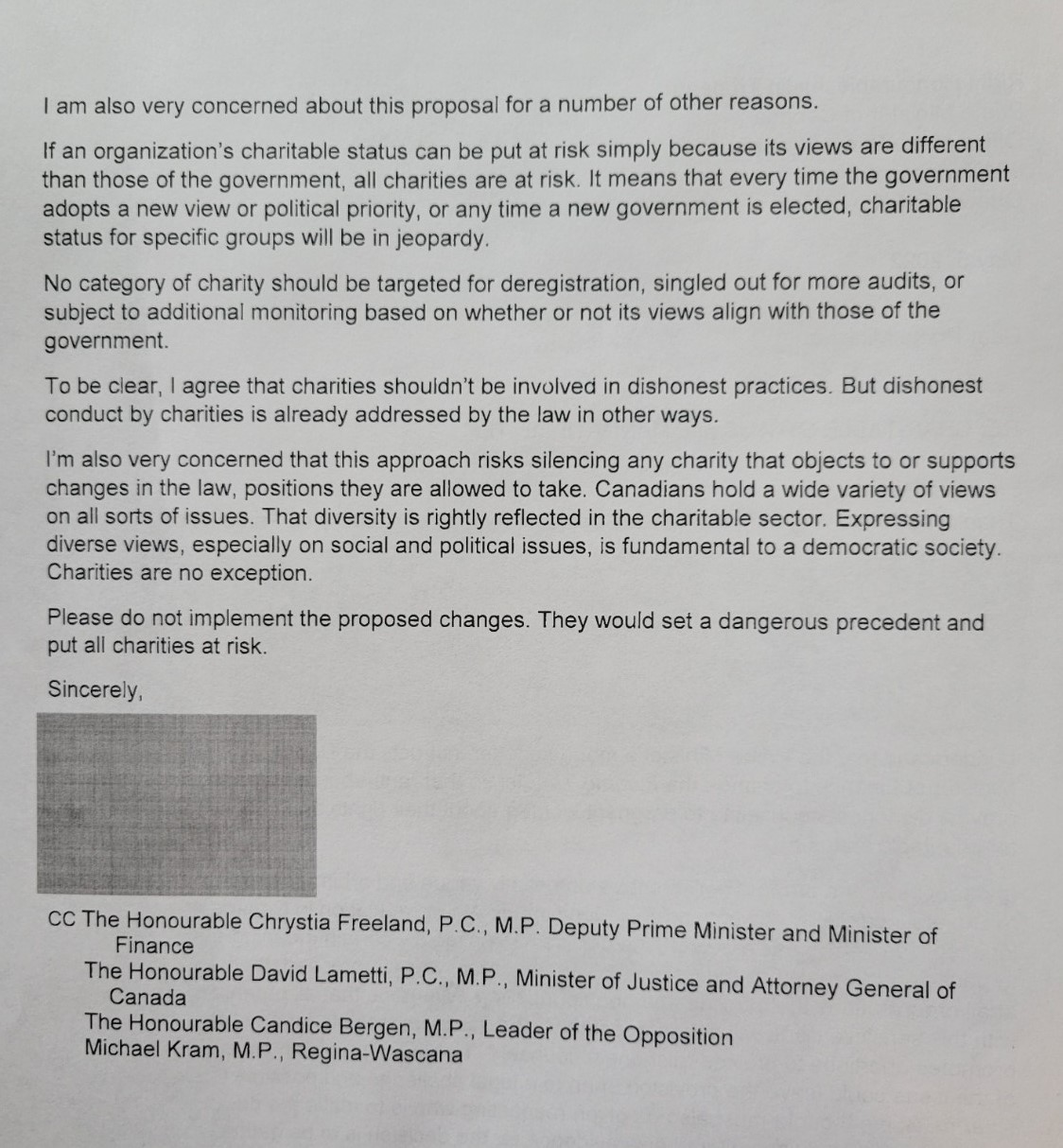
Part 2 here.
“I’ve yet to find one person who does think it’s a good idea.”
This is a long article that is behind a paywall on the internet. I have highlighted some important points Doherty makes, but the entire article is worth reading.
I also noticed that this article was included twice in the package I received.
--------------------------------------------------------------------------------------------
FUTURE of GOOD
THE CANADIAN GOVERNMENT PROMISED TO STRIP ANTI-ABORTION ORGANIZATIONS OF THEIR CHARITABLE STATUS. HERE’S WHY IT HASN’T.
May 24, 2022
Author Brennan Doherty
WHY IT MATTERS
This policy, if enacted, could affect the charitable status of organizations that oppose abortion - but it could also open the door to more scrutiny of charities any government disagrees with.
In the wake of the Supreme Court of the United States’ likely overturn of Roe v. Wade, a pivotal court case cementing the right of Americans to access abortion services, Prime Minister Justin Trudeau’s government was quick to jump to the microphone.
Canadians, unlike Americans, have no legal right to abortion access. Ever since abortion was legalized in 1988, Canadian governments have generally taken a hands off approach to the issue: not overtly interfering with it, but not enshrining it with legal protections, either. During the last election, Trudeau pledged to penalize provinces that don’t provide a minimum level of abortion access, a major issue in Maritime provinces and the Far North. “This government will never back down on defending and promoting women’s rights in Canada and around the world,” Trudeau told the Globe and Mail in May 2022.
Nearly a year after his government returned to power, Trudeau still hasn’t implemented one of the most under-the-radar promises in his election platform: stripping the charitable status of anti-abortion organizations, including crisis pregnancy centres “that provide dishonest counseling to women about their rights and about the options available to them at all stages of the pregnancy.” This would happen through changes to the Income Tax Act.
The Abortion Rights Coalition of Canada (ARCC) has underscored the issue of dishonest and coercive practices at crisis pregnancy centres in several reports, something the leaders of these organizations refute. “We definitely would like to see anti-choice groups not have charitable tax status,” says Joyce Arthur, executive director of ARCC.
Yet the Trudeau government may have good reason to avoid following through on their promise to strip anti-abortion organizations of their status.
Legal experts told Future of Good the policy, if enacted, would open a legal can of worms, especially around the definition of an anti-abortion organization. Future governments may use the precedent of a specific law stripping anti-abortion charities of their status to go after charitable organizations they dislike: environmental charities, for example. Furthermore, experts say, such a policy could open the door to regulating the ideology of the charitable sector in a way that doesn’t currently exist in Canada.
“We don’t regulate the normative space for charities - and by design,” says Adam Parachin, a charity law professor at York University. “The system is, by design, meant to be a space for diverse and pluralistic views. You can’t have pluralism without a diversity of views.”
DEFINE ‘ANTI-ABORTION’
The biggest question on the minds of policymakers, sector leaders, and experts when it comes to stripping anti-abortion organizations of their status is simple - what counts? Advocacy organizations like LifeCanada National Association or the New Brunswick Right to Life Association are all explicit in their anti-abortion views, but other organizations may be less so. Arthur says crisis pregnancy centres can be deceptive about their worldview despite promising to be unbiased and non-judgemental. “They never, ever talk about the risks and complications of pregnancy and childbirth, which are far greater than abortion,” she says.
On its website, the Calgary Pregnancy Care Centre says its volunteer peer counsellors are willing to discuss all options around pregnancy - including adoption, parenting, and abortion - in a caring and respectful environment. However, the Centre says on its website that it refuses to provide abortion referrals. When asked about that policy, executive director Jutta Wittmeier dismissed the question. “You don’t need a referral for an abortion clinic,” she says. “It’s a moot point.” (Arthur says the Centre should, nonetheless, be willing to give out information on abortion providers).
The Centre does more than pregnancy counseling. Wittmeier says they also give out care packages to parents, run parenting classes, and do financial literacy courses. In fact, its charitable type, according to CRA data, is ‘relief of poverty.’ This isn’t uncommon for crisis pregnancy centres. “It’s more likely to be a health centre that operates in accordance with certain beliefs,” says Kathryn Chan, an associate lawprofessor at the University of Victoria.
To make matters more complicated, many religious denominations preach against abortion. These include the Catholic and Orthodox churches, as well as many evangelical Christian denominations. Other prominent religions in Canada, such as Islam and Judaism, permit abortion to varying degrees, but sometimes restrict it for non-medical reasons. Many charities are affiliated with these religious denominations. Would they be at risk of losing it under the Trudeau government’s policy?
Even legal experts are confused. “Should there be a means test to determine what percentage of expenditures goes towards anti-abortion initiatives?” Helene Mersky, an associate lawyer at Blumberg Segal LLP focused on non-profit and charity law, recently wrote. “Should it be a question of how many people are impacted by the charity’s activity? Will charities be penalized if an officer re-tweets an anti-abortion message on the charity’s Twitter? None of these questions have thus far been addressed by the Liberals.”
If the Trudeau government did provide a clear-cut definition of an anti-abortion charity, both lawyers and charitable sector advocates say such a policy could open the door to governments penalizing charities working on issues they simply don’t like.
POLITICIZING THE CHARITABLE SECTOR
One of former Alberta Premier Jason Kenney’s major promises in the lead-up to his 2018 election was to go after environmental groups he believed were ‘attacking’ the province’s oil and gas industry. He vowed to bring a multimillion-dollar investigation down on the heads of legitimate, law-abiding charities - scrutinizing their financial ties, internal documents, and connections to anti-pipeline protects. While the resulting inquiry was completely ineffective, it did demonstrate just how a ruling party’s plans could threaten the viability of an entire corner of the charitable sector.
Imagine Canada, a lobbyist for the charitable sector, argued against the Trudeau government’s proposal for precisely this reason. As it wrote in an April 2022 statement, charity work has led to a lot of good developments in Canadian society - climate change action and same-sex marriage legalization to name a few. Banning organizations with specific ideologies could open the door for future governments to target organizations or causes they disagree with.
“If we’re going to open that can of worms and start trying to pull out one strand at a time that we don’t like, the whole house of cards is going to collapse,” Parachin says. “Maybe today, it’s anti-abortion charities. Tomorrow it could be Muslim charities or environmental charities.” Chan agrees. “You always have to think this through from both sides of the political spectrum,” she says.
The loosening of rules around political activities by charities in 2018 may actually give anti-abortion organizations a case should they face a crackdown by the federal government. Chan says the results of the case that got rid of the Income Tax Act’s rules on political activities “...suggested that there are constitutional limitations on the government’s ability to prevent charities from engaging in political activities in certain ways.” In other words, a government that tries to limit a charity’s political activities (which could include anti-abortion advocacy) may violate Canada’s constitution.
And as Imagine Canada pointed out in its statement, the federal government already has the tools to go after charities providing dishonest counselling and misinformation to clients. The Charities Directorate currently says charities providing health information must do so in a way that is “reasonably unbiased, factual and sufficiently detailed”, according to a CRA website. The regulator’s guidelines also say organizations working on public policy “must be truthful, accurate, and not misleading.”
Violating these rules can lead to disciplinary action against individual charities, including the potential removal of their charitable status.Yet legal experts say the way abortion was legalized in Canada, as well as the loosening of political speech rules for charities, could hamper the ability of the federal government to crack down on anti-abortion charities.
CANADA’S ABORTION LAW VACUUM
Canada may have legalized abortion in 1988, but the legal framework supporting it remains unclear to this day. There is, in fact, no law governing abortion in Canada. It is regulated by provincial and territorial organizations and professional associations as any other medical procedure. While this legal vacuum has allowed for abortion access across Canada without re-opening a contentious political debate on the subject, it also makes it difficult to tell whether laws restricting abortion are constitutional or not.
Pro-abortion advocates have suggested Canadian charities should be aligned withhuman rights law, and that anti-abortion activities might contravene that principle. Chan pointed to a UK case involving a Catholic adoption agency that refused to place children with same-sex couples. “It raised the question of whether that entity should have charitable status, because it was discriminating against people not in accordance with human rights law,” she says. Canada hasn’t seen such a case, but Chan says this avenue might be what pro-abortion groups use to justify the removal of charitable status.
After all, the question at stake for charitable status to anti-abortion organizations is whether or not the services they provide are for the public benefit. “Who gets to define what is for the public benefit?” Chan asks. “Does being for the public benefit mean being in accordance with human rights law? In accordance with the constitutional order?”
Unfortunately, she says, there is very little case law around this issue in Canada because of the difficulties charities have had in bringing cases to the Federal Court of Appeal, where decisions around charitable registration decisions by the CRA are made.
In fact, she says, no charity has won a case at the Federal Court related to charitable registration in over 20 years. To get around this issue, Chan says, charities are increasingly bringing cases to the Ontario Supe [rest of text missing]
And because of Canada’s lack of a concrete legal framework around abortion, it may be difficult for pro-abortion advocates to make a legal argument for stripping the charitable status of anti-abortion organizations. As Parachin puts it, the removal of the final restrictions around abortion in Canada in 1988 didn’t set out clear limits in terms of access to abortion. “We actually don’t know what kind of restriction on abortion would pass constitutional muster because we’ve not had a legislature since that time bring forward new legislation,” he says. “The idea that organizations advocating against abortion are somehow swimming upstream against established human rights takes for granted that we actually know the parameters - and we don’t.”
OPENING THE CAN OF WORMS
At the time of publication, the Canadian government hadn’t announced any additional details on whether it would revoke the charitable status of anti-abortion organizations.
Arthur says she was told by someone at Finance Canada that the rule would only apply to organizations seeking charitable status in the in future - so, an anti-abortion organization with charitable status today would keep it, but a new organization wouldn’t be allowed to apply for one.
Future of Good reached out to a spokesperson for Finance Canada on Friday afternoon with questions, including whether the Canadian government had plans to follow through on its campaign promise. As of publication time, Future of Good had not received an official response.
For her part, Wittmeier hasn’t heard anything about other crisis pregnancy centres losing their charitable statuses. “I don’t know why they haven’t followed through,” Wittmeier says of the policy. “I’m grateful because there’s lots to do helping pregnant people and their partners in the midst of difficult circumstances for whatever reason.”
Whatever the federal government does decide, the resulting legal arguments - and, likely, legal challenges - could be a nightmare for policymakers and lawyers to wade through. “I’m someone plugged in with people who spend their livelihoods opining in these fields,” Parachin says. “I’ve yet to find one person who does think it’s a good idea.”