Showing posts with label Jadelle. Show all posts

Sunday, March 30, 2014

Jadelle not purchased for Tanzania - instead purchased for Mali

Remember Jadelle? Well it's back.

I recently received more information from CIDA/DFATD about the $6 million funding to IPPF.

In my current ATIP, it looks like my writing about Jadelle before (see page 181 below) triggered some questions from DFATD to IPPF, about Jadelle.

DFATD asked IPPF:
"Could you please provide us with more information on the contraceptives that your Tanzanian member uses as part of the project we fund?
The response (in part) from IPPF was that:
1. IPPF has not purchased Jadelle and distributed it to Tanzania
2. UMATI has not purchased Jadelle with Canadian funds
3. Canadian funds have not been used to ensure service providers and insert and remove Jadelle [sic] (see page 178 below)
Interesting. But what is even more interesting is that on another page located withing the semi-annual report, I discovered that Jadelle was purchased and used in Mali.

In the IPPF semi-annual report (April-September 2013) it was revealed that IPPF purchased a quantity of 4,000 Jadelle implants for Mali. On the same report, sure enough there is no Jadelle listed for Tanzania. (I'll post those pages later.)

(Update April 25, 2014, More information on this drug here
"Adverse health conditions among American women subsequent to Norplant use American women have experienced serious adverse health conditions after having Norplant inserted, including, but not limited to, increased intracranial fluid pressure (pseudo tumor cerebri), chronic blurred vision, leading to permanent vision loss or blindness, and tumors in the brain and other organs.2,3 Other conditions experienced by American women include hyper menorrhea (heavy and sustained menstrual bleeding), serious acne, sustained nausea, debilitating headaches, weakness or paralysis in one or more limbs, endometriosis, ovarian cysts, weight gains of sometimes over 100 pounds, severe mood swings and irritability. Further, many have found that having Norplant removed was a much more difficult procedure than they had been originally advised.4")


Note: On my last CIDA/DFATD ATIP, I had questioned them to find out specifically what was being funded under the "Approved Activities" (1) for the five countries Afghanistan, Mali, Tanzania, Bangladesh and Sudan. I was told that "no records related to your request exist." This time I received some of the details of that request. I'll blog more about that later.

Saturday, September 28, 2013

CIDA - when due diligence isn't diligent

(Updated Sept 30, 2013)

When the government spends our money, you'd think they'd know what they're spending it on, right? Wrong.

In my last entry on my ATIP to CIDA regarding the $6 million funding to IPPF for the five countries Afghanistan, Mali, Tanzania, Bangladash and Sudan, I told you that IPPF was supplying the contraceptive drug Jadelle to Tanzania. (Note that CIDA is now part of Foreign Affairs, Trade and Development Canada)

I knew this because Jadelle was identified in the semi-annual yearly report I received, as being used (in Tanzania). In fact it was the only drug identified in the report. I thought well, what other kinds of implants, contraceptives etc., are they using? Don't we want to know that too?

Time for another ATIP.

Based on my previous ATIP which yielded the semi-annual and annual progress reports, were a list of  "Approved Activities", along with units delivered for each activity, and what the targets were.

For example, for oral contraceptives, 830,552 services were delivered in Year 2 (1 April - 30 Sept 2012), with the target for the year being 1,663,868, and with a target of 5,199,995 for the entire duration of the project.

Other "Approved Activities" that caught my eye ,were 1121; "sterilization services", item 1124, "gynaecological services"; item 1128, "other SRH medical services"; item 1211 "family planning services"; item 1221, 1222 and 1223, "develop/produce/deliver Behavior Change Communication  material"; item 1323: "injectables"; item 1324, "implants"; and item 1325: "other hormonal methods".

So I sent another ATIP, and asked to see a further breakdown of these activities, for example, what kinds of contraceptives were they delivering, and how many of each kind? And, for the "other SRH medical services", what kind of "other SRH medical services", and their breakdown by numbers, for each different category of service, and so on for each of the above services.

How do we know they aren't sneaking in abortion services into that category, or giving advice to a woman to obtain an abortion? We don't. Not unless we can see the breakdowns.

Guess what I received? Nothing. The response I received was:

"Please be advised that after a through search of our file, no records related to your request exist."

This was a huge surprise, especially since the contribution agreement (received through another ATIP) states that the Annual Workplan will contain "A list of equipment and materials to be purchased with CIDA's contribution."

I was looking for that list of equipment and materials. But nothing existed? How could that be? One would assume that the program area would have this information in order to satisfy the terms of the funding agreement, n'est pas? When I talked to the director involved in the ATIP area of CIDA, his response was that since CIDA didn't hold those records, there was nothing he could to to help me. He followed up or discussion with an email that said this:

"the Department's Access to Information and Privacy (ATIP) office can only provide records which already exist at the time of the request and since the legislation only applies to the Government of Canada, we cannot and do not request documents from third parties. Further, this office is not able to provide information on the content of the records, which are produced by program officials. The former Canadian International Development Agency's ATIP office provided you with records regarding this project and as your inquiry below is more in the nature of a policy question, we discussed that questions regarding programs and program/project management are more properly addressed in correspondence to the Minister responsible."

But how can CIDA satisfy it's due diligence responsibility, if they don't insist that the organization to which they dole out our money, informs CIDA exactly how our money is being spent?

So I contacted the Minister, Christian Paradis:

"I have requested a series of access to information requests from CIDA, regarding the$6 Million funding given to International Planned Parenthood.

My latest request yielded a response that "no records relate to your file exist".

...The numbers identified in the semi-annual and annual reports I did receive, are at a very high level and are only a summary report. These numbers do not constitute the due-diligence required to provide the level of detail that I requested in my ATIP.

The contribution agreement states that the Annual Workplan will contain "A list of equipment and materials to be purchased with CIDA's contribution." I am looking for this breakdown of these materials as noted in my ATIP.

...The program area should have this information in order to satisfy the terms of the funding agreement. And since taxpayers are the source of this funding, this information should be readily available to Canadians like myself. This is the information I am seeking with this ATIP request.

Here is Mr. Paradis' office short and sweet response to my question:

"Unfortunately, I am unable to provide you with any detailed numbers identified in the semi-annual and annual reports."

So how is our money being spent? And is it being used for abortion services? Why doesn't CIDA know? And why doesn't Mr. Paradis know?

Lots of questions. Not too many answers.

Friday, September 27, 2013

MP Maurice Vellacott speaks out

MP Maurice Vellacott sent this letter to Foreign Affairs and International Trade Canada (the old CIDA) regarding the drug Jadelle which we Canadians are paying for. A drug that isn't good enough for Canadians, but apparently just fine for Tanzania.
 
I'm looking forward to hearing Mr. Rochon's response.
 
----------------------------
 
September 26, 2013

Paul Rochon
Deputy Minister of International Development
Foreign Affairs and International Trade Canada
200 Promenade du Portage
Gatineau, Quebec K1A 0G4

Fax: 819-953-3352

Dear Mr. Rochon,

The accompanying report provides evidence that Canadian foreign affairs bureaucrats have approved the use of Canadian taxpayer dollars to the International Planned Parenthood Federation (IPPF) for a project that administered the sterilization drug Jadelle (Norplant-2) to Tanzanian women. Jadelle (Norplant-2) was developed by the Population Council.

Norplant-2 is not available in Canada. It is also not marketed in the United States, where Pfizer spent millions of dollars to settle a lawsuit with thousands of women over alleged harm caused by the contraceptive implant.

Canadian foreign affairs officials have funded this drug to be distributed to Third World women, when it is viewed as harmful to North American women, and therefore not marketed in Canada or the US.

Besides the drug’s threat to women’s health, it is also highly unlikely that women in Tanzania were given adequate information about the drug to provide truly informed consent for the implant.

If the drug companies can't make Jadelle available in Canada and America, due to negative health repercussions for women here, why the double standard? Why is it good enough for women in Third World countries, especially when this is contrary to the goals and aims of our government’s maternal health commitment?

Our government made a strong commitment in 2010 to prioritize foreign aid funding to projects that contribute to maternal, newborn and child health. The information about sterilizing Tanzanian women with this troubling drug is found in an annual progress report on a 2013 project, and was uncovered by Canadian researcher Pat Maloney.

This report would indicate, then, that these foreign affairs bureaucrats are pursuing an agenda at odds with the Canadian public and with our government’s stated priorities. They are failing in the due diligence we expect from them when allocating Canadian funds to foreign aid projects.

There needs to be greater oversight of these foreign affairs employees, and their allocation of taxpayer dollars, to ensure that all their activities are consistent with our government’s priorities before we allocate further funding to them.

I am sending a copy of this letter to the Foreign Affairs Minister, and although it did not happen under his watch, I know he'll be rightly upset at this blatant undermining and sabotage of our Government's good international initiatives to improve maternal and child health in developing countries.
 
Yours sincerely,
 
Maurice Vellacott, MP
Saskatoon-Wanuskewin

Cc. Hon. John Baird, Minister of Foreign Affairs

Saturday, September 14, 2013

What's not good enough for us is good enough for Tanzania

(Updated September 28, 2013)

In one of my recent ATIPs to CIDA regarding the $6 million funding to International Planned Parenthood, I wanted to know what kind of due diligence CIDA was doing to ensure that no abortion services were being provided as part of this funding.

This is what I asked for:

"Copies of all of CIDA's reporting activities, regarding the monitoring and due diligence on the ground in the five countries (Afghanistan, Bangladesh, Mali, Sudan, and Tanzania), of its project with International Planned Parenthood Federation (IPPF), where CIDA ensures compliance with the funding requirement that "Abortion services will not be funded by this program. On request abortion is illegal in the five target countries. IPPF has also indicated that menstrual regulation will not be funded under this program." I would like to see all such monitoring and due diligence reports ensuring that the funding was not used for abortion services or abortion advocacy, back to the beginning of the funding agreement which is my understanding, began in January 2012?"

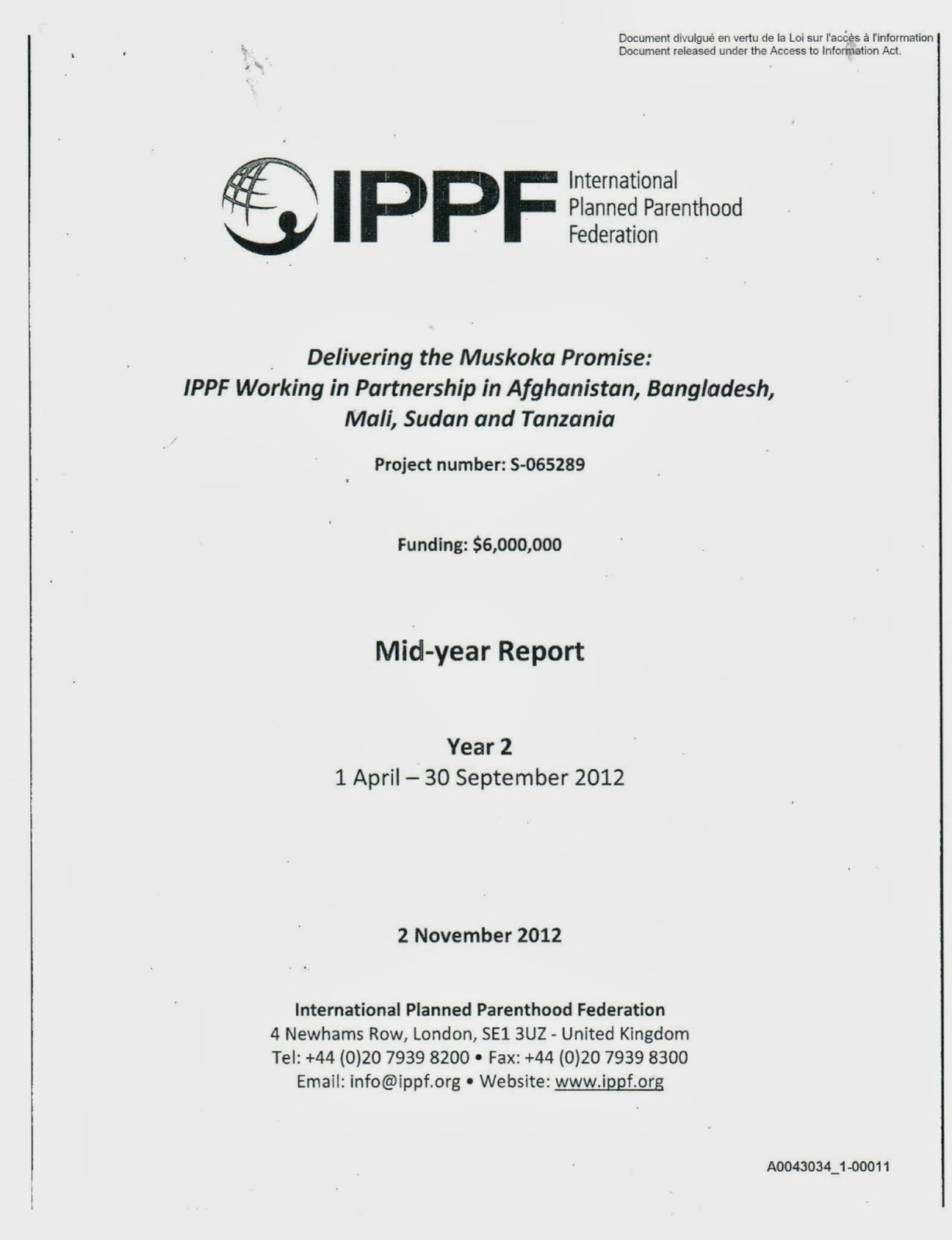
I received back an Annual progress report for Year 1 of the project (27 January - 31 March 2012), and a mid-year report for Year 2 (1 April - 30 September 2012), as well as some email correspondence from CIDA to IPPF.

I will comment on these two items in upcoming blog entries.

But there was one thing that stuck out to me on the package that I received. It was this sentence:

"Through partnership and collaboration, UMATI (an IPPF partner in Tanzania) secured support for contraceptives being injectables, Jadelle, IUD and oral contraceptives."

So what is Jadelle? It is a contraceptive implant also known as Norplant. And there's been a major lawsuit against the drug and it isn't available anymore in the United States:

"After 17 years of litigation, Pfizer has reached a preliminary agreement to settle a Norplant contraceptive class action lawsuit for $29.5 million, according to Mealey's Drugs & Devices Report. The lawsuit, which was scheduled to go to trial in Louisiana, was brought by 3,500 to 4,000 women

The move comes a decade after Wyeth, which is now owned by Pfizer, halted sales of the controversial implant, which was hailed as a breakthrough in 1991. Norplant consisted of silicone rods that contained hormones, six of which were implanted beneath the skin of the upper arm for up to five years to prevent pregnancy.

A few years later, however, tens of thousands of women had filed lawsuits claiming Wyeth failed to adequately warn about irregular menstrual bleeding, nausea, headaches and depression. By 1999, Wyeth paid $54 million to settle with 36 women. The Louisiana lawsuits alleged Norplant released too much active ingredient during the first 18 months after insertion, which made the device defective.

In 2002, a federal court dismissed most of the remaining lawsuits for lack of evidence, although the Louisiana lawsuits lingered. For its part, Pfizer denied the allegations and agreed to settle in order "to put to rest all controversy" and avoid the further expense of going to court, a spokesman tells Mealey's."

Jadelle or Norplant is not available in Canada.

One blogger said this about Jadelle/Norplant:

"A woman on birth control can stop taking her pills. A woman on depo-provera can stop taking her injections. But Jadelle, like its predecessor, is impossible to remove short of surgery. A woman who has been chemically sterilized by Jadelle will stay sterilized—for five long years."

So a drug that's too harmful for Canadian women to use, that was the subject of a major lawsuit, that keeps women sterilized for five years, is apparently just fine to implant in women in third world countries.

Just in case you wanted to know what the government is doing with your tax dollars.

(I've updated this entry with the cover page of the Mid-Year report. Below that, is the page that identifies the use of Jadelle: "Through partnership and collaboration, UMATI secured support for contraceptives being injectables, Jadelle, IUD and oral contraceptives. Most of these commodities were obtained from local government and Pupulation Services International.")