Showing posts with label Department of Foreign Affairs Trade and Development. Show all posts

Monday, February 16, 2015

IPPF and Depo-Provera: what about informed consent?

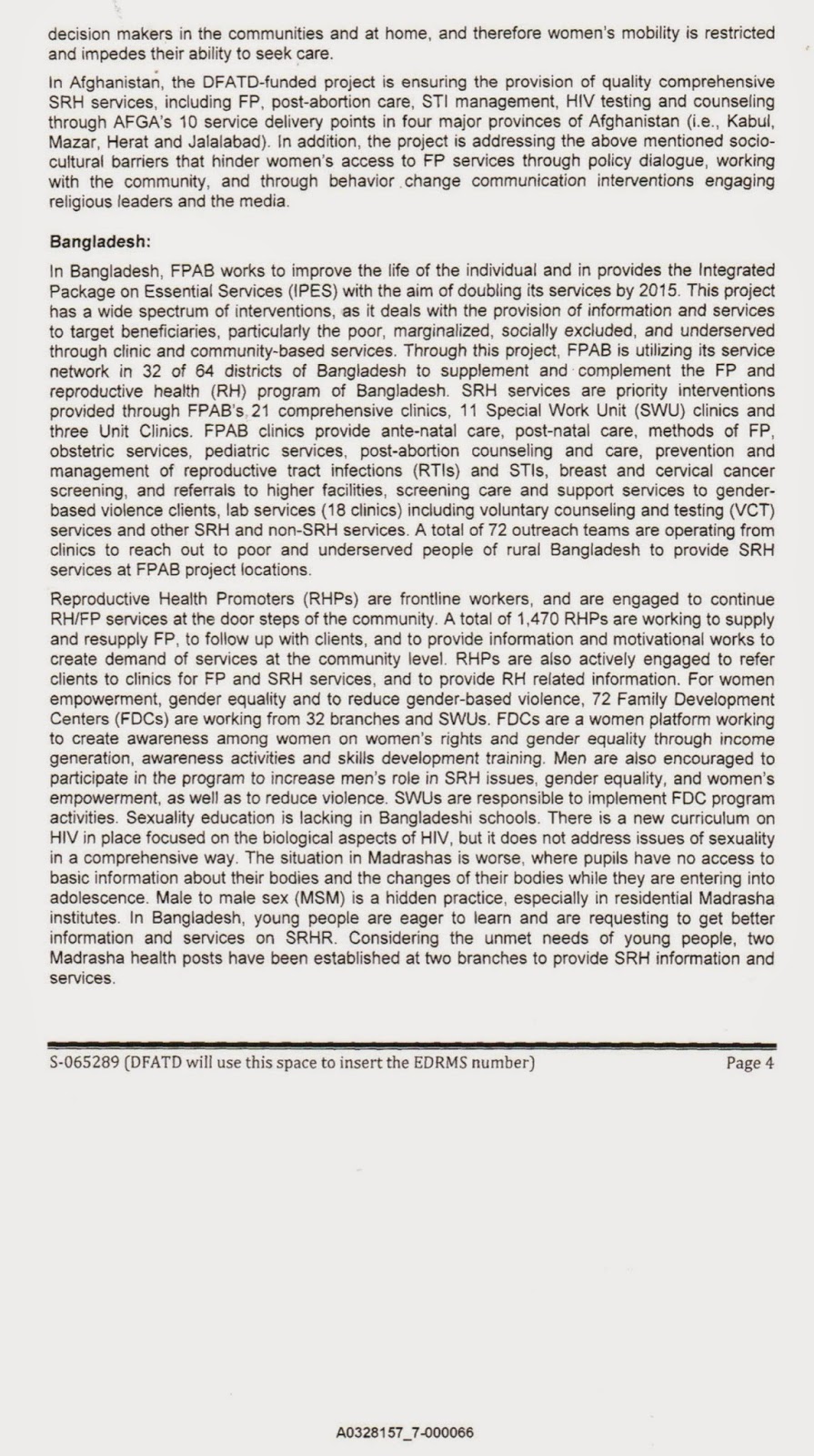
When we inject harmful drugs into the arms of poor women in Afghanistan, Bangladesh, Mali, Sudan, and Tanzania, do we tell them of the drug's serious side effects?

I'm talking about the contraceptive Depo-Provera. (revealed through an access to information request to DFATD on the $6 million funding to IPPF for the Maternal, Newborn, and Child Health initiative)

IPPF (through DFATD) purchased 18,000 units of this drug in one year (2013-2014), and injected over a half million shots of it into these women since 2012. (1)

So what are the drug's side effects?

Depo-Provera doubles the risk of breast cancer in women (2), causes severe bone loss forcing Pfizer to put a black box warning (3) on the drug. The drug also has horrible side effects for women coming off the drug, as reported by women themselves. (4)

Are we telling them of these risks? What about informed consent (5)? Laura Shea of the Women's Health Network wrote a 22 page paper on this drug. She discusses Bone Density loss, and the other side effects. She also comments on its use in developing countries.
"Many women’s groups have opposed the use of injectable contraceptives like Depo Provera in developing countries because Depo Provera poses particular health concerns for poor women, who may have low bone density due to poor nutritional status. These women are already vulnerable because access to local health care facilities is often inadequate or non-existent, and the right to informed consent is often overlooked..."
And just last month we learned that Depo-Provera is linked to a 40% higher risk of HIV.

So what is Canada doing about this? We team up with the Bill and Melinda Gates Foundation, who also provides Depo-Provera to poor countries. (7)

One of the mantras repeated over and over again throughout the hundreds of pages of documentation I've received from DFATD on the IPPF funding, is how IPPF is helping "remote, under-served, poor, and vulnerable populations" in these countries.

Really?

Does IPPF inform these women of the very serious side effects of these drugs? Do they explain the risks in the women's own language? Do these women benefit in any way from informed consent?

I couldn't find any references in the mountain of documentation I received, that referred to informed consent in any way. Yet IPPF tells us they are helping "remote, under-served, poor, and vulnerable populations". With Canadian money.

(1)  

(2) A study of Depo-Provera
"found that for women between 20 to 44 Years of Age, continued use for 12 months or longer was associated with a 2.2-fold [95% confidence interval (CI), 1.2–4.2] increased risk of invasive breast cancer."
"Women who use Depo-Provera Contraceptive Injection may lose significant bone mineral density. Bone loss is greater with increasing duration of use and may not be completely reversible. It is unknown if use of Depo-Provera Contraceptive Injection during adolescence or early adulthood, a critical period of bone accretion, will reduce peak bone mass and increase the risk of osteoporotic fracture in later life. Depo-Provera Contraceptive Injection should be used as a long-term birth control method (eg, longer than 2 years) only if other birth control methods are inadequate (see WARNINGS)."


Side effects as reported by women themselves (682 comments)

Adolescents and Young Women? (From a paper written by Laura Wershler for Canadian Woman Studies in 2005)
"One acknowledged outcome of Depo-Provera use is the time delay (three to 18 months or longer) after the last shot for a full return to fertility. This recovery time can be, for some women, fraught with distressing health problems for which no apparent treatment protocol exists. Weight gain is extremely common and more extreme in teenagers than adult women. Many women discontinue the drug for this reason. The depressive effects of DepoProvera are well known. Severe depression, anxiety, and paranoia have all been reported. Some women experience symptoms while on it, others experience depression after stopping the drug. Hot flashes, vaginal dryness, and other menopausal symptoms experienced by some women are directly due to the "bottomed-out levels of estrogen and testosterone" (Rako 1 10) that are also responsible for loss of bone density. Loss of desire for sex and loss of sexual sensitivity are also subsequent to hormonal depletion. Herein lays the irony of DepoProvera use by young women. The drug induces the hormonal profile of a menopausal woman and with it the potential to experience the full constellation of symptoms (once thought to be all in women's heads) that can so diminish the quality of life for women in mid-life and beyond. As a contraceptive choice for teenagers and young women, DepoProvera provides them the opportunity to experience loss of libido, vaginal dryness, unmanageable weight gain, depression, bone loss and other unpleasant outcomes in exchange for pregnancy prevention. These negative side-effects cause many women to stop using the drug, but others tolerate them, often not aware their symptoms are related to their choice of contraceptive. The other irony? Women who tolerate Depo-Provera best are most likely to take it long-term and, therefore, are most at risk for significant and potentially irreversible bone loss... "

(5) Reflections on Depo Provera: Contributions to Improving Drug Regulation in Canada 
"International use as a population control measure 
Historically, family planning programmes typically limited contraceptive choice to those methods that resulted in either: 1) permanent sterilization, or; 2) temporary sterilization as in the case of Depo Provera. Even before its approval as a contraceptive, Depo Provera was promoted by family planning programmes and population control agencies, predominantly in the so-called “developing” countries, because it was identified as a highly effective, provider-controlled technology that promised to drive down birth rates among poor women. Many women’s groups have opposed the use of injectable contraceptives like Depo Provera in developing countries because Depo Provera poses particular health concerns for poor women, who may have low bone density due to poor nutritional status. These women are already vulnerable because access to local health care facilities is often inadequate or non-existent, and the right to informed consent is often overlooked..." (emphasis mine)
(6) Depo-Provera Linked to Higher HIV Risk Researchers Find 
"Depo-Provera is associated with an increased risk of HIV infection in women, according to a review of research in Africa.
Women who receive the so-called “birth control shot” have about 40 percent higher odds of becoming infected with HIV, compared to women using some other form of birth control or no birth control at all, researchers reported."
(7) The Globe speaks to Stephen Harper and Melinda Gates about maternal and child health
"...And Mr. Harper, do you see that the same way, that reproductive health needs to be a part of the initiative? 
[Stephen Harper] Yes, there’s actually a myth that we don’t fund any family planning or maternal health. That’s not true. We do. We, specifically as a result of a vote in Parliament do not fund abortion services but we fund other forms. And yes, I do happen to believe that’s an essential part of the continuum."

Friday, December 12, 2014

IPPF: 45 million services, but no abortion?

You may recall that the $6 million funding Canada gave to IPPF through DFATD for Afghanistan, Bangladesh, Mali, Sudan and Tanzania, was not to go for abortion services.

In fact, in the ATIP document I received from DFATD, there are multiple assurances from IPPF that the money is not being used for abortion services.Yet all we really have is IPPF's word for it.

Below I have summarized all the services provided by IPPF in fiscal year 2013/2014.

As you can see, that's a lot of services, yet many are not at all well defined.

So I asked for some clarifications on some of these services.

For item 1128 (Provide other SRH medical services) which had 1,798,317 services, I asked for a further breakdown of what these services were.

DFATD response:
"Consultation - Bangladesh, Mali
Diagnostic tests - Bangladesh, Mali,Tanzania
Therapy/treatment - Bangladesh, Afghanistan
Surgery - Bangladesh, Tanzania
Other - Bangladesh, Tanzania, Sudan"
As you can see these breakdowns still don't tell us what kinds of services IPPF is providing. So I asked for an additional clarification.

DFATD response:
"IPPF does not have additional description for these services, but it should be noted that these services do not relate to HIV, STI, abortion, gynaecology, obstetrics, etc."
So IPPF has no idea what exactly, these almost 2 million services include--yet we are simply expected to take IPPF's word for it that they don't include abortion?

Then for item 1211 (Other family planning services for young people), of which there were 4,860,975 services, I asked for a description of each of these "family planning services" and their breakdown by numbers, for each different category of service.

DFATD response:
"All family planning services are provided to young people. Essentially the same methods as the other FP indicators, for clients under 25. No information about how DFATD funding relates to this."
I then asked DFATD, if IPPF is saying that they do not know how much DFATD money goes to giving FP services to young people?

DFATD's response:
"IPPF does not price consultations or staff member’s time - by either age group or service category, therefore they cannot earmark a specific amount for what was spent on youth family planning services. IPPF estimates the cash value based on salaries and clinic space as they are the two key drivers of price."
So IPPF provided almost 5 million services to young people, with no further breakdown. Again we just have to take IPPF's word for it. And what is the ages of these young people?

DFATD's response:
"Member Associations (IPPF's local partners) abide by the legal limits in the country it operates."
And what are the legal age limits in these countries? I'm waiting for an answer to that.

But there in a nutshell, is the real problem with all this. The Canadian people give their tax dollars to DFATD. DFATD then gives that money to IPPF. IPPF then gives that money to its "member associations" to provide in most cases--undefined services.

If IPPF can't break down these services any further (and they can't), then how do they know the member associations are not using the money for abortion? Do we just have to take their word for it? Apparently.


Tuesday, October 7, 2014

Government of Bangladesh dismisses board of FPAB

Two more interesting things from my recent ATIP to DFATD and the $6 million grant to IPPF.

1) FPAB is the Family Planning Association of Bangladesh. In other words, FPAB is IPPF's member association in that country

Apparently the entire FPAB board was dismissed by the Bangladesh government.

DFATD refers to page 5 of the semi-annual report (ATIP page 67), which I also had from my last ATIP. (See ATIP page 119 below).

This is what DFATD asked in their question to IPPF:
"Could you provide some information about why the Government of Bangladesh dismissed FPAB's Board in August? Also, I don't know if you informed DFATD about this when it happened. However, this is the sort of thing we should know about when it happens, so that we are able to respond to any questions that may arise."

I looked at page 5 of the semi-annual report (from my previous ATIP) to see what IPPF reported there (see below ATIP page numbers 66 and 67. I also include page 66 for context). Well that part of the ATIP is blacked out on the semi-annual report.

So what does IPPF respond to DFATD's question? I don't know, because that paragraph is completely blanked out citing s.21(1)(b) of the Access to Information Act*. Which mean we have no idea, why the Government of Bangladesh dismissed the entire board, of an organization that operates on IPPF's behalf, using dollars from Canadian tax payers.

2) Note this question from DFATD to IPPF, and IPPF's response, also on page 119:
"DFATD: In addition, I would be curious to know how IPPF CO monitors project activities. Much of the report seems to be based on the self-reporting of the MAs. While I have no reason to doubt their reports, given the level of interest in the project, it would be helpful to learn how you track progress on the less quantitative aspects of the project. (emphasis mine)
IPPF: Regional Technical Officers are in regular communication with Member Associations (MA), and take regular visits to each MA to monitor their activities and progress. It is during these visits that the more qualitative aspects of the project are monitored and reviewed. In turn, Regional Technical Officers are also in regular contact with the Access Team in the Central Office to ensure MA. activities are in compliance with IPPF technical guidelines as well as IPPF's Strategic Framework.

"Self reporting" of member associations. I find this a bit worrisome. Especially when the entire board of one of those organizations has been dismissed and we don't know why.


* s.21(1)(b) The head of a government institution may refuse to disclose any record requested under this Act that contains...an account of consultations or deliberations in which directors, officers or employees of a government institution, a minister of the Crown or the staff of a minister participate

Tuesday, September 23, 2014

DFATD and IPPF - purchased and provided are different

More on my DFATD ATIP for the $6 million funding to International Planned Parenthood.

Suzanne asked who is using all this contraception, and wondered about the 15000 IUDs? So I decided to review the numbers to find out.

Below are the list of "Commodities and Clinical Consumables" (purchases) and the "Data Table" report (provided). Both reports are for the year 1 April 2013 to 31 March 2014. The numbers are different.

This is what was purchased:
IUDs listed under "Commodities and Clinical Consumables":
Afghanistan: 15,000
Bangladesh: 0
Mali: 2,500
Sudan: 0
Tanzania: 0
Total: 17,250

And this is what was provided:
IUDs listed under "Data Table":
Afghanistan: 11,299
Bangladesh: 4,221
Mali: 1,366
Sudan: 1,104
Tanzania: 1,671
Total: 19,661

----------------
This is what was purchased:
Condoms listed under "Commodities and Clinical Consumables":
Afghanistan: 290,000
Bangladesh: 0
Mali: 1,132,587
Sudan: 0
Tanzania: 0
Total: 1,447,787

And this is what was provided:
Condoms listed under "Data Table":
Afghanistan: 22,370
Bangladesh: 530,452
Mali: 224,588
Sudan: 1,653
Tanzania: 92,007
Total: 871,070 (the total on the Data Table report actually says 868,241)


These two tables are the "Data Tables" from the report


Monday, September 22, 2014

DFATD and IPPF - check your numbers

More on my DFATD ATIP for the $6 million funding to International Planned Parenthood.

I received a list of commodities and clinical consumables for the period 1 April 2013 - March 2014 (12 month period), which included contraception, injectables, condoms, spermicides etc. I also received the same information for the previous semi-annual report for April -September 2013 (a six month period).

I decided to compare the two reports to see how the numbers had increased, since the first was for a full year and the latter for only six months. When I looked a bit closer at the two reports, I noticed something. The numbers on both reports for Afghanistan and Sudan were identical (below I reproduce the first page of Afghanistan's).

No commodities were purchased between October 2013 and March 2014 (since the numbers are identical). Maybe all items were purchased at the beginning of the year? I don't know.

In any event, how many contraceptives and emergency contraceptives are we buying in Afghanistan anyway? See charts below.

(NOTE: Postinor-2 is emergency contraception. EC is considered an abortifacient if the egg has already been fertilized (i.e it prevents implantation in the uterus, killing the embryo). Abortion is illegal in Afghanistan.)


DFATD and IPPF - 45,118 people not sterilized in Tanzania

I've finally received the results of my most recent ATIP to DFATD regarding the $6 million funding to International Planned Parenthood. 

This one asked for information since my last ATIP, in particular, for IPPF's Annual Report for 1 April 2013 - March 2014.

I have learned a couple of interesting things this time, and will post them over the next little while.

The first thing I learned is that the people of Tanzania may not be as enthralled with being sterilized as IPPF would like them to be.

On page 143 of the ATIP, from the Annual Report, on line item 1121 Provide sterilization services in Afghanistan, Bangladesh, Mali, Sudan and Tanzania note this:

The target sterilizations for the year is 63,455 sterilizations, but the actual is only 18,337 sterilizations. That's 45,118 people under target.

Under the comments section is this:
"The overall shortfall is almost entirely due to Tanzania. It has not been possible to ascertain why."

Could it be that the people of Tanzania don't want to be sterilized? Maybe they don't like having IPPF suggesting they should be sterilized. 


Saturday, May 31, 2014

Canada pays for emergency contraception and abortion care in Afghanistan

Elizabeth Payne reported in today's Ottawa Citizen on my posting that revealed that CIDA/DFATD is funding emergency contraception in Afghanistan through IPPF.

What she didn't say, is that my ATIP also revealed that we are funding "safe abortion care".

The first thing that's worrisome about the Citizen article, is that NDP international development critic  Hélène Laverdière thinks that the emergency contraception used (Postinor-2) is not abortion.
“It’s not abortion, it is contraception". 
In fact the information provided by the manufacturer says that:
"Postinor-2 is not intended as a regular method of contraception." 
That's because, emergency contraception is an abortifacient if the egg has already been fertilized (i.e it prevents implantation in the uterus, killing the embryo). Wishful thinking, doesn't make it true.

Then Ms. Laverdière says:
"I don’t see why if it is a choice for Canadian women, it cannot be a choice offered to Afghan women.”
Now this is really out there. Shouldn't Ms. Laverdière, in her role as international development critic, know that abortion (including emergency contraception) is illegal in Afghanistan?

As I noted in that blog posting, the Population Research Institute says that:
"The current Afghanistan abortion law mandates a seven-year prison term and a monetary fine for each abortion performed. The only exception requires the written opinion of physicians, and a judicial review. According to strict and clear guidelines promulgated by the Ministry of Justice, this same law would apply to anyone who has prescribed “morning-after pills” or “emergency contraception” in Afghanistan, or even to anyone carrying these devices in the country."
And finally this from DFATD in the Citizen article:
"Foreign Affairs spokeswoman Amy Mills, quoting the World Health Organization. “WHO confirms that: ‘Levonorgestrel emergency contraceptive pills are not effective once the process of implantation has begun, and they will not cause abortion,’ ” she wrote in an email, adding, “DFATD funds are not used to fund abortion.”
I beg to differ. Canada is funding emergency contraception and abortion care in Afghanistan.

Abortion by any other name...

Sunday, May 4, 2014

MP questions CIDA due diligence insuring IPPF isn't funding abortions

We now have more cause for concern regarding CIDA/DFATD's $6 million funding of IPPF.

In an ATIP to DFATD I asked for correspondence regarding the Muskoka initiative on maternal and child health.to the PMO and CIDA.

This yielded a few letters, but one in particular was noteworthy.

On October 27, 2011, in a very detailed letter from MP Maurice Vellacott to Stephen Harper, Mr. Vellacott voices his concerns to the Prime Minister by asking seven questions about the $6 million funding IPPF received as part of the Muskoka initiative. (see below for Mr. Vellacott's letter and the responses from Mr. Harper and Ms. Oda).

In a nutshell, Mr. Vellacott's questions what due diligence is in place to ensure the funding would not go to pay for any abortion services, as was stipulated by the contribution agreement between CIDA and IPPF. All pertinent questions I thought, some of which I've also asked myself to CIDA/DFATD. (For all my links to the CIDA/IPPF funding see this page.)

The Prime Minister doesn't answer any of Mr. Vellacott's questions. Not one. And then the PM simply forwards Mr. Vellacott's letter on, to then Minister Bev Oda, who also doesn't answer any of his questions. Not one. In fact Ms. Oda's reply is obviously a form letter, since it is exactly the same as all of her responses to the other letters in the package.

So why were Mr. Vellacott's questions never answered?


Tuesday, April 15, 2014

IMPLANON in Sudan: tip of the iceberg?

My latest ATIP to CIDA/DFATD reveals that the contraceptive IMPLANON is being purchased and administered in Sudan by IPPF.

I thought I'd have a look at the risks and other issues associated with the implant.

They are all listed below. I thought I'd just point out a few of them from the Merck publication of the FDA-Approved Patient Labeling:
"It is not known if IMPLANON is as effective in very overweight women because studies did not include many overweight women."

Are overweight women in Sudan told this?
"Serious Blood Clots: IMPLANON may increase your chance of serious blood clots, especially if you have other risk factors such as smoking. It is possible to die from a problem caused by a blood clot, such as a heart attack or a stroke."

Are women in Sudan told about this, and other serious risks?
"Breast Cancer: It is not known whether IMPLANON use changes a woman’s risk for breast cancer."

They don't know the risk of breast cancer? Then why is IMPLANON being used at all?
"This is not a complete list of possible side effects." 

You mean there's more side effects? What are they?

And the document is replete with advice to call your health care provider for more information? Would that be IPPF? Does IPPF have doctors to answer these women's questions?

Finally, is the 11 page list of risks, interactions with other medications, side effects, etopic pregnancy risks, etc.--explained fully to the woman? Is she given a copy of this brochure in her own language? Can she even read it? (literacy rate in Sudan is 27%) What about informed consent?

Lots of questions. Not many answers. This is poor women's lives we are risking with Canadian money. Is that what being a Canadian is all about?

And I haven't even talked about the other drugs we are buying for the five countries (Afghanistan, Mali, Tanzania, Bangladash and Sudan).
-----------------------------------------------------------------------------------------------------------

(IMPLANON from the manufacturer MERCK)

FDA-Approved Patient Labeling
IMPLANON® (etonogestrel implant)
Subdermal Use

IMPLANON® does not protect against HIV infection (the virus that causes AIDS) or other
sexually transmitted diseases. Read this Patient Information leaflet carefully before you
decide if IMPLANON is right for you. This information does not take the place of talking with
your healthcare provider. If you have any questions about IMPLANON, ask your healthcare
provider.

What is IMPLANON?
IMPLANON is a hormone-releasing birth control implant for use by women to prevent pregnancy
for up to 3 years. The implant is a flexible plastic rod about the size of a matchstick that contains
a progestin hormone called etonogestrel. Your healthcare provider will insert the implant just
under the skin of the inner side of your upper arm. You can use a single IMPLANON implant for
up to 3 years. IMPLANON does not contain estrogen.

What if I need birth control for more than 3 years?
The IMPLANON implant must be removed after 3 years. Your healthcare provider can insert a
new implant under your skin after taking out the old one if you choose to continue using
IMPLANON for birth control.

What if I change my mind about birth control and want to stop using IMPLANON before 3
years?
Your healthcare provider can remove the implant at any time. You may become pregnant as
early as the first week after removal of the implant. If you do not want to get pregnant after your
healthcare provider removes the IMPLANON implant, you should start another birth control
method right away.

How does IMPLANON work?
IMPLANON prevents pregnancy in several ways. The most important way is by stopping the
release of an egg from your ovary. IMPLANON also thickens the mucus in your cervix and this
change may keep sperm from reaching the egg. IMPLANON also changes the lining of your
uterus.

How well does IMPLANON work?
When the IMPLANON implant is placed correctly, your chance of getting pregnant is very low
(less than 1 pregnancy per 100 women who use IMPLANON for 1 year). It is not known if
IMPLANON is as effective in very overweight women because studies did not include many
overweight women.

Who should not use IMPLANON?
Do not use IMPLANON if you
• Are pregnant or think you may be pregnant
• Have, or have had serious blood clots, such as blood clots in your legs (deep venous
thrombosis), lungs (pulmonary embolism), eyes (total or partial blindness), heart (heart
attack), or brain (stroke)
• Have liver disease or a liver tumor
• Have unexplained vaginal bleeding
• Have breast cancer or any other cancer that is sensitive to progestin (a female
hormone), now or in the past
• Are allergic to anything in IMPLANON

Tell your healthcare provider if you have or have had any of the conditions listed above. Your
healthcare provider can suggest a different method of birth control.

In addition, talk to your healthcare provider about using IMPLANON if you:
• Have diabetes
• Have high cholesterol or triglycerides
• Have headaches
• Have gallbladder or kidney problems
• Have a history of depressed mood
• Have high blood pressure
• Have an allergy to numbing medicines (anesthetics) or medicines used to clean your
skin (antiseptics). These medicines will be used when the implant is placed into or
removed from your arm.

Interaction with Other Medicines
Tell your healthcare provider about all the medicines you take, including prescription and non-prescription medicines, vitamins and herbal supplements. Certain medicines may make
IMPLANON less effective, including:
• barbiturates
• bosentan
• carbamazepine
• felbamate
• griseofulvin
• oxcarbazepine
• phenytoin
• rifampin
• St. John's wort
• topiramate
• HIV medicines

Ask your healthcare provider if you are not sure if your medicine is one listed above.

If there are medicines that you have been taking for a long time, that make IMPLANON less
effective, tell your healthcare provider. Your healthcare provider may remove the IMPLANON
implant and recommend a birth control method that can be used effectively with these
medicines.

When you are using IMPLANON, tell all of your healthcare providers that you have IMPLANON
in place in your arm.

How is the IMPLANON implant placed and removed?
Your healthcare provider will place and remove the IMPLANON implant in a minor surgical
procedure in his or her office. The implant is placed just under the skin on the inner side of your
upper arm.

The timing of insertion is important. Your healthcare provider may:
• Perform a pregnancy test before inserting IMPLANON
• Schedule the insertion at a specific time of your menstrual cycle (for example, within the
first days of your regular menstrual bleeding)

Immediately after the IMPLANON implant has been placed, you and your healthcare
provider should check that the implant is in your arm by feeling for it.

If you and your healthcare provider cannot feel the IMPLANON implant, use a nonhormonal
birth control method (such as condoms) until your healthcare provider
confirms that the implant is in place. You may need special tests to check that the implant is
in place or to help find the implant when it is time to take it out.

Your healthcare provider will cover the site where IMPLANON was placed with 2 bandages.
Leave the top bandage on for 24 hours. Keep the smaller bandage clean, dry, and in place for 3
to 5 days.

You will be asked to review and sign a consent form prior to inserting the IMPLANON implant.
You will also get a USER CARD to keep at home with your health records. Your healthcare
provider will fill out the USER CARD with the date the implant was inserted and the date the
implant is to be removed. Keep track of the date the implant is to be removed. Schedule an
appointment with your healthcare provider to remove the implant on or before the removal date.

Be sure to have checkups as advised by your healthcare provider.

What are the most common side effects I can expect while using IMPLANON?
Changes in Menstrual Bleeding Patterns (menstrual periods)
The most common side effect of IMPLANON is a change in your normal menstrual bleeding
pattern. In studies, about one out of ten women stopped using the implant because of an
unfavorable change in their bleeding pattern. You may experience longer or shorter bleeding
during your periods or have no bleeding at all. The time between periods may vary, and in
between periods you may also have spotting.

Talk with your healthcare provider right away if:
• You think you may be pregnant
• Your menstrual bleeding is heavy and prolonged

Besides changes in menstrual bleeding patterns, other frequent side effects that caused women
to stop using the implant include:
• Mood swings
• Weight gain
• Headache
• Acne
• Depressed mood

Other common side effects include:
• Headache
• Vaginitis (inflammation of the vagina)
• Weight gain
• Acne
• Breast pain
• Viral infections such as sore throats or flu-like symptoms
• Stomach pain
• Painful periods
• Mood swings, nervousness, or depressed mood
• Back pain
• Nausea
• Dizziness
• Pain
• Pain at the site of insertion

This is not a complete list of possible side effects. For more information, ask your healthcare
provider for advice about any side effects that concern you. You may report side effects to the
FDA at 1-800-FDA-1088.

What are the possible risks of using IMPLANON?
Problems with Insertion and Removal

The implant may not be placed in your arm at all due to a failed insertion or if the implant
has fallen out of the needle. If this happens, you may become pregnant. Immediately
after insertion, and with help from your healthcare provider, you should be able to feel
the implant under your skin. If you can’t feel the implant, tell your healthcare provider.

Removal of the implant may be very difficult or impossible because the implant is not
where it should be. Special procedures, including surgery in the hospital, may be needed
to remove the implant. If the implant is not removed, then the effects of IMPLANON will
continue for a longer period of time.

Other problems related to insertion and removal are:
• Pain, irritation, swelling, or bruising at the insertion site
• Scarring, including a thick scar called a keloid around the insertion site
• Infection
• Scar tissue may form around the implant making it difficult to remove
• The implant may come out by itself. You may become pregnant if the implant
comes out by itself. Use a back up birth control method and call your healthcare
provider right away if the implant comes out.
• The need for surgery in the hospital to remove the implant
• Injury to nerves or blood vessels in your arm
• The implant breaks making removal difficult

Ectopic Pregnancy
If you become pregnant while using IMPLANON, you have a slightly higher chance that
the pregnancy will be ectopic (occurring outside the womb) than do women who do not
use birth control. Unusual vaginal bleeding or lower stomach (abdominal) pain may be a
sign of ectopic pregnancy. Ectopic pregnancy is a medical emergency that often requires
surgery. Ectopic pregnancies can cause serious internal bleeding, infertility, and even
death. Call your healthcare provider right away if you think you are pregnant or have
unexplained lower stomach (abdominal) pain.

Ovarian Cysts
Cysts may develop on the ovaries and usually go away without treatment but sometimes
surgery is needed to remove them.

Breast Cancer
It is not known whether IMPLANON use changes a woman’s risk for breast cancer. If you
have breast cancer now, or have had it in the past, do not use IMPLANON because
some breast cancers are sensitive to hormones.

Serious Blood Clots
IMPLANON may increase your chance of serious blood clots, especially if you have
other risk factors such as smoking. It is possible to die from a problem caused by a blood
clot, such as a heart attack or a stroke.

Some examples of serious blood clots are blood clots in the:
• Legs (deep vein thrombosis)
• Lung (pulmonary embolism)
• Brain (stroke)
• Heart (heart attack)
• Eyes (total or partial blindness)

The risk of serious blood clots is increased in women who smoke. If you smoke and want
to use IMPLANON, you should quit. Your healthcare provider may be able to help.
Tell your healthcare provider at least 4 weeks before if you are going to have surgery or
will need to be on bed rest. You have an increased chance of getting blood clots during
surgery or bed rest.

Other Risks
A few women who use birth control that contains hormones may get:
• High blood pressure
• Gallbladder problems
• Rare cancerous or noncancerous liver tumors

Broken or Bent Implant
If the implant breaks or bends while in your arm, how the implant works should not be
affected. If you have questions contact your healthcare provider.

When should I call my healthcare provider?
Call your healthcare provider right away if you have:
• Pain in your lower leg that does not go away
• Severe chest pain or heaviness in the chest
• Sudden shortness of breath, sharp chest pain, or coughing blood
• Symptoms of a severe allergic reaction, such as swollen face, tongue or pharynx;
trouble swallowing; or hives and trouble breathing
• Sudden severe headache unlike your usual headaches
• Weakness or numbness in your arm, leg, or trouble speaking
• Sudden partial or complete blindness
• Yellowing of your skin or whites of your eyes, especially with fever, tiredness, loss of
appetite, dark colored urine, or light colored bowel movements
• Severe pain, swelling, or tenderness in the lower stomach (abdomen)
• Lump in your breast
• Problems sleeping, lack of energy, tiredness, or you feel very sad
• Heavy menstrual bleeding

What if I become pregnant while using IMPLANON?
You should see your healthcare provider right away if you think that you may be pregnant. It is
important to remove the implant and make sure that the pregnancy is not ectopic (occurring
outside the womb). Based on experience with other hormonal contraceptives, IMPLANON is not
likely to cause birth defects.

Can I use IMPLANON when I am breastfeeding?
If you are breastfeeding your child, you may use IMPLANON if 4 weeks have passed since you
had your baby. A small amount of the hormone contained in IMPLANON passes into your
breast milk. The health of breast-fed children whose mothers were using the implant has been
studied up to 3 years of age in a small number of children. No effects on the growth and
development of the children were seen. If you are breastfeeding and want to use IMPLANON,
talk with your healthcare provider for more information.

Thursday, April 10, 2014

PMO: Engaging citizens fosters trust

When Stephen Harper told us that Canada will host a summit on saving the lives of vulnerable women and children, I thought, good idea.

What would the obvious next question be that immediately springs to mind: Who will be attending the summit?

In other words, who are the "Canadian stakeholders, experts" and "global leaders from developed and developing countries, international organizations, civil society, the private sector, and foundations to take stock of the progress made to date and discuss the way forward" mentioned in the press release?

So I asked the Prime Minister's office this question. And in the interest of transparency--as I assume the summit will be funded by taxpayers--I thought I'd get some kind of substantive answer from the PMO.

What I was told was that:
"The list of participants of the summit will be made available in due course—all of the latest information will be updated immediately to www.pm.gc.ca  where you can access it."
Which prompted me to ask two more questions:

1) I'd also like to obtain information on the process that is being used for selecting invitees. How is that being accomplished? And what is the criteria for choosing an organization?

2) Also, what if I'd like to submit a name of an organization to be included in the summit? How can I go about doing that?

After a couple of more emails and phone calls to the PMO, I finally received my response from Carl Vallée. Short and sweet:
"We don't discuss internal process."
Don't we, as Canadian Citizens have a right to know who is being invited to discuss something as important as this summit obviously will be? After all, it is our money that will be funding the summit itself, never mind the actual aid to this initiative: a total of $7.3 billion from G8 and non-G8 countries, which includes Canada.

I think my questions are completely fair and reasonable and deserve an answer. In fact why would the PMO even tell us about this initiative, if they have no intention of answering questions about it, or giving us any additional information?

What about openness and transparency?