Showing posts with label Tanzania. Show all posts

Monday, September 22, 2014

DFATD and IPPF - 45,118 people not sterilized in Tanzania

I've finally received the results of my most recent ATIP to DFATD regarding the $6 million funding to International Planned Parenthood. 

This one asked for information since my last ATIP, in particular, for IPPF's Annual Report for 1 April 2013 - March 2014.

I have learned a couple of interesting things this time, and will post them over the next little while.

The first thing I learned is that the people of Tanzania may not be as enthralled with being sterilized as IPPF would like them to be.

On page 143 of the ATIP, from the Annual Report, on line item 1121 Provide sterilization services in Afghanistan, Bangladesh, Mali, Sudan and Tanzania note this:

The target sterilizations for the year is 63,455 sterilizations, but the actual is only 18,337 sterilizations. That's 45,118 people under target.

Under the comments section is this:
"The overall shortfall is almost entirely due to Tanzania. It has not been possible to ascertain why."

Could it be that the people of Tanzania don't want to be sterilized? Maybe they don't like having IPPF suggesting they should be sterilized. 


Sunday, March 30, 2014

Jadelle not purchased for Tanzania - instead purchased for Mali

Remember Jadelle? Well it's back.

I recently received more information from CIDA/DFATD about the $6 million funding to IPPF.

In my current ATIP, it looks like my writing about Jadelle before (see page 181 below) triggered some questions from DFATD to IPPF, about Jadelle.

DFATD asked IPPF:
"Could you please provide us with more information on the contraceptives that your Tanzanian member uses as part of the project we fund?
The response (in part) from IPPF was that:
1. IPPF has not purchased Jadelle and distributed it to Tanzania
2. UMATI has not purchased Jadelle with Canadian funds
3. Canadian funds have not been used to ensure service providers and insert and remove Jadelle [sic] (see page 178 below)
Interesting. But what is even more interesting is that on another page located withing the semi-annual report, I discovered that Jadelle was purchased and used in Mali.

In the IPPF semi-annual report (April-September 2013) it was revealed that IPPF purchased a quantity of 4,000 Jadelle implants for Mali. On the same report, sure enough there is no Jadelle listed for Tanzania. (I'll post those pages later.)

(Update April 25, 2014, More information on this drug here
"Adverse health conditions among American women subsequent to Norplant use American women have experienced serious adverse health conditions after having Norplant inserted, including, but not limited to, increased intracranial fluid pressure (pseudo tumor cerebri), chronic blurred vision, leading to permanent vision loss or blindness, and tumors in the brain and other organs.2,3 Other conditions experienced by American women include hyper menorrhea (heavy and sustained menstrual bleeding), serious acne, sustained nausea, debilitating headaches, weakness or paralysis in one or more limbs, endometriosis, ovarian cysts, weight gains of sometimes over 100 pounds, severe mood swings and irritability. Further, many have found that having Norplant removed was a much more difficult procedure than they had been originally advised.4")


Note: On my last CIDA/DFATD ATIP, I had questioned them to find out specifically what was being funded under the "Approved Activities" (1) for the five countries Afghanistan, Mali, Tanzania, Bangladesh and Sudan. I was told that "no records related to your request exist." This time I received some of the details of that request. I'll blog more about that later.

Tuesday, December 10, 2013

CIDA does IPPF site visits in only two of five countries

It seems DFAIT's (formerly CIDA) due diligence criteria of making field visits to ensure that the $6 million funding to IPPF does not include abortion services, didn't happen in three of the five countries involved.

This latest ATIP request to DFAIT was based on an email I had received previously from a CIDA media person that stated:

"Field visits to projects and regular monitoring by CIDA field representatives also provide key information that permits CIDA to determine and assess whether the implementing organization is performing or delivering services in accordance with the terms and conditions of the funding agreement."

So I asked for:

"all information regarding these field visits to the five countries benefiting from the $6 million funding to IPPF."

This is what I received.

There were site visits to Bangladesh between February 12, 2012 and Feb 23, 2012.

And this note:

"All partners were very pleased to have a CIDA officer visit. Some have been receiving funding for several years but have never had the opportunity to welcome a CIDA officer."

Sounds like this is the first time CIDA had done any checking as to how our funds are being used in Bangladesh in several years.

We know that FPAB [IPPF's member association in Bangladesh] does menstrual regulation in Bangladesh, but supposedly no Canadian funds are being used for this. But then we read this comment in the report under their "advocacy program":

"...the management team indicated that FPAB does a lot of advocacy work. Advocacy is part of everything they do, either at the policy making level through activities targeting the MoHFW (Ministry of Health and Family Welfare) or at the district and grassroots levels, whenever there is an opportunity during formal meetings with local authorities and religious leaders at training sessions etc. They envision this staying the same over the next few years."

Would that mean then, advocacy for menstrual regulation and abortions? One would assume so, since it is a well known fact that IPPF wants to make abortion legal everywhere and never shies away from telling us so.

The "background" portion of the information does make one reference that abortion services will not be funded under the initiative.

Pages 76 and 77 identify a site visit to Tanzania, but it says virtually nothing about how the funds are used here. It does say that:

"IPPFAR [IPPF Africa Regional Office] also mobilizes resources for its MAs ([member Associations], and advocates for sexual and reproductive rights at the county, regional and international level."

There's that "advocacy" word again.

And you may be asking, what about the due diligence that our money is not being used for abortion services is Afghanistan, Mali and the Sudan? Good question. My ATIP revealed this:

"Please note, no records were found for Afghanistan, Mail or Sudan."

Apparently those field visits and regular monitoring to three of the five countries to "determine and assess whether the implementing organization is performing or delivering services in accordance with the terms and conditions of the funding agreement." never even happened.

(Note: this ATIP was for the first Annual Progress Report for the project: 27 January - 31 March 2012, and for the Mid-year Report: 1 April - 30 September 2012. There will be additional reports for each year of the funding.)

Saturday, September 14, 2013

What's not good enough for us is good enough for Tanzania

(Updated September 28, 2013)

In one of my recent ATIPs to CIDA regarding the $6 million funding to International Planned Parenthood, I wanted to know what kind of due diligence CIDA was doing to ensure that no abortion services were being provided as part of this funding.

This is what I asked for:

"Copies of all of CIDA's reporting activities, regarding the monitoring and due diligence on the ground in the five countries (Afghanistan, Bangladesh, Mali, Sudan, and Tanzania), of its project with International Planned Parenthood Federation (IPPF), where CIDA ensures compliance with the funding requirement that "Abortion services will not be funded by this program. On request abortion is illegal in the five target countries. IPPF has also indicated that menstrual regulation will not be funded under this program." I would like to see all such monitoring and due diligence reports ensuring that the funding was not used for abortion services or abortion advocacy, back to the beginning of the funding agreement which is my understanding, began in January 2012?"

I received back an Annual progress report for Year 1 of the project (27 January - 31 March 2012), and a mid-year report for Year 2 (1 April - 30 September 2012), as well as some email correspondence from CIDA to IPPF.

I will comment on these two items in upcoming blog entries.

But there was one thing that stuck out to me on the package that I received. It was this sentence:

"Through partnership and collaboration, UMATI (an IPPF partner in Tanzania) secured support for contraceptives being injectables, Jadelle, IUD and oral contraceptives."

So what is Jadelle? It is a contraceptive implant also known as Norplant. And there's been a major lawsuit against the drug and it isn't available anymore in the United States:

"After 17 years of litigation, Pfizer has reached a preliminary agreement to settle a Norplant contraceptive class action lawsuit for $29.5 million, according to Mealey's Drugs & Devices Report. The lawsuit, which was scheduled to go to trial in Louisiana, was brought by 3,500 to 4,000 women

The move comes a decade after Wyeth, which is now owned by Pfizer, halted sales of the controversial implant, which was hailed as a breakthrough in 1991. Norplant consisted of silicone rods that contained hormones, six of which were implanted beneath the skin of the upper arm for up to five years to prevent pregnancy.

A few years later, however, tens of thousands of women had filed lawsuits claiming Wyeth failed to adequately warn about irregular menstrual bleeding, nausea, headaches and depression. By 1999, Wyeth paid $54 million to settle with 36 women. The Louisiana lawsuits alleged Norplant released too much active ingredient during the first 18 months after insertion, which made the device defective.

In 2002, a federal court dismissed most of the remaining lawsuits for lack of evidence, although the Louisiana lawsuits lingered. For its part, Pfizer denied the allegations and agreed to settle in order "to put to rest all controversy" and avoid the further expense of going to court, a spokesman tells Mealey's."

Jadelle or Norplant is not available in Canada.

One blogger said this about Jadelle/Norplant:

"A woman on birth control can stop taking her pills. A woman on depo-provera can stop taking her injections. But Jadelle, like its predecessor, is impossible to remove short of surgery. A woman who has been chemically sterilized by Jadelle will stay sterilized—for five long years."

So a drug that's too harmful for Canadian women to use, that was the subject of a major lawsuit, that keeps women sterilized for five years, is apparently just fine to implant in women in third world countries.

Just in case you wanted to know what the government is doing with your tax dollars.

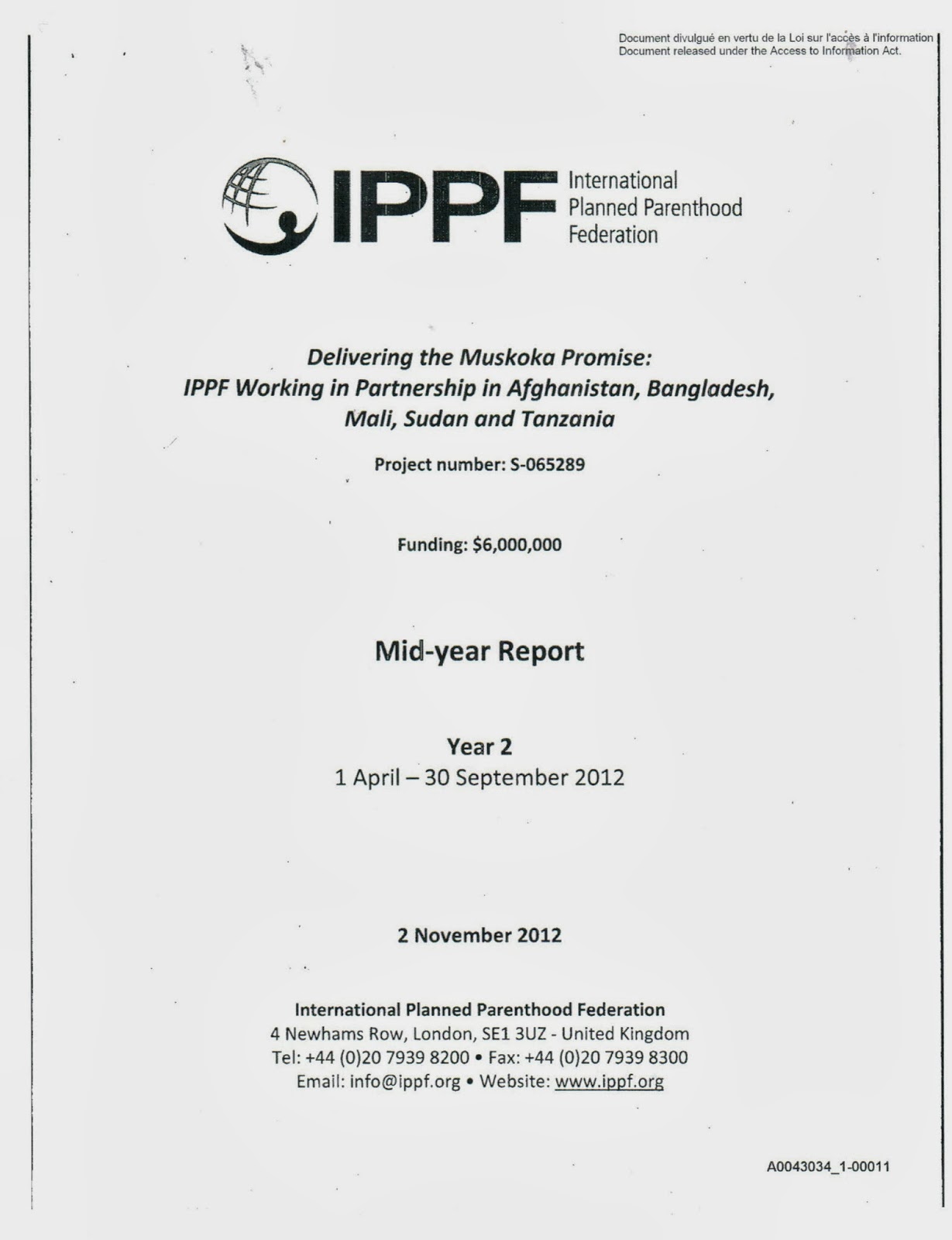
(I've updated this entry with the cover page of the Mid-Year report. Below that, is the page that identifies the use of Jadelle: "Through partnership and collaboration, UMATI secured support for contraceptives being injectables, Jadelle, IUD and oral contraceptives. Most of these commodities were obtained from local government and Pupulation Services International.")