Showing posts with label bangladesh. Show all posts

Tuesday, October 7, 2014

Government of Bangladesh dismisses board of FPAB

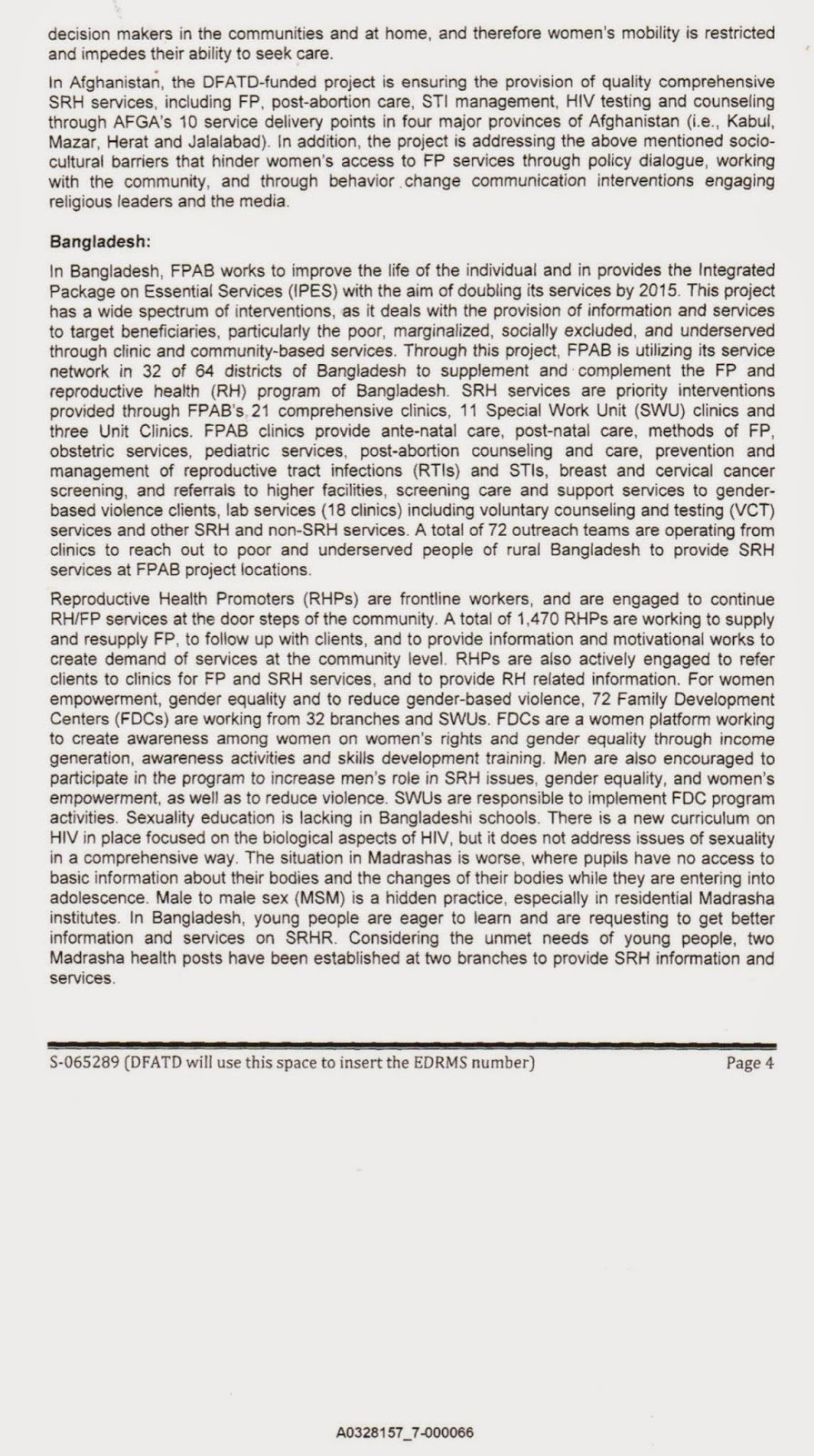
Two more interesting things from my recent ATIP to DFATD and the $6 million grant to IPPF.

1) FPAB is the Family Planning Association of Bangladesh. In other words, FPAB is IPPF's member association in that country. 

Apparently the entire FPAB board was dismissed by the Bangladesh government.

DFATD refers to page 5 of the semi-annual report (ATIP page 67), which I also had from my last ATIP. (See ATIP page 119 below).

This is what DFATD asked in their question to IPPF:
"Could you provide some information about why the Government of Bangladesh dismissed FPAB's Board in August? Also, I don't know if you informed DFATD about this when it happened. However, this is the sort of thing we should know about when it happens, so that we are able to respond to any questions that may arise."

I looked at page 5 of the semi-annual report (from my previous ATIP) to see what IPPF reported there (see below ATIP page numbers 66 and 67. I also include page 66 for context). Well that part of the ATIP is blacked out on the semi-annual report.

So what does IPPF respond to DFATD's question? I don't know, because that paragraph is completely blanked out citing s.21(1)(b) of the Access to Information Act*. Which mean we have no idea, why the Government of Bangladesh dismissed the entire board, of an organization that operates on IPPF's behalf, using dollars from Canadian tax payers.

2) Note this question from DFATD to IPPF, and IPPF's response, also on page 119:
"DFATD: In addition, I would be curious to know how IPPF CO monitors project activities. Much of the report seems to be based on the self-reporting of the MAs. While I have no reason to doubt their reports, given the level of interest in the project, it would be helpful to learn how you track progress on the less quantitative aspects of the project. (emphasis mine)
IPPF: Regional Technical Officers are in regular communication with Member Associations (MA), and take regular visits to each MA to monitor their activities and progress. It is during these visits that the more qualitative aspects of the project are monitored and reviewed. In turn, Regional Technical Officers are also in regular contact with the Access Team in the Central Office to ensure MA. activities are in compliance with IPPF technical guidelines as well as IPPF's Strategic Framework.

"Self reporting" of member associations. I find this a bit worrisome. Especially when the entire board of one of those organizations has been dismissed and we don't know why.


* s.21(1)(b) The head of a government institution may refuse to disclose any record requested under this Act that contains...an account of consultations or deliberations in which directors, officers or employees of a government institution, a minister of the Crown or the staff of a minister participate

Tuesday, December 10, 2013

CIDA does IPPF site visits in only two of five countries

It seems DFAIT's (formerly CIDA) due diligence criteria of making field visits to ensure that the $6 million funding to IPPF does not include abortion services, didn't happen in three of the five countries involved.

This latest ATIP request to DFAIT was based on an email I had received previously from a CIDA media person that stated:

"Field visits to projects and regular monitoring by CIDA field representatives also provide key information that permits CIDA to determine and assess whether the implementing organization is performing or delivering services in accordance with the terms and conditions of the funding agreement."

So I asked for:

"all information regarding these field visits to the five countries benefiting from the $6 million funding to IPPF."

This is what I received.

There were site visits to Bangladesh between February 12, 2012 and Feb 23, 2012.

And this note:

"All partners were very pleased to have a CIDA officer visit. Some have been receiving funding for several years but have never had the opportunity to welcome a CIDA officer."

Sounds like this is the first time CIDA had done any checking as to how our funds are being used in Bangladesh in several years.

We know that FPAB [IPPF's member association in Bangladesh] does menstrual regulation in Bangladesh, but supposedly no Canadian funds are being used for this. But then we read this comment in the report under their "advocacy program":

"...the management team indicated that FPAB does a lot of advocacy work. Advocacy is part of everything they do, either at the policy making level through activities targeting the MoHFW (Ministry of Health and Family Welfare) or at the district and grassroots levels, whenever there is an opportunity during formal meetings with local authorities and religious leaders at training sessions etc. They envision this staying the same over the next few years."

Would that mean then, advocacy for menstrual regulation and abortions? One would assume so, since it is a well known fact that IPPF wants to make abortion legal everywhere and never shies away from telling us so.

The "background" portion of the information does make one reference that abortion services will not be funded under the initiative.

Pages 76 and 77 identify a site visit to Tanzania, but it says virtually nothing about how the funds are used here. It does say that:

"IPPFAR [IPPF Africa Regional Office] also mobilizes resources for its MAs ([member Associations], and advocates for sexual and reproductive rights at the county, regional and international level."

There's that "advocacy" word again.

And you may be asking, what about the due diligence that our money is not being used for abortion services is Afghanistan, Mali and the Sudan? Good question. My ATIP revealed this:

"Please note, no records were found for Afghanistan, Mail or Sudan."

Apparently those field visits and regular monitoring to three of the five countries to "determine and assess whether the implementing organization is performing or delivering services in accordance with the terms and conditions of the funding agreement." never even happened.

(Note: this ATIP was for the first Annual Progress Report for the project: 27 January - 31 March 2012, and for the Mid-year Report: 1 April - 30 September 2012. There will be additional reports for each year of the funding.)