Showing posts with label International Planned Parenthood Federation. Show all posts

Monday, February 16, 2026

Canada hides tax dollars going to abortions in Uganda and Mozambique

Dear Information Commissioner,

I would like to submit my complaint to you regarding my ATIP to Global Affairs using Sections 20(1)(b) and 20(1)(c) of the federal Access to Information Act. See attached letter below. It would seem that this refusal is a work around to an open, transparent, accountable government. 

The tax dollars going to these third party organizations (Action Canada for Sexual Health and Rights, Planned Parenthood Federation (IPPF) the Guttmacher Institute) are hidden from public scrutiny by the very fact that they are given to these organizations through the primary source organization (Oxfam), so that they can be hidden from public disclosure. 

IPPF is a global international company and the Guttmacher Institute is an American company--they aren't even Canadian companies and yet the Canadian dollars they receive is hidden from Canadian scrutiny. None of this is in the public interest.

In other words, if I am a company that does not want the public to know how much money I am getting from the government (AKA the public purse), I simply need to piggyback onto a primary company who receives funds and voila, the public is none the wiser of where their hard earned tax dollars are going and what they are being used for. 

This is definitely not open, not transparent, and not accountable to the public.

Can you please look into this?

Thank you.

Sincerely,
Patricia Maloney

My ATIP that I was refused access to:
“For this contract to Oxfam. How much of the grant went to (or will go to) Action Canada for Sexual Health and Rights? Agreement Number: 7433891P008437001. Also what other organizations received monies from this contract, and how much money did each of them receive, or will receive? Also how much did International Planned Parenthood Federation (IPPF) the Guttmacher Institute receive, or will receive?”

This is what the $19,638,400 grant was for:

"This project aims to improve access to high quality and gender-sensitive sexual and reproductive health (SRH) services for vulnerable adolescent girls and young women, between the ages of 15 and 24, in Mozambique and Uganda. Projects activities include: (1) recruiting and training peer educators and facilitators to raise awareness of topics related to sexual and reproductive health and rights (SRHR) amongst beneficiaries in the targeted communities; (2) holding training sessions for adolescent girls and women, and engaging with men, boys and community-leaders to raise awareness of SRHR and address discriminatory social norms; (3) delivering training to health care providers and providing local health care facilities with the appropriate equipment to deliver gender-responsive and youth-friendly SRH services, including access to contraceptives, safe abortion (where legal), post-abortion care, and secondary prevention services for gender-based violence; and (4) organizing advocacy campaigns alongside local women’s and girls’ rights organizations to push for better and more accessible SRH services, and the adoption of rights- and evidence-based policies in both Uganda and Mozambique. The project seeks to benefit nearly 500,000 people, 95% of whom are adolescent girls and young women between the ages of 15 and 24. Oxfam Canada is implementing this project in partnership with the International Planned Parenthood Federation (IPPF), the Guttmacher Institute, Action Canada for Sexual Health and Rights, and various Women’s Rights Organizations and Youth-led Organizations across Uganda and Mozambique."

Final thought. Why are Canadian taxpayers paying for abortions in Uganda and Mozambique? And why are Canadian tax dollars paying for "organizing advocacy campaigns" for abortion in Uganda and Mozambique?

Friday, December 18, 2020

The evil of abortion takes on newly exposed depravities

When it came to light that Planned Parenthood was selling aborted children for profit, there wasn't really a lot of discussion as to how the aborted body parts were used. Now we know -- and from the researchers themselves.

Planned Parenthood even called the videos from the Center for Medical Progress fake (and are now being sued for this libel). Another lie exposed.

This article documents three papers that document how the aborted children are being used. This is evil at its greatest.

There was a need for intact heads and body parts to be used, so that multiple body parts can be harvested and used in the same experiment. 

If this is not diabolical, nothing is.

Human hair growing amidst the rodent fur where it was grafted

Wednesday, August 5, 2015

Tax dollars go to Planned Parenthood Ottawa

From my friend Anastasia:

So, Planned Parenthood Canada is a little different than the US. To the best of my knowledge, they do not operate abortion clinics, but they do offer abortion information and referrals and a whole lot more of what Planned Parenthood Ottawa proudly calls " inclusive pro-choice sexual health education" that is pretty awful. 
 
Do your tax dollars pay them? You bet! And you might be surprised (or offended) by who else helps them. Page 15 of the 2012-2013 Annual Report for Planned Parenthood Ottawa indicates that they received $103,117 ----close to half their revenues--from the City of Ottawa alone. Another "Core and Project Funder" is the Ontario Trillium Foundation which apparently is funded by Ontario government lotteries. 
 
Additional "event sponsors" included "The Canadian Museum of War", the "National Arts Centre", "the Museum of Civilization" etc. etc. Wait a minute. Aren't they government funded too? Well the NAC just received $110 million from the federal government for renos--presumably so our tax dollars can help them to "sponsor" PPO events. Other "event sponsors" included Al's Steakhouse, Les Suites, the Radisson and Bridgehead, to name a few. I might just send their management a note letting them know just what I think of PP and their kind and why I might not want to frequent any establishment that supports them. 
 
You can check out the Annual Report here: http://www.ppottawa.ca/cms/upload/dir/ppo/Documents/Annual%20Reports/Annual%20Report%202012for%20Web.pdf  The pertinent donor pages are 14 and 15. Worth taking a look 

Tuesday, July 28, 2015

Letter to Justin Trudeau re: Planned Parenthood funding

Dear Mr. Trudeau,

Last week we learned that Planned Parenthood Federation of America (PPFA) is selling aborted baby parts for profit. PPFA is part of International Planned Parenthood Federation (IPPF)


In light of the fact that we have a federal election coming up, I have two questions I would like you to answer for me.

Question 1) Back in 2010, then Liberal leader Bob Rae put forward a motion to fund abortion through the Maternal Health initiative:
"That, in the opinion of the House, the government’s G8 maternal and child health initiative for the world’s poorest regions must include the full range of family planning, sexual and reproductive health options, including contraception, consistent with the policy of previous Liberal and Conservative governments, and all other G8 governments last year in L’Aquila, Italy; that the approach of the Government of Canada must be based on scientific evidence, which proves that education and family planning can prevent as many as one in every three maternal deaths; and that the Canadian government should refrain from advancing the failed right-wing ideologies previously imposed by the George W. Bush administration in the United States, which made humanitarian assistance conditional upon a “global gag rule” that required all non-governmental organizations receiving federal funding to refrain from promoting medically-sound family planning."
As you know, 'the full range of family planning, sexual and reproductive health options' in the Liberal's motion includes abortion, and IPPF is one of the major abortion organizations in the world.

Can you please tell me if you still support the $6M Canadians have given to International Planned Parenthood Federation (IPPF) as part of the Muskoka initiative? 

Question 2) As current leader of the Liberal party, I haven't heard you speak out against Planned Parenthood's recent activities in selling aborted baby parts. Your silence on the subject to date, suggests you support these illegal activities of Planned Parenthood? Can you please confirm or deny this at your earliest convenience?

Sincerely,
Patricia Maloney

Letter to Thomas Mulcair re: Planned Parenthood funding

Dear Mr. Mulcair,

In light of the fact that we have a federal election coming up, I have a question I would like you to answer for me.

Last week we learned that Planned Parenthood Federation of America (PPFA) is selling aborted baby parts for profitPPFA is part of International Planned Parenthood Federation (IPPF).

As you know, IPPF received $6 million from Canada for the Maternal, Newborn and Child Health initiative.

I understand that if elected you would restore funding for abortion under the Muskoka initiative (or under another similar initiative):
"The NDP would restore funding for abortion and family planning to Canada's keynote development initiative which promotes maternal, newborn and child health."
I haven't heard you speak out against Planned Parenthood's recent activities in selling aborted baby parts. Your silence on the subject to date, suggests you support these illegal activities of Planned Parenthood.

Since Canadians have funded IPPF in the past, and in light of these recent allegations of IPPF's activities, would you continue to support funding to IPPF?

Sincerely,
Patricia Maloney

Letter to Stephen Harper re: Planned Parenthood funding

Dear Mr. Harper,

In light of the fact that we have a federal election coming up, I have a question I would like you to answer for me.

Last week we learned that Planned Parenthood Federation of America (PPFA) is selling aborted baby parts for profitPPFA is part of International Planned Parenthood Federation (IPPF).

As you know, IPPF received $6 million from Canada for the Maternal, Newborn and Child Health initiative.

I haven't heard you speak out against Planned Parenthood's recent activities in selling aborted baby parts. Your silence on the subject to date, suggests you support these illegal activities of Planned Parenthood.

Since the Harper government has funded IPPF in the past, and in light of these recent allegations of IPPF's activities, would you continue to support funding to IPPF?

Sincerely,
Patricia Maloney

Do our leaders still support Planned Parenthood?

By now we've all seen the horrors that await preborn children in Planned Parenthood clinics:
The Center for Medical Progress videos 

And now we see the latest cavalier way PP employees view the aborted bodies of these children. To these employees, these body parts are a profit making venture.

In fact what does Stephen Harper, Thomas Mulcair and Justin Trudeau say about this practice? Especially since we in Canada paid $6 million dollars to International Planned Parenthood Federation, one would hope they all would speak out in horror? But not a peep out of any of them. Does this mean they condone the practice? Will the next Prime Minister continue to fund IPPF knowing what we know now?

In fact I have written to the three of them. None have responded except the PM's office to tell me my letter had been forwarded to the Honourable Christian Paradis, Minister of International Development. So now I've asked Mr. Paradis for a response as well.

Mr. Harper's letter
Mr. Mulcair's letter
Mr. Trudeau's letter

I suggest people email the three leaders and ask them if they condone this practice. And ask them if they still support Planned Parenthood. Emails here:

stephen.harper@parl.gc.ca
justin.trudeau@parl.gc.ca
thomas.mulcair@parl.gc.ca

Monday, July 20, 2015

IPPF - Menstrual Regulation or Erratic Regulation?

We know that the $6 million DFATD gave IPPF for the Maternal, newborn and child health initiative wasn't to be used for abortion or menstrual regulation services.

(Note that MR is an abortion only if the woman is pregnant; so not all MR's amount to abortions. Because they don't check whether the woman is pregnant first, laws that ban abortions can be circumvented, since they don't actually know that she is pregnant. But if she is pregnant, then MR is an abortion.)

We also know Canadians are forced to simply take IPPF's word that this money is not being used for abortion or menstrual regulation services. See here and here. That's because IPPF says they aren't using the funding for abortion services, but there is no third party corroboration of this fact.

My latest ATIP to DFATD has again raised the MR question. This time the evidence is even more questionable.

On June 9, 2014, IPPF sent a report to DFATD detailing the services it provided in the five countries. Under the heading GYNECOLOGY - MANAGEMENT - MEDICAL, was the following line item:
"Gynecology - Management - Medical -Menstrual Regulation 9,800 [services]"
It seems that DFATD asked to IPPF to clarify this. There were a few emails from IPPF on this, and finally we get IPPF's conclusion of their investigation.
"Dear Anne, 
Per [name blacked out] previous email, attached I am sending you a revised table (originally submitted on 9 June 2014) showing the breakdown of 2013 gynaecological service data. With this email, I re-confirm that all the services that have been previously reported have been undertaken with funding from the DFATD project. The only revision has been that the services previously reported as `Menstrual Regulation' are now reported under `Erratic Regulation'. (emphasis added)
After consulting back with each of the MAs that had initially reported services under `Menstrual Regulation' we found that these have been miscategorised and no menstrual regulation services had in fact been offered. The MAs in Afghanistan and Sudan, who had originally reported' menstrual regulation services in 2013, had actually provided `Erratic regulation' (i.e. of menstruation) services. The IPPF service statistics module definition for the `Erratic regulation' service is: `A trained service provider provides management for menstrual irregularities such as heavy or painful periods with medication (such as oestrogens) when this is not contraindicated, for clients experiencing abnormally heavy or irregular periods, in a space which allows confidentiality.'  (emphasis added)
These services have now been correctly re-categorised. There are therefore no menstrual regulation services recorded for any of the 5 MAs in the DFATD project and the revised table with the breakdown of 2013's gynaecological services now displays the correct category. 
I am happy to go over this information with you over the phone if it would be helpful. 
With Warm Regards,
[name blacked out]"
So I looked up "erratic regulation", first on IPPF's site. No such definition exists there. Then I Googled "erratic regulation". I did find some definitions, but none of them relate to a anything gynecological and I could find nothing to indicate that this is a bona fide gynecological treatment.

As expected, Menstrual regulation was on IPPF's website:
"Evacuation of the uterus of a woman who has missed her menstrual period by 14 days or fewer, who previously had regular periods and who has been at risk of conception. In some countries menstrual regulation is legal, even though therapeutic abortion is not."
The corrected document IPPF sent to DFATD reads:
"Gynecology - Management - Medical - Erratic Regulation 9,800 [services]"  
So what exactly is going on here?
---------------------------------------------------------------------------------------------------------
Letter from IPPF to DFATD:

 Original submission from IPPF to DFATD


 Corrected submission from IPPF to DFATD:

Wednesday, April 15, 2015

Top Trillium executive on Sunshine list

Suzanne Fortin makes a good point.

So what does COHEN BARRACK, ANDREA, CEO of Trillium make? A nice big whopping $209,572 a year. Not bad I must say.


And I wonder what she also makes as Chairperson of International Planned Parenthood for Canada?

Fake Person doesn't want any public money to go to crisis pregnancy centres.

But I guess it's just fine and dandy that the CEO of the very same organization that doles out our money, makes over 200,000 a year, but revokes money from an organization that helps support women through crisis pregnancies.

Good grief.

Tuesday, April 14, 2015

So who quashed funding for CPC?

Remember when Fake Person complained to Trillium, and then Trillium revoked funding to Pregnancy Options and Support Centre in Sarnia?

Guess who the CEO is of the Ontario Trillium Foundation? Andrea Cohen Barrack

And guess who the Chairperson is of International Planned Parenthood for Canada? Andrea Cohen Barrack

The one and the same person.

So let's see.

A government organization, that doles out our tax dollars, is headed by someone, who also just happens to head up an organization, that promotes abortion as a valid and neutral choice. And then the former organization revokes funding for another organization who does not promote abortion.

Isn't that the interesting little story?

Monday, February 16, 2015

IPPF and Depo-Provera: what about informed consent?

When we inject harmful drugs into the arms of poor women in Afghanistan, Bangladesh, Mali, Sudan, and Tanzania, do we tell them of the drug's serious side effects?

I'm talking about the contraceptive Depo-Provera. (revealed through an access to information request to DFATD on the $6 million funding to IPPF for the Maternal, Newborn, and Child Health initiative)

IPPF (through DFATD) purchased 18,000 units of this drug in one year (2013-2014), and injected over a half million shots of it into these women since 2012. (1)

So what are the drug's side effects?

Depo-Provera doubles the risk of breast cancer in women (2), causes severe bone loss forcing Pfizer to put a black box warning (3) on the drug. The drug also has horrible side effects for women coming off the drug, as reported by women themselves. (4)

Are we telling them of these risks? What about informed consent (5)? Laura Shea of the Women's Health Network wrote a 22 page paper on this drug. She discusses Bone Density loss, and the other side effects. She also comments on its use in developing countries.
"Many women’s groups have opposed the use of injectable contraceptives like Depo Provera in developing countries because Depo Provera poses particular health concerns for poor women, who may have low bone density due to poor nutritional status. These women are already vulnerable because access to local health care facilities is often inadequate or non-existent, and the right to informed consent is often overlooked..."
And just last month we learned that Depo-Provera is linked to a 40% higher risk of HIV.

So what is Canada doing about this? We team up with the Bill and Melinda Gates Foundation, who also provides Depo-Provera to poor countries. (7)

One of the mantras repeated over and over again throughout the hundreds of pages of documentation I've received from DFATD on the IPPF funding, is how IPPF is helping "remote, under-served, poor, and vulnerable populations" in these countries.

Really?

Does IPPF inform these women of the very serious side effects of these drugs? Do they explain the risks in the women's own language? Do these women benefit in any way from informed consent?

I couldn't find any references in the mountain of documentation I received, that referred to informed consent in any way. Yet IPPF tells us they are helping "remote, under-served, poor, and vulnerable populations". With Canadian money.

(1)  

(2) A study of Depo-Provera
"found that for women between 20 to 44 Years of Age, continued use for 12 months or longer was associated with a 2.2-fold [95% confidence interval (CI), 1.2–4.2] increased risk of invasive breast cancer."
"Women who use Depo-Provera Contraceptive Injection may lose significant bone mineral density. Bone loss is greater with increasing duration of use and may not be completely reversible. It is unknown if use of Depo-Provera Contraceptive Injection during adolescence or early adulthood, a critical period of bone accretion, will reduce peak bone mass and increase the risk of osteoporotic fracture in later life. Depo-Provera Contraceptive Injection should be used as a long-term birth control method (eg, longer than 2 years) only if other birth control methods are inadequate (see WARNINGS)."


Side effects as reported by women themselves (682 comments)

Adolescents and Young Women? (From a paper written by Laura Wershler for Canadian Woman Studies in 2005)
"One acknowledged outcome of Depo-Provera use is the time delay (three to 18 months or longer) after the last shot for a full return to fertility. This recovery time can be, for some women, fraught with distressing health problems for which no apparent treatment protocol exists. Weight gain is extremely common and more extreme in teenagers than adult women. Many women discontinue the drug for this reason. The depressive effects of DepoProvera are well known. Severe depression, anxiety, and paranoia have all been reported. Some women experience symptoms while on it, others experience depression after stopping the drug. Hot flashes, vaginal dryness, and other menopausal symptoms experienced by some women are directly due to the "bottomed-out levels of estrogen and testosterone" (Rako 1 10) that are also responsible for loss of bone density. Loss of desire for sex and loss of sexual sensitivity are also subsequent to hormonal depletion. Herein lays the irony of DepoProvera use by young women. The drug induces the hormonal profile of a menopausal woman and with it the potential to experience the full constellation of symptoms (once thought to be all in women's heads) that can so diminish the quality of life for women in mid-life and beyond. As a contraceptive choice for teenagers and young women, DepoProvera provides them the opportunity to experience loss of libido, vaginal dryness, unmanageable weight gain, depression, bone loss and other unpleasant outcomes in exchange for pregnancy prevention. These negative side-effects cause many women to stop using the drug, but others tolerate them, often not aware their symptoms are related to their choice of contraceptive. The other irony? Women who tolerate Depo-Provera best are most likely to take it long-term and, therefore, are most at risk for significant and potentially irreversible bone loss... "

(5) Reflections on Depo Provera: Contributions to Improving Drug Regulation in Canada 
"International use as a population control measure 
Historically, family planning programmes typically limited contraceptive choice to those methods that resulted in either: 1) permanent sterilization, or; 2) temporary sterilization as in the case of Depo Provera. Even before its approval as a contraceptive, Depo Provera was promoted by family planning programmes and population control agencies, predominantly in the so-called “developing” countries, because it was identified as a highly effective, provider-controlled technology that promised to drive down birth rates among poor women. Many women’s groups have opposed the use of injectable contraceptives like Depo Provera in developing countries because Depo Provera poses particular health concerns for poor women, who may have low bone density due to poor nutritional status. These women are already vulnerable because access to local health care facilities is often inadequate or non-existent, and the right to informed consent is often overlooked..." (emphasis mine)
(6) Depo-Provera Linked to Higher HIV Risk Researchers Find 
"Depo-Provera is associated with an increased risk of HIV infection in women, according to a review of research in Africa.
Women who receive the so-called “birth control shot” have about 40 percent higher odds of becoming infected with HIV, compared to women using some other form of birth control or no birth control at all, researchers reported."
(7) The Globe speaks to Stephen Harper and Melinda Gates about maternal and child health
"...And Mr. Harper, do you see that the same way, that reproductive health needs to be a part of the initiative? 
[Stephen Harper] Yes, there’s actually a myth that we don’t fund any family planning or maternal health. That’s not true. We do. We, specifically as a result of a vote in Parliament do not fund abortion services but we fund other forms. And yes, I do happen to believe that’s an essential part of the continuum."

Friday, December 12, 2014

IPPF: 45 million services, but no abortion?

You may recall that the $6 million funding Canada gave to IPPF through DFATD for Afghanistan, Bangladesh, Mali, Sudan and Tanzania, was not to go for abortion services.

In fact, in the ATIP document I received from DFATD, there are multiple assurances from IPPF that the money is not being used for abortion services.Yet all we really have is IPPF's word for it.

Below I have summarized all the services provided by IPPF in fiscal year 2013/2014.

As you can see, that's a lot of services, yet many are not at all well defined.

So I asked for some clarifications on some of these services.

For item 1128 (Provide other SRH medical services) which had 1,798,317 services, I asked for a further breakdown of what these services were.

DFATD response:
"Consultation - Bangladesh, Mali
Diagnostic tests - Bangladesh, Mali,Tanzania
Therapy/treatment - Bangladesh, Afghanistan
Surgery - Bangladesh, Tanzania
Other - Bangladesh, Tanzania, Sudan"
As you can see these breakdowns still don't tell us what kinds of services IPPF is providing. So I asked for an additional clarification.

DFATD response:
"IPPF does not have additional description for these services, but it should be noted that these services do not relate to HIV, STI, abortion, gynaecology, obstetrics, etc."
So IPPF has no idea what exactly, these almost 2 million services include--yet we are simply expected to take IPPF's word for it that they don't include abortion?

Then for item 1211 (Other family planning services for young people), of which there were 4,860,975 services, I asked for a description of each of these "family planning services" and their breakdown by numbers, for each different category of service.

DFATD response:
"All family planning services are provided to young people. Essentially the same methods as the other FP indicators, for clients under 25. No information about how DFATD funding relates to this."
I then asked DFATD, if IPPF is saying that they do not know how much DFATD money goes to giving FP services to young people?

DFATD's response:
"IPPF does not price consultations or staff member’s time - by either age group or service category, therefore they cannot earmark a specific amount for what was spent on youth family planning services. IPPF estimates the cash value based on salaries and clinic space as they are the two key drivers of price."
So IPPF provided almost 5 million services to young people, with no further breakdown. Again we just have to take IPPF's word for it. And what is the ages of these young people?

DFATD's response:
"Member Associations (IPPF's local partners) abide by the legal limits in the country it operates."
And what are the legal age limits in these countries? I'm waiting for an answer to that.

But there in a nutshell, is the real problem with all this. The Canadian people give their tax dollars to DFATD. DFATD then gives that money to IPPF. IPPF then gives that money to its "member associations" to provide in most cases--undefined services.

If IPPF can't break down these services any further (and they can't), then how do they know the member associations are not using the money for abortion? Do we just have to take their word for it? Apparently.


Tuesday, October 7, 2014

Government of Bangladesh dismisses board of FPAB

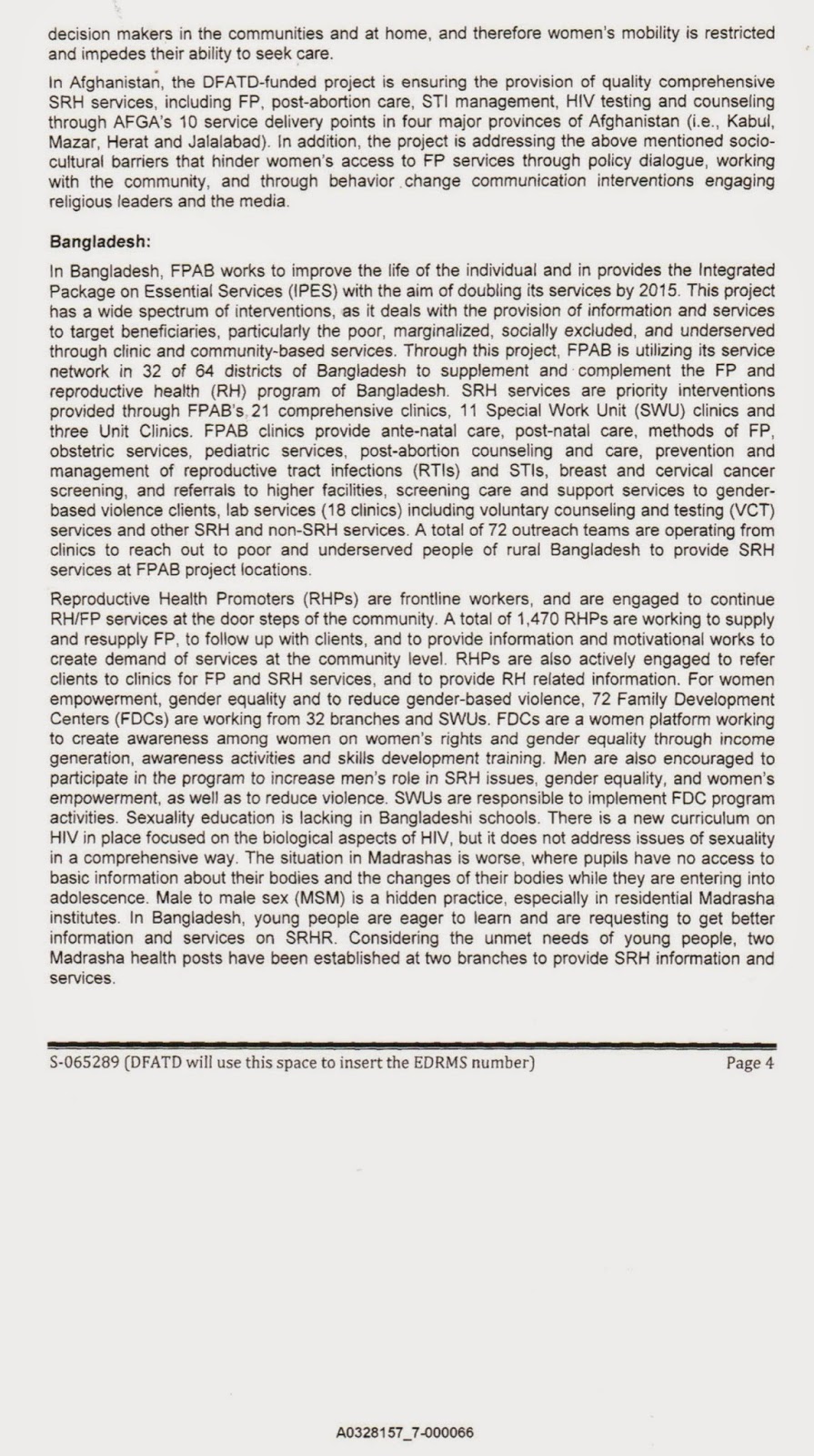
Two more interesting things from my recent ATIP to DFATD and the $6 million grant to IPPF.

1) FPAB is the Family Planning Association of Bangladesh. In other words, FPAB is IPPF's member association in that country

Apparently the entire FPAB board was dismissed by the Bangladesh government.

DFATD refers to page 5 of the semi-annual report (ATIP page 67), which I also had from my last ATIP. (See ATIP page 119 below).

This is what DFATD asked in their question to IPPF:
"Could you provide some information about why the Government of Bangladesh dismissed FPAB's Board in August? Also, I don't know if you informed DFATD about this when it happened. However, this is the sort of thing we should know about when it happens, so that we are able to respond to any questions that may arise."

I looked at page 5 of the semi-annual report (from my previous ATIP) to see what IPPF reported there (see below ATIP page numbers 66 and 67. I also include page 66 for context). Well that part of the ATIP is blacked out on the semi-annual report.

So what does IPPF respond to DFATD's question? I don't know, because that paragraph is completely blanked out citing s.21(1)(b) of the Access to Information Act*. Which mean we have no idea, why the Government of Bangladesh dismissed the entire board, of an organization that operates on IPPF's behalf, using dollars from Canadian tax payers.

2) Note this question from DFATD to IPPF, and IPPF's response, also on page 119:
"DFATD: In addition, I would be curious to know how IPPF CO monitors project activities. Much of the report seems to be based on the self-reporting of the MAs. While I have no reason to doubt their reports, given the level of interest in the project, it would be helpful to learn how you track progress on the less quantitative aspects of the project. (emphasis mine)
IPPF: Regional Technical Officers are in regular communication with Member Associations (MA), and take regular visits to each MA to monitor their activities and progress. It is during these visits that the more qualitative aspects of the project are monitored and reviewed. In turn, Regional Technical Officers are also in regular contact with the Access Team in the Central Office to ensure MA. activities are in compliance with IPPF technical guidelines as well as IPPF's Strategic Framework.

"Self reporting" of member associations. I find this a bit worrisome. Especially when the entire board of one of those organizations has been dismissed and we don't know why.


* s.21(1)(b) The head of a government institution may refuse to disclose any record requested under this Act that contains...an account of consultations or deliberations in which directors, officers or employees of a government institution, a minister of the Crown or the staff of a minister participate

Tuesday, September 23, 2014

DFATD and IPPF - purchased and provided are different

More on my DFATD ATIP for the $6 million funding to International Planned Parenthood.

Suzanne asked who is using all this contraception, and wondered about the 15000 IUDs? So I decided to review the numbers to find out.

Below are the list of "Commodities and Clinical Consumables" (purchases) and the "Data Table" report (provided). Both reports are for the year 1 April 2013 to 31 March 2014. The numbers are different.

This is what was purchased:
IUDs listed under "Commodities and Clinical Consumables":
Afghanistan: 15,000
Bangladesh: 0
Mali: 2,500
Sudan: 0
Tanzania: 0
Total: 17,250

And this is what was provided:
IUDs listed under "Data Table":
Afghanistan: 11,299
Bangladesh: 4,221
Mali: 1,366
Sudan: 1,104
Tanzania: 1,671
Total: 19,661

----------------
This is what was purchased:
Condoms listed under "Commodities and Clinical Consumables":
Afghanistan: 290,000
Bangladesh: 0
Mali: 1,132,587
Sudan: 0
Tanzania: 0
Total: 1,447,787

And this is what was provided:
Condoms listed under "Data Table":
Afghanistan: 22,370
Bangladesh: 530,452
Mali: 224,588
Sudan: 1,653
Tanzania: 92,007
Total: 871,070 (the total on the Data Table report actually says 868,241)


These two tables are the "Data Tables" from the report


Monday, September 22, 2014

DFATD and IPPF - check your numbers

More on my DFATD ATIP for the $6 million funding to International Planned Parenthood.

I received a list of commodities and clinical consumables for the period 1 April 2013 - March 2014 (12 month period), which included contraception, injectables, condoms, spermicides etc. I also received the same information for the previous semi-annual report for April -September 2013 (a six month period).

I decided to compare the two reports to see how the numbers had increased, since the first was for a full year and the latter for only six months. When I looked a bit closer at the two reports, I noticed something. The numbers on both reports for Afghanistan and Sudan were identical (below I reproduce the first page of Afghanistan's).

No commodities were purchased between October 2013 and March 2014 (since the numbers are identical). Maybe all items were purchased at the beginning of the year? I don't know.

In any event, how many contraceptives and emergency contraceptives are we buying in Afghanistan anyway? See charts below.

(NOTE: Postinor-2 is emergency contraception. EC is considered an abortifacient if the egg has already been fertilized (i.e it prevents implantation in the uterus, killing the embryo). Abortion is illegal in Afghanistan.)


DFATD and IPPF - 45,118 people not sterilized in Tanzania

I've finally received the results of my most recent ATIP to DFATD regarding the $6 million funding to International Planned Parenthood. 

This one asked for information since my last ATIP, in particular, for IPPF's Annual Report for 1 April 2013 - March 2014.

I have learned a couple of interesting things this time, and will post them over the next little while.

The first thing I learned is that the people of Tanzania may not be as enthralled with being sterilized as IPPF would like them to be.

On page 143 of the ATIP, from the Annual Report, on line item 1121 Provide sterilization services in Afghanistan, Bangladesh, Mali, Sudan and Tanzania note this:

The target sterilizations for the year is 63,455 sterilizations, but the actual is only 18,337 sterilizations. That's 45,118 people under target.

Under the comments section is this:
"The overall shortfall is almost entirely due to Tanzania. It has not been possible to ascertain why."

Could it be that the people of Tanzania don't want to be sterilized? Maybe they don't like having IPPF suggesting they should be sterilized. 


Thursday, May 29, 2014

Pro-abortion "Knowledge Centre" for the Maternal, Newborn and Child Health Summit

Check out these links. They are for the Canadian Network of Maternal, Newborn and Child Health. These are the groups identified on the website that goes with the summit being held in Toronto right now (May 28-May 30, 2014).

At least three of these groups are of particular concern: International Planned Parenthood Federation (IPPF), United Nations Population Fund (UNFPA) and Action Canada for Population and Development (ACPD).

We already know that IPPF is a strong abortion supporter around the world and works tirelessly to make abortion legal everywhere around the globe. I have also written extensively on Canada's funding to IPPF.

Below are some quotes from the ACPD and UNFPA websites.
ACPD raises contradictions in Canada’s refusal to fund abortion service abroad in recently released Lancet article
Posted on May 12, 2014 
“Accountability in Canada’s Muskoka Initiative questioned” 
"Is the Canadian Prime Minster’s billion dollar initiative for maternal, newborn, and child health failing to meet the standards it has urged on the rest of the world? Paul C Webster investigates. 
It was a message that pleased many global health advocates; Harper’s conservative Christian power base liked the emphasis on mothers and children as well. To reassure some of its most ardently Christian supporters, the Harper government had previously terminated Canadian development support for abortion services, a move that not only contradicted domestic Canadian law but also the laws of most countries where Canada funds maternal health programmes, according to Sandeep Prasad, executive director, Action Canada for Population and Development." (emphasis added)
(Not true. In Afghanistan, Bangladesh, Mali, Sudan, and Tanzania, abortion is illegal.)
Embassy article: “Ghosts of abortion debate haunt maternal, child health summit”
"Sandeep EuroNGOs 2013ACPD featured in Embassy article by Kristen Shane on Canada’s upcoming Summit on Maternal, Newborn and Child Health.  
“The same concerns about a lack of funding for safe abortions and sexual and reproductive health that bubbled up four years ago when Prime Minister Stephen Harper declared maternal, child and new-born health his main development priority threaten to boil over again as Canada and the world look to recalibrate their commitments later this month in Toronto." 
Does UNFPA promote abortion?
"No. Guided by paragraph 8.25 of the Cairo Programme of Action, UNFPA does not support or promote abortion as a method of family planning. It accords the highest priority and support to voluntary family planning to prevent unwanted pregnancies so as to eliminate recourse to abortion. UNFPA supports governments to strengthen their national health systems to deal effectively with complications of unsafe abortions, thereby saving women’s lives (every year, an estimated 13 per cent of maternal deaths result from  unsafe abortions). 
How does emergency contraception work? 
According to the World Health Organization, emergency contraceptives prevent unintended pregnancies. Since they do not terminate pregnancy, their use is not a form of abortion. Women have the right to information and services on emergency contraception just as with all other safe and effective methods of family planning. (emphasis added)
(Except that emergency contraception is abortion.)

Sunday, May 4, 2014

MP questions CIDA due diligence insuring IPPF isn't funding abortions

We now have more cause for concern regarding CIDA/DFATD's $6 million funding of IPPF.

In an ATIP to DFATD I asked for correspondence regarding the Muskoka initiative on maternal and child health.to the PMO and CIDA.

This yielded a few letters, but one in particular was noteworthy.

On October 27, 2011, in a very detailed letter from MP Maurice Vellacott to Stephen Harper, Mr. Vellacott voices his concerns to the Prime Minister by asking seven questions about the $6 million funding IPPF received as part of the Muskoka initiative. (see below for Mr. Vellacott's letter and the responses from Mr. Harper and Ms. Oda).

In a nutshell, Mr. Vellacott's questions what due diligence is in place to ensure the funding would not go to pay for any abortion services, as was stipulated by the contribution agreement between CIDA and IPPF. All pertinent questions I thought, some of which I've also asked myself to CIDA/DFATD. (For all my links to the CIDA/IPPF funding see this page.)

The Prime Minister doesn't answer any of Mr. Vellacott's questions. Not one. And then the PM simply forwards Mr. Vellacott's letter on, to then Minister Bev Oda, who also doesn't answer any of his questions. Not one. In fact Ms. Oda's reply is obviously a form letter, since it is exactly the same as all of her responses to the other letters in the package.

So why were Mr. Vellacott's questions never answered?


Friday, May 2, 2014

Canadian money to IPPF for funding "safe abortion care" and "emergency contraception" in Afghanistan

Despite assurances by the Federal government that no Canadian money given to IPPF would go towards abortion, my latest ATIP to CIDA/DFATD revealed that IPPF is buying "emergency contraception" (34,000 units of the Abbot drug Postinor -2 (Levonorgestrel)). They are also providing "safe abortion care" in Afghanistan.

As we know, "emergency contraception" is taken after sexual intercourse for the purpose of "preventing" pregnancy, but it functions as an abortifacient if fertilization has already occurred (it prevents implantation of the embryo, thus destroying the life of the newly conceived human being.)

(See below for page 30 from the IPPF Annual Report Year 2 (1 April 2012 - 31 March 2013) and page 88 from the IPPF Midyear Report (1 April to 30 September 2013).

In fact, according to this medical leaflet, Postinor-2 is only used as emergency contraception:
"Postinor-2 is an emergency contraceptive only. Postinor-2 is not intended as a regular method of contraception. It is used to prevent pregnancy when taken within 72 hours of unprotected intercourse. It is estimated that Postinor-2 will prevent 85% of expected pregnancies. 95% of expected pregnancies will be prevented if taken within the first 24 hours, declining to 58% if taken between 48 hours and 72 hours after unprotected intercourse."
Not only that. Apparently AFGA's abortion services "needs improvement." (Afghan Family Guidance Association is an associate member of International Planned Parenthood Federation (IPPF) and receives funding from IPPF).

Why is AFGA providing abortion care, when we aren't even supposed to be funding abortion services in these countries?

This is what the Population Research Institute says about the legality of abortion, and emergency contraception in Afghanistan:
"The current Afghanistan abortion law mandates a seven-year prison term and a monetary fine for each abortion performed. The only exception requires the written opinion of physicians, and a judicial review. According to strict and clear guidelines promulgated by the Ministry of Justice, this same law would apply to anyone who has prescribed “morning-after pills” or “emergency contraception” in Afghanistan, or even to anyone carrying these devices in the country."
IPPF states in their annual report that this funding is directed towards:
"women, girls, men and boys who need access to reproductive health services and information. Clients reached throughout this project are female, male, young and old, couples and families in five countries (Afghanistan, Bangladesh, Mali, Sudan and Tanzania). The project prioritizes vulnerable individuals and groups, and also young people, especially young women. Seventy per cent of all the clients served through the project are poor, marginalized, socially excluded and/or underserved, while 33% of all clients are young people, aged between 15-25 years."
Are these poor, marginalized and vulnerable young women, even told what emergency contraceptive is? That it doesn't necessarily prevent conception--i.e. that if fertilization (conception) has occurred, it destroys that newly conceived life by preventing implantation. In other words, are these poor, marginalized and vulnerable clients giving their informed consent?

By all accounts, this is a pretty clear indication to me, that we are providing abortion services in Afghanistan. Abortion services that are specifically excluded from the terms and conditions of the $6 million dollar grant we gave to IPPF.

This should cause us grave concern.