Showing posts with label Access to Information Act. Show all posts

Monday, April 20, 2026

Why does an already completed ATIP need to be re-examined?

Canada's Access to information is dysfunctional to say the least (ie I still have two outstanding ATIPs way over the pretend 30 day rule: one with Finance at 475 days old, and one with Health at 486 days old, with no end in sight for either one).

I have now encountered a new indication of just how messed up the system is. 

But first...a good thing about the system is that a person can request documents from ATIPs somebody else has already asked for: Completed Access to Information Requests. I have used this feature a number of times and usually within a couple of days I will receive the information requested. 

However recently when I requested this document, nothing was forthcoming. When I inquired why this was the case this is what I was told:

Because your request is being processed informally, it is not subject to the statutory deadlines, complaint mechanisms, or other formal requirements set out in Part 1 of the Access to Information Act. However, we will make every effort to process it as promptly as possible. 

Please note that the records responsive to your request are quite extensive, which may affect the time required to review and prepare them for release. We appreciate your patience as we work through the material, and we will provide the records to you as soon as we are able.

In response I asked this logical question:

Since the ATIP has already been completed, I don't understand why a further analysis of the info must be done? There were only 47 pages in the package. Can you please explain the delay? 

Their response:

While the records have previously been released and the volume is not large, some time is still required to properly process an informal request. This includes confirming that all information remains appropriate for disclosure, verifying that any applicable exemptions or redactions remain appropriate, and ensuring the records are accurate and complete before being shared again. 

The necessary internal and administrative steps must still be complete to ensure accuracy and consistency.


In addition, we are currently processing multiple informal and formal access to information requests, and we must balance and prioritize these requests accordingly to ensure all are handled fairly and appropriately.

So five weeks later and counting, it sounds like the bureaucrats are starting at the beginning of the request, all over again, why? Is it a stalling tactic? Did they make mistakes the first time? Whatever their reasoning, it is just stupid. It's like the government has come up with a new way to hinder access to information requests. Which I guess shouldn't surprise me.

Friday, June 28, 2024

Unredacted ATIP reveals abortion advocate's disinformation

It is interesting what gets hidden in an ATIP. Usually of course you have no idea what they are hiding because the hidden information is redacted. But recently I had occasion to ask for two different ATIPs about the Abortion Rights Coalition that were about a year apart. I received some duplicate information from them. The first one contained certain redacted information that the second one did not redact. 

The unredacted information revealed that the redacted info from the first ATIP, was ARCC telling their usual unrelenting falsehoods about pregnancy care centres.

This is the text that was redacted from the first ATIP from a letter from ARCC to the Minister of Health on April 4, 2018:

"...Further, it would help to dispel harmful myths about abortion and mitigate the effects of misinformation spread by anti-choice groups. Over 290 anti-choice groups exist across Canada, including about 165 “crisis pregnancy centres” (CPCs)....Most agencies have websites or do other public outreach, and all provide misinformation about abortion and work to reinforce stigma. Further, CPCs often mislead or scare women seeking abortion while advocacy groups seek to recriminalize abortion, which would violate women's charter rights."

Redacted information about CPCs


Unredacted information on CPCs


Two questions. 

1) Why was this information redacted from the first ATIP? The three Information Act clauses cited don't seem pertinent (19 (1), 20 (1) (c), 20 (1) (b.1)) to the redaction. And if they should have been redacted, why weren't they in the second ATIP?

2) Were the bureaucrats embarrassed (as they should be) when they saw this disinformation about pregnancy care centres, so they redacted "all [CPCs] provide misinformation about abortion and work to reinforce stigma"?

Here is another statement from meeting notes ARCC had with MP Don Davies from July 4, 2017 that was redacted from the first ATIP, but not the second ATIP:
"...The idea is to have a central, reliable place that women can go to, mitigating the effects of misinformation provided by "crisis pregnancy centres" and anti-choice groups."

More libelous nonsense.

(Here's a true statement no one can argue with, and is definitely not a lie: All abortion clinics kill babies.)

Fun Fact: My first ATIP took them 442 days to process and contained 11 pages. The second one took 396 days to process and contained 20 pages and produced similar information as the first. Don't let anyone ever tell you that ATIPs are ever processed in 30 days.

19 (1) Subject to subsection (2), the head of a government institution shall refuse to disclose any record requested under this Part that contains personal information.

  • 20 (1) (c) information the disclosure of which could reasonably be expected to result in material financial loss or gain to, or could reasonably be expected to prejudice the competitive position of, a third party; or

    • 20 (1) (b.1) information that is supplied in confidence to a government institution by a third party for the preparation, maintenance, testing or implementation by the government institution of emergency management plans within the meaning of section 2 of the Emergency Management Act and that concerns the vulnerability of the third party’s buildings or other structures, its networks or systems, including its computer or communications networks or systems, or the methods used to protect any of those buildings, structures, networks or systems

Thursday, March 21, 2024

Access to Information is broken in Canada

To: Pierre Poilievre

CC: Justin Trudeau, Jagmeet Singh, Mona Fortier

Dear Pierre Poilievre,

Along with the dozens and dozens of things you will need to fix once you become Prime Minister, I have one more item to add to your list. Please fix the Access to Information Act. It is a disaster. I know this, because I use it a lot. 

Broken item number 1: You can wait months and months and months for a reply to your access to information. As an example I have two outstanding requests with the department of Finance: One has been outstanding since June 2023 (that's nine months). I was recently told to "expect that we will be able to reply within the next 2 to 4 months" more. Another had been outstanding since May 2023 (10 months) and I finally only received it this week. Whatever happened to that 30 day promise of response?

I could give you more examples, but you get the picture. 

Broken item number 2: When they don't want to give you any information at all, they will actually say they do not confirm or deny the existence of records relevant to your request. I am not kidding: 

"In accordance with 10(2) of the Act (The head of a government institution may but is not required to indicate under subsection (1) whether a record exists.), the Canada Revenue Agency does not confirm or deny the existence of records relevant to your request. If such records did exist, they would qualify for exemption under subsection 24(1) of the Act, which permits the head of a government institution to refuse to disclose information. For details on the provisions cited, go to laws-lois.justice.gc.ca/eng/acts/a-1(24 (1) The head of a government institution shall refuse to disclose any record requested under this Part that contains information the disclosure of which is restricted by or pursuant to any provision set out in Schedule II"
 
Broken item number 3: Pages come back in PDF format. But the bureaucrats have decided to stymie us even more; sneaky so-and so's. What they do is, take the original text and save it as a JPEG then put it back into PDF format and send it to you. This means that you cannot search the text. In the past, you would receive the PDF in a searchable format. This is a purely vindictive measure.

Broken item number 4: Sure, you can complain to the Office of the Information Commissioner. But this doesn't help because it takes them forever to respond; even longer than the original ATIP you're complaining about. I have one complaint at the OIC that I've been waiting 21 months for. As far as I know it hasn't even been assigned to an investigator yet. Departments know this, so can just take their sweet time in responding.

Justin Trudeau wants to control every aspect of a citizen's life. The only tool we have, to in any way, make this government accountable, is access to information. But just like everything else in this country, under this government, under this prime minister, it is broken.

Please, please, please Pierre Poilievre, fix it.

Thank you.

Sincerely,
Patricia Maloney

Thursday, April 9, 2015

941 stillbirth and livebirth abortions done in 2013-2014

Below are numbers for late-term stillbirth and livebirth abortions (Code P96.4 "Termination of pregnancy, affecting fetus and newborns") from CIHI for 2013/2014.

I reported on this information previously here and here for 2010/2011.

It's important to note that there are two different outcomes for these late-term abortions coded with P96.4 "Termination of pregnancy, affecting fetus and newborns". Some of the babies were delivered stillborn (780). And some were delivered alive (161).

Notice that Quebec reports neither stillbirths nor livebirths for code P96.4, so we have no idea how many are being done in Quebec. Last time I did receive numbers for the livebirth abortions for Quebec but not for the stillbirth abortions. CIHI told me this is because:
"Quebec data is not included. As part of the Agreement between the Government of Quebec and the Canadian Institute for Health Information (CIHI), the data transmitted by Quebec and held by CIHI may only be used for the mandate given to CIHI by Quebec. Therefore, CIHI is not authorized to provide you with the requested data for Quebec."
When I asked for clarification on this,CIHI said:
"Data transmitted to us by a jurisdiction still belongs to the jurisdiction in question. We are authorized to provide Québec’s aggregate data or information only when the request falls within the mandate in the agreement between CIHI and the Government of Québec. Media requests do not fall within the mandate."
Notice that the numbers of livebirth abortions this time, i.e. for 2013/14 (161) are higher than last time, i.e. for 2010/11 (158) and don't even include Quebec numbers (there were 21 livebirth abortions reported in Quebec in 2010/2011).

Both stillbirth and livebirth abortions are on the increase in Canada. Last time CIHI reported 727 stillbirth abortions compared to 780 this time.

As for the livebirth abortions, we can assume that at least some of these babies were probably aborted because of serious fetal abnormalities, as reported in this National Post story at 5 months gestation.

And the National Post also reported that:
"many hospitals make it a policy to first terminate the fetus in-utero, perhaps using lethal injection... Dr. Wendy Norman, a clinical professor at the University of British Columbia, confirmed in an email to the Post that abortions “performed intentionally in major centres for pregnancies over 20 weeks would almost certainly include a technique … to induce fetal demise PRIOR to the delivery of the fetus.”
If what Dr. Norman says is true, this would mean the child would die before it exited the mother's body, which means it would not be classified as a livebirth abortion. Yet these current stats confirm doctors are still performing abortions resulting in livebirths, so what is going on here?

I suspect that some of these babies are born alive because they are not giving the baby the injection first to stop its heart. But I am only guessing.

In fact all we have is speculation, since there are no reasons attached to any of these deaths. Are these livebirth babies tossed aside and left on their own, struggling to survive until they die? Are they done on compassionate grounds so the mother can hold her child before the child dies? If so, then why isn't the child allowed to be born at term and placed in perinatal palliative care? Is it because we don't offer perinatal palliative care to pregnant women in these difficult situations? That would be true compassion. And if we don't offer this option, why not?

And why won't Quebec let us see their livebirth abortion stats? If I could speak French I would request the information from the Quebec government through access to information.

What we do know about these babies who are subject to late term abortions, is that some of them are born alive (161), then they die. What are the reasons for these abortions? Why are the numbers increasing?

And of course CIHI is not ATIPable, so whatever CIHI won't divulge is completely hidden from us. If the data still resided with Statistics Canada, I could do an access to information request and ask to see this agreement with Quebec. But I can't do that with CIHI.

Lots of questions, very few answers.


Tuesday, October 7, 2014

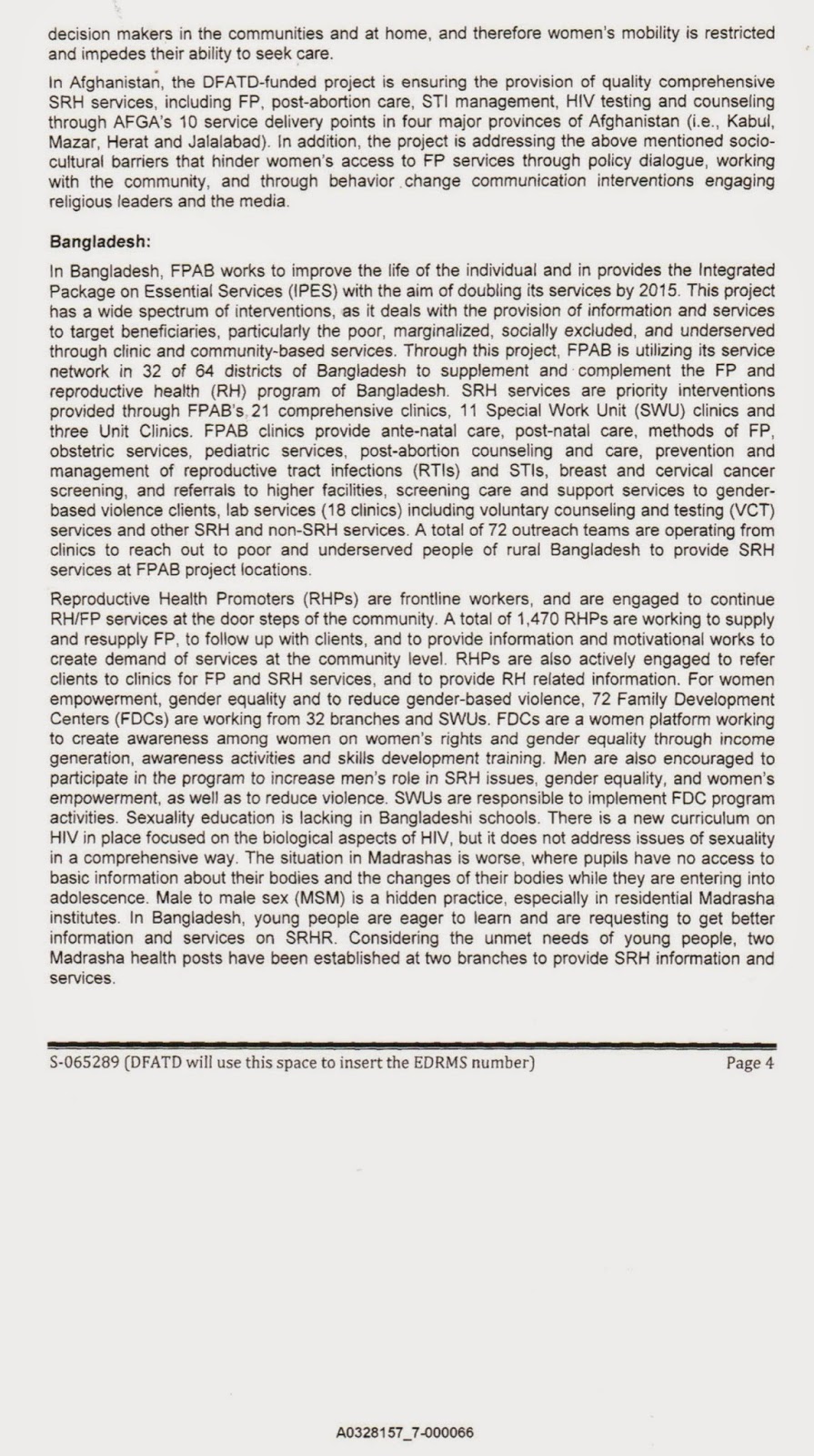
Government of Bangladesh dismisses board of FPAB

Two more interesting things from my recent ATIP to DFATD and the $6 million grant to IPPF.

1) FPAB is the Family Planning Association of Bangladesh. In other words, FPAB is IPPF's member association in that country

Apparently the entire FPAB board was dismissed by the Bangladesh government.

DFATD refers to page 5 of the semi-annual report (ATIP page 67), which I also had from my last ATIP. (See ATIP page 119 below).

This is what DFATD asked in their question to IPPF:
"Could you provide some information about why the Government of Bangladesh dismissed FPAB's Board in August? Also, I don't know if you informed DFATD about this when it happened. However, this is the sort of thing we should know about when it happens, so that we are able to respond to any questions that may arise."

I looked at page 5 of the semi-annual report (from my previous ATIP) to see what IPPF reported there (see below ATIP page numbers 66 and 67. I also include page 66 for context). Well that part of the ATIP is blacked out on the semi-annual report.

So what does IPPF respond to DFATD's question? I don't know, because that paragraph is completely blanked out citing s.21(1)(b) of the Access to Information Act*. Which mean we have no idea, why the Government of Bangladesh dismissed the entire board, of an organization that operates on IPPF's behalf, using dollars from Canadian tax payers.

2) Note this question from DFATD to IPPF, and IPPF's response, also on page 119:
"DFATD: In addition, I would be curious to know how IPPF CO monitors project activities. Much of the report seems to be based on the self-reporting of the MAs. While I have no reason to doubt their reports, given the level of interest in the project, it would be helpful to learn how you track progress on the less quantitative aspects of the project. (emphasis mine)
IPPF: Regional Technical Officers are in regular communication with Member Associations (MA), and take regular visits to each MA to monitor their activities and progress. It is during these visits that the more qualitative aspects of the project are monitored and reviewed. In turn, Regional Technical Officers are also in regular contact with the Access Team in the Central Office to ensure MA. activities are in compliance with IPPF technical guidelines as well as IPPF's Strategic Framework.

"Self reporting" of member associations. I find this a bit worrisome. Especially when the entire board of one of those organizations has been dismissed and we don't know why.


* s.21(1)(b) The head of a government institution may refuse to disclose any record requested under this Act that contains...an account of consultations or deliberations in which directors, officers or employees of a government institution, a minister of the Crown or the staff of a minister participate