Showing posts with label D&E abortion. Show all posts

Friday, January 13, 2023

Misinformation from pro-choice groups on abortion

Dear Justin Trudeau and Chrystia Freeland,

I would like to speak to you about misinformation. On abortion. From pro-choice charities. From abortion facilities.

I know that you want to investigate pro-life charities. You allege that they "are actively working to spread misinformation about abortion" and that you will amend the income tax act "to make them ineligible for charitable status".

You have not provided any evidence of these allegations against pro-life charities. This is because pro-life charities do not engage in these practices.

Can you please tell me if you will also be investigating pro-choice charities that engage in spreading misinformation to women about abortion? One can't help but notice that you only singled out pro-life groups. Why is that? If investigations go forward, logically, all charities that engage in providing misinformation must be investigated. Focusing on only one sector is discriminatory towards that sector, wouldn't you agree?

To help you get started, I have done some research for you. In particular I've chosen two abortion facilities, and one pro-abortion charity that advocates for abortion. I do a very narrow focus on only second trimester abortion misinformation. These abortions are often D&E (Dilation and evacuation) abortions. As background information, in 2020, there were at least 1,913 of these second trimester dilation and extraction abortions in Canada (based on CIHI data). 
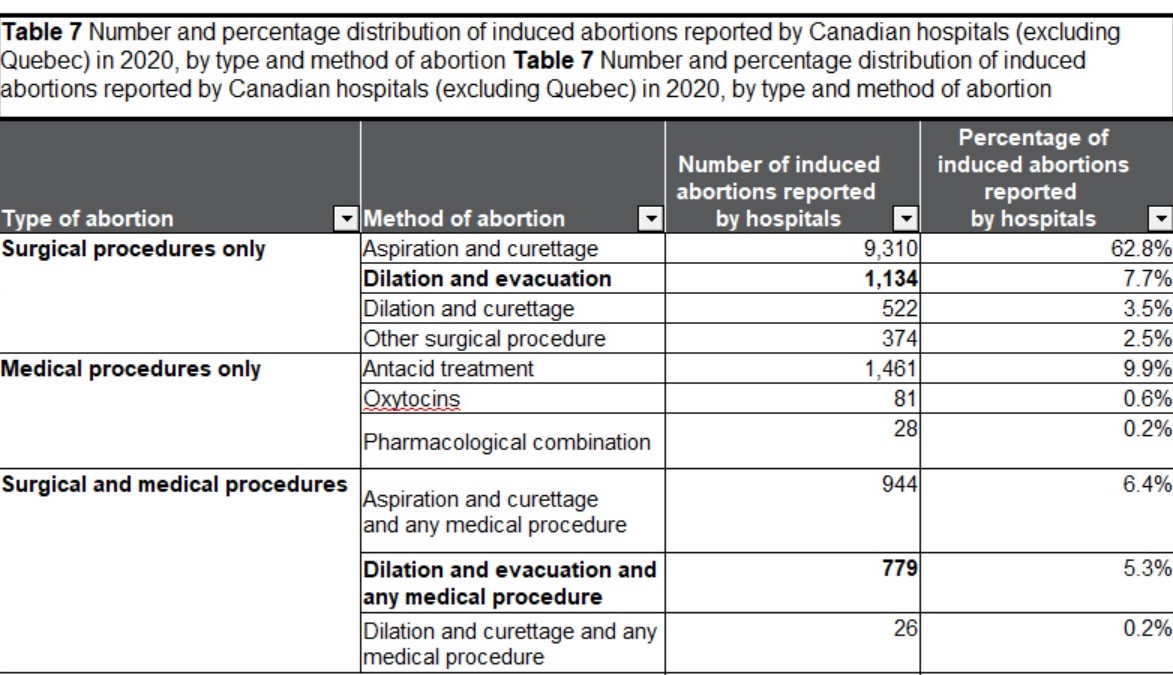


As you can see from the chart, this number only represents those D&E abortions performed in hospitals, and not in clinics and not in Quebec. So there are more of these abortions performed than what CIHI reports. How many more, we do not know.

Here is an accurate description of a D&E abortion.

D&E abortions are completed in two steps on consecutive days:

1. Preparation Stage — Day 1: A pre-abortion ultrasound identifies how far along you are in the pregnancy and reveals the position of the fetus and placenta. Feticide: An injection to induce fetal demise is sometimes given through the woman's abdomen or cervix. This is an elective step taken by 50% of physicians in the US. Antibiotics: A single dose of oral antibiotics is given to prevent infection. Dilation: The cervix is softened and gradually dilated (opened) over a 24-hour period using osmotic dilators. Seaweed stalks (laminaria) or hydrogel rods are used for this purpose as they slowly expand by absorbing the moisture in the woman's cervix. After the placement of the dilators, the woman is free to leave the clinic until her appointment the following day.

2. Evacuation Stage — Day 2: Anesthesia: D&Es are typically performed using a paracervical block (local anesthetic injected into your cervix) and intravenous conscious sedation. Removal of Fetus and Placenta: The doctor uses a speculum to open the woman's vagina, making her cervix visible. A tube is inserted into her uterus, by which all amniotic fluid is suctioned out. Using forceps, the fetus is then dismembered and extracted in pieces. After the extraction, suction and curettage ensure that the uterus is completely emptied. An ultrasound is commonly used to confirm that the abortion is complete. (Emphasis added)

(Notice that the word "fetus" is used three times. Canadian prochoice charities almost never (if ever) use the word fetus when talking about abortions.)

 _________________________________________________________________________

Below are examples of misinformation from pro-choice facilities regarding second trimester abortions. Many of these second trimester abortions would be D&E abortions (many if not all).

1) According to a pro-abortion website, Vancouver Island Women's Clinic performs 

Aspiration or surgical [abortions] up to 23 weeks, 6 days LMP (done in hospital)

This is what the clinic says on their site about these second term abortions.

Surgical abortions are done at the hospital. You will need at least two appointments; one for a consultation visit and the second for the surgical procedure. If your pregnancy is over 14 weeks, you will need to come to the clinic the day before the procedure [notice that this surgical procedure is not described] for laminaria to be inserted into the cervix to soften it overnight.

During the consultation process, you will talk with the nurse and the doctor to review your options, have blood work organized, and discuss a birth control plan. We will answer any questions you have. You will then have an ultrasound and physical examination with the doctor, discuss the procedure [there is no description of the procedure] and sign consents to be booked for the surgery. The procedure [there is no description of the procedure] itself will be booked as a second appointment at the hospital. You must arrive at the hospital 2 hours prior to your procedure. [there is no description of the procedure]

The procedure [there is no description of the procedure] itself takes 5-10 minutes, and then it takes approximately 60 minutes for the recovery. It is usually done under intravenous sedation to relax and sedate you. This type of sedation is safer than a general anesthetic. The cervix is frozen, so that there is minimal pain. Most people are at the hospital for 3-5 hours and you must have someone drive you home. We recommend that someone stay with you overnight due to variable effects from the anesthetic medication. You can expect to feel tired on the day of the procedure. [there is no description of the procedure] Most people can resume their usual activities the next day, unless you do heavy lifting at work.

Complication rates are less than 1% for surgical procedures. [there is no description of the procedure] You are given antibiotics immediately before the procedure [there is no description of the procedure] to minimize the risk of infection. An ultrasound is used during or after the procedure [there is no description of the procedure] to ensure completion, and the tissue is examined [what is this tissue? not explained] before you leave the hospital. There is about 1/100,000 chance of a serious reaction to the medications used or any permanent damage to the uterus. There are no known long-term effects of surgical abortion. Women are able to conceive again and have a normal pregnancy. There are no known problems or consequences with having more than one abortion.

We strongly recommend a check-up 2 weeks following the procedure. [there is no description of the procedure] The doctor will speak with you to review your experience, and you will have a chance to discuss your feelings about the process, and ask any remaining questions about birth control. The check-up can also be done with your own health care provider if you have one.

The word fetus is never used. The procedure is not described. One could easily believe that the procedure doesn't pull anything apart; that a fetus is not involved; that nothing is killed. This is misinformation.

___________________________________________________________________________

2) CARE Program, BC Women's Hospital & Health Centre 

CARE Program provides abortions up to the 25th week of pregnancy.

An abortion after the 12th week of pregnancy (2nd trimester) can involve two to three days of appointments. Depending on how far away you live from Vancouver, you may need to arrange to stay in Vancouver for two to three nights.

Because the pregnancy is more developed after 12 weeks, an additional step is needed to prepare the cervix for the abortion procedure. [there is no description of the procedure] Depending on the number of weeks of the pregnancy, one or two days prior to the abortion you will check in to the clinic, and see the counsellor as in a first trimester abortion.

After signing the Consent Form, you will be given antibiotics, and blood will be drawn to test for Rh factor.

In the procedure room, an ultrasound, and tests for sexually transmitted infections (such as chlamydia and gonorrhea) will be done, after which a small device called a cervical dilator will be placed in the opening of your cervix. Cervical dilators absorb moisture and slowly expand, gently dilating (enlarging) the opening of the cervix over the next 24 hours.

It is important that you are certain of your decision to have an abortion before cervical dilators are inserted. If you change your mind, there is a risk of miscarriage and infection when these are removed without having the abortion done.

On the day of your abortion, you will check in, and a nurse will place a small intravenous tube in your arm (for medication to relieve pain).

Because you have had cervical dilators inserted, your cervix will be prepared for the procedure [there is no description of the procedure], which involves the use of suction and small instruments to empty your uterus [empty the uterus of what, and how?].

After you have rested in the recovery room and when you are ready, you will be able to leave the clinic.

The word fetus is never used. The procedure is not described. One could easily believe that the "procedure" doesn't pull anything apart; that a fetus is not involved; that no fetus is killed. This is misinformation. 

3) Options for Sexual health:

It is a procedure done in a clinic/hospital where the health care provider removes the contents [what are these contents?] of the uterus. In early pregnancy, this is done with aspiration (suction) and usually takes less than 10 minutes. Later in pregnancy, there may be additional steps [what are these additional steps?] in the procedure and it can take longer. 

No description of second trimester abortions. Ironically this abortion information is provided in a section called "the facts", yet no facts on the "procedure" are explained. In fact, there is nothing at all on their site describing second term abortion and / or dilation and extraction abortions. Nothing about fetuses. Nothing about removing limbs from fetuses. Nothing about killing fetuses. Misinformation at its finest.

___________________________________________________________________________

Examples of misinformation from pro-choice groups attacking pro-life charities

Another area of grave concern is when those who promote or perform abortions engage in misinforming women, attacking pro-life charities, making serious unsubstantiated allegations against them.

Two examples.

1) Vancouver Island Women’s Clinic

You may come across many anti-abortion websites that have frightening and inaccurate information about abortion. Beware of "crisis pregnancy centres." Antichoice groups sometimes set up offices, distress centres, phone lines or “clinics” that pretend to help pregnant women with information and pregnancy tests. Many of these groups try to influence vulnerable individuals to continue their pregnancy by frightening them. Some will say anything to have you keep your pregnancy. Their information about gestational development, health risks, and after-effects of abortion may be incorrect. The may also attempt to delay the process, which could lead to a reduction in the number of options you have. If you have any questions or concerns about what you’ve heard or read, please call us and we will help to answer them honestly and without bias. (emphasis added)

No evidence and no proof of these allegations. Misinformation.

2) From Options for Sexual health:

Please note that some organizations that offer pregnancy options counselling, information or decision-making support are pregnancy crisis centers, anti-abortion organizations that spread misinformation about abortion and pressure people into continuing pregnancies. (emphasis added)

No evidence and no proof of these allegations. Misinformation.

Options for Sexual health received provincial funding in 2021 of $1,327,327. They had receipted donations of $84,937, and non-receipted donations of $245,701. 

Wouldn't the donors of Options for Sexual health, as well as governments Mr. Trudeau and Ms. Freeland, want to know about this misinformation they spread?

There is nothing from these pro-choice groups about what a D&E abortion actually does, and how it is performed. Nothing about killing the fetus by removing the limbs one at a time, then crushing the skull and extracting its pieces. The words "fetus", "extract limbs", "killed", etc. are never used. The phrase "empty your uterus" is used. Emptied of what, and emptied how? Not stated. 

All of this is a gross exercise in misinforming women.

I have provided only three examples of misinformation from pro-abortion groups. I can assure you there are many other examples but this letter is already long enough.

I hope Mr. Trudeau that you will investigate all charitable pro-choice groups in Canada and revoke their charitable status, if and when, they spread misinformation to women.

Thank you.

Sincerely,

Patricia Maloney

Thursday, November 24, 2022

Canada kills 1,913+ children by barbaric abortion procedure

Imagine if someone pulled off one of your arms, then a second arm, then a leg, then a second leg. Then crushed your head. This is what a D&E abortion is.

In 2020 alone, there were at least 1,913 of these dilation and extraction abortions in Canada (based on CIHI for 2020, Tab 7). A you can see form the chart, this number only represents those D&E abortions performed in hospitals, and not in clinics. This means that there could be double to triple this number of D&E abortions, since clinics don't report these abortions to CIHI. (This estimate is based on the fact that in Ontario, there are twice as many abortions done in clinics as in hospitals).


According to a pro-abortion extremist, there are at least 20 facilities that perform abortions D&E abortions in Canada, all the way up to 24 weeks. 

At 24 weeks gestation a child can live outside the womb.

Below are two videos of what a second trimester surgical abortion looks like. The first is the testimony of an ultrasound technician who was present at the abortion. The second is from Dr. Kathi Aultman a former abortion doctor.

https://youtu.be/nd_9y1-L60c

D & E ABORTION

These three facilities all provide abortions up until 24 weeks.

Cabbagetown Women's Clinic, Toronto

Vancouver Island Women's Clinic, Victoria

Pregnancy Options Program/Abortion Clinic, London Health Sciences, Victoria Hospital, London

Tuesday, June 30, 2020

Fetal pain during abortion is an ethical problem

Fetal pain during an abortion is a real thing. Recently I listened to an interview from Johnathon Van Maren with John C Bockmann, about his new research on fetal pain: Reconsidering fetal pain.

Three things of note about this research.

First, is that the two authors (Stuart WG Derbyshire and John C Bockmann) are on different sides of the abortion debate:
The two authors of this paper have very different views on the morality of abortion. One of us believes that abortion is necessary for women’s health and autonomy, while the other believes that abortion violates the ethical principle of non-maleficence and ought to be restricted and discouraged.
I'd say it's unusual to hear of a pro-choice person willing to collaborate with a pro-life person on abortion.

Second, is that most previous research on fetal pain believed that that the cortex was necessary for pain experience. There is new evidence to the contrary, and pain could be felt as early as 13 weeks gestation.
"Reports often suggest that the cortex and intact thalamocortical tracts are necessary for pain experience. Given that the cortex only becomes functional and the tracts only develop after 24 weeks, many reports rule out fetal pain until the final trimester. Here, more recent evidence calling into question the necessity of the cortex for pain and demonstrating functional thalamic connectivity into the subplate is used to argue that the neuroscience cannot definitively rule out fetal pain before 24 weeks."
"The most common surgical technique is dilatation and evacuation (D&E). In a D&E, the cervix is dilated, the amniotic fluid drained, and the fetus is removed in pieces via several surgical manoeuvres using grasping forceps. Again fetal death follows either direct feticide performed before the D&E or the trauma of the D&E results in the death of the fetus. We consider the possibility of fetal pain during these two procedures post-13 weeks’ gestation."
Canada performs D&E abortions. Thousands of them. Every year.

In 2018 Canadian doctors performed at least 2,076 D&E abortions according to CIHI. I say at least because CIHI only reports D&E abortions for those performed in hospitals. We do not know the numbers of these abortions performed in clinics. We also know that CIHI reported at least 3,002 hospital abortions done between 13 and 21+weeks gestation, with an additional 3,818 of unknown gestational ages. How many of those unknown gestational age abortions were done? We don't know.

(Once again the gestational ages of the clinic abortions are also not reported. Also the "gestational age" abortions are not in addition to the "type" of abortion; they are different ways of categorizing the same hospital abortions. But since D&E abortions are done from 13-24 weeks gestation, we must ask ourselves exactly what type of abortion this difference of 926 is made up of?

Third, regardless of the sheer number of how many D&E abortions are performed each year in Canada (and one is too many), shouldn't we also be concerned about the morality of the pain inflicted on the fetus? It is refreshing to see a pro-choice person care enough about fetal pain, as well as the morality of causing fetal pain, to undertake such research.
"We also agree that if fetal pain is likely then that has ethical and clinical significance independent of any views on the morality of abortion per se. That said, it is also clear to us that the issue of fetal pain has ethical significance because of abortion practices and not because of other surgical or therapeutic fetal procedures."
Thousands of Canadian children in the womb are pulled apart every year, limb by limb, without anesthesia, when it is very probable that they feel those limbs being crunched and ripped. Just imagine someone doing the same to you. That would be called barbaric.

More on fetal pain here.

Friday, February 26, 2016

How Canada tortured 2,542 preborn children in 2014

In 2014 Canadian doctors tortured and killed (through D&E abortions) at least 1,851 preborn children. (This does not include those abortions done in Quebec or in clinics, but hospitals only.) *

We can safely assume that the same percentage (7.5%) would also apply to Quebec, or 691 (9,221 X 7.5%) done in Quebec.

That's at least 2,542 D&E hospital abortions done in one year. (CIHI doesn't publish the types of abortions done in clinics so this number is likely much higher.)

What is interesting about this torturing of fetuses, is that Amnesty International thinks that women deprived of having an abortion are tortured.
"The total ban on abortion in El Salvador is nothing less than institutionalized violence against women and a form of torture or other ill-treatment."
In fact the word torture is used a total of 33 times in Amnesty's literature, as it relates to El Salvador not allowing women to undergo abortion there.

Some may not like my using the term torture to refer to the killing of preborn children in this manner. Those people should watch this video by Dr. Anthony Levatino. Dr. Levatino had performed over 1200 abortions before he gave up on doing abortions, and became pro-life. He describes for us, exactly what happens in a D&E abortion (done between 13 and 24 weeks of pregnancy).

This is the size of the baby in utero at 20 weeks. It is 7 inches long from head to rump and excluding the legs, or the size of a man'a hand.


After the woman is prepped, etc, the suction is turned on and pale yellow amniotic liquid is sucked out of the uterus.


The baby is too big to extract with the vacuum because she can't fit through the catheter. As well, the baby's limbs and head are too large to be removed by suction alone.

So a D&E is performed.

The sopher clamp is used for a D&E. This is a grasping instrument. It is about 13 inches long and made of stainless steal. The "business" end (Dr. Levatino actually called it that) is about 2 1/2 inches long and about 1/2 inch wide. There are rows of sharp teeth along it. When the sopher clamp gets hold of something, it does not let go. It is quite effective.


The abortionist uses this clamp to grasp an arm or a leg. Once he has a hold of something, he pulls hard in order to tear the limb from the baby's body.

In this illustration a leg has been pulled off and an arm is currently being extracted. One by one the rest of the limbs are removed, along with the intestines, the spine, and the heart and lungs.


Usually the most difficult part is extracting the baby's head which is the size of a large plum at 20 weeks. The head is grasped and crushed. The abortionist knows he's crushed the scull when a white substance comes out of the cervix. This was the baby's brains.


So what then is the real definition of torture? Is it preventing women from having an abortion? Or is it the dismemberment of a fetus, limb by limb, spine, intestines and lungs and then crushing her head?

* CIHI abortion stats 2014


Monday, May 11, 2015

2nd trimester D&E abortion - affirming her right to choose

Dr. Anthony Levatino used to be an abortion doctor. He isn't any more. Below he describes a second trimester abortion.
"Imagine if you can that you are a pro-choice obstetrician/gynecologist like I once was. Your patient today is 24 weeks pregnant. At twenty-four weeks from last menstrual period, her uterus is two finger-breadths above the umbilicus.
If you could see her baby, which is quite easy on an ultrasound, she would be as long as your hand plus a half from the top of her head to the bottom of her rump not counting the legs. Your patient has been feeling her baby kick for the last 2 months or more but now she is asleep on an operating room table and you are there to help her with her problem pregnancy.
The first task is remove the laminaria that had earlier been placed in the cervix to dilate it sufficiently to allow the procedure you are about to perform. With that accomplished, direct your attention to the surgical instruments arranged on a small table to your right. The first instrument you reach for is a 14-French suction catheter. It is clear plastic and about nine inches long. It has a bore through the center approximately ¾ of an inch in diameter.Picture yourself introducing this catheter through the cervix and instructing the circulating nurse to turn on the suction machine which is connected through clear plastic tubing to the catheter. What you will see is a pale yellow fluid that looks a lot like urine coming through the catheter into a glass bottle on the suction machine. This is the amniotic fluid that surrounded the baby to protect her.
With suction complete, look for your Sopher clamp. This instrument is about thirteen inches long and made of stainless steel. At the end are located jaws about 2 ½ inches long and about ¾ of an inch wide with rows of sharp ridges or teeth. This instrument is for grasping and crushing tissue. When it gets hold of something, it does not let go. A second trimester D&E abortion is a blind procedure. The baby can be in any orientation or position inside the uterus. Picture yourself reaching in with the Sopher clamp and grasping anything you can.
At twenty-four weeks gestation, the uterus is thin and soft so be careful not to perforate or puncture the walls. Once you have grasped something inside, squeeze on the clamp to set the jaws and pull hard–really hard. You feel something let go and out pops  a fully formed leg about six inches long. Reach in again and grasp whatever you can. Set the jaw and pull really hard once again and out pops an arm about the same length. Reach in again and again with that clamp and tear out the spine, intestines, heart and lungs.
The toughest part of a D&E abortion is extracting the baby’s head. The head of a baby that age is about the size of a large plum and is now free floating inside the uterine cavity. You can be pretty sure you have hold of it if the Sopher clamp is spread about as far as your fingers will allow. You will know you have it right when you crushed own on the clamp and see white gelatinous material coming through the cervix. That was the baby’s brains. You can then extract the skull pieces. Many times a little face will come out and stare back at you.
Congratulations! You have just successfully performed a second trimester Suction D&E abortion. You just affirmed her right to choose.
If you refuse to believe that this procedure inflicts severe pain on that unborn child, please think again.
Before I close, I want to make a comment on the necessity and usefulness of utilizing second and third trimester abortion to save women’s lives. I often hear the argument that we must keep abortion legal in order to save women’s lives in cases of life threatening conditions that can and do arise in pregnancy.
Albany Medical Center where I worked for over seven years is a tertiary referral center that accepts patients with life threatening conditions related to or caused by pregnancy. I personally treated hundreds of women with such conditions in my tenure there. There are several conditions that can arise or worsen typically during the late second or third trimester of pregnancy that require immediate care. In many of those cases, ending or “terminating” the pregnancy, if you prefer, can be life saving. But is abortion a viable treatment option in this setting? I maintain that it usually, if not always, is not."